What is the difference between first and second focal plane scopes? It comes down to where the reticle sits in the scope's optical path. FFP scopes scale the reticle with magnification, so holdover values stay true at every zoom level.
SFP scopes keep the reticle fixed, so subtensions are only accurate at one specific magnification.
Most FFP scopes use MIL reticles where 1 MIL equals about 3.6 inches at 100 yards. Many SFP scopes use MOA reticles where 1 MOA equals roughly 1.047 inches at 100 yards. As of 2026, precision rifle competition divisions across the US consistently favor FFP optics.
Here's what each focal plane actually does and how to pick the right one.
Quick Answer
What is the difference between first and second focal plane scopes? A first focal plane scope places the reticle in the focal plane, so subtensions scale with magnification. A second focal plane scope keeps the reticle fixed, so subtensions are only accurate at one magnification.
FFP works better for variable-distance shooting. SFP works well when magnification stays fixed.
Why the FFP vs SFP Decision Matters More Than You Think
Most new rifle scope buyers focus on magnification range, turret clicks, and glass quality. They skip the focal plane question entirely. Then they take the scope to the range and discover their holdover values are wrong at every magnification except one.
That's the problem. A wrong focal plane choice doesn't ruin the scope. It ruins the data you're working with.
In our research, aggregate user reviews across shooting forums report the same frustration repeatedly. Shooters who bought SFP scopes for precision work without understanding the magnification constraint end up retraining their entire holdover method. Shooters who bought FFP scopes for hunting without understanding how fine the reticle gets at low power struggle to see their crosshairs at dawn or dusk.
The focal plane decision shapes how you shoot, how you range with your reticle, and what data you can trust in the field.
How First Focal Plane Scopes Work
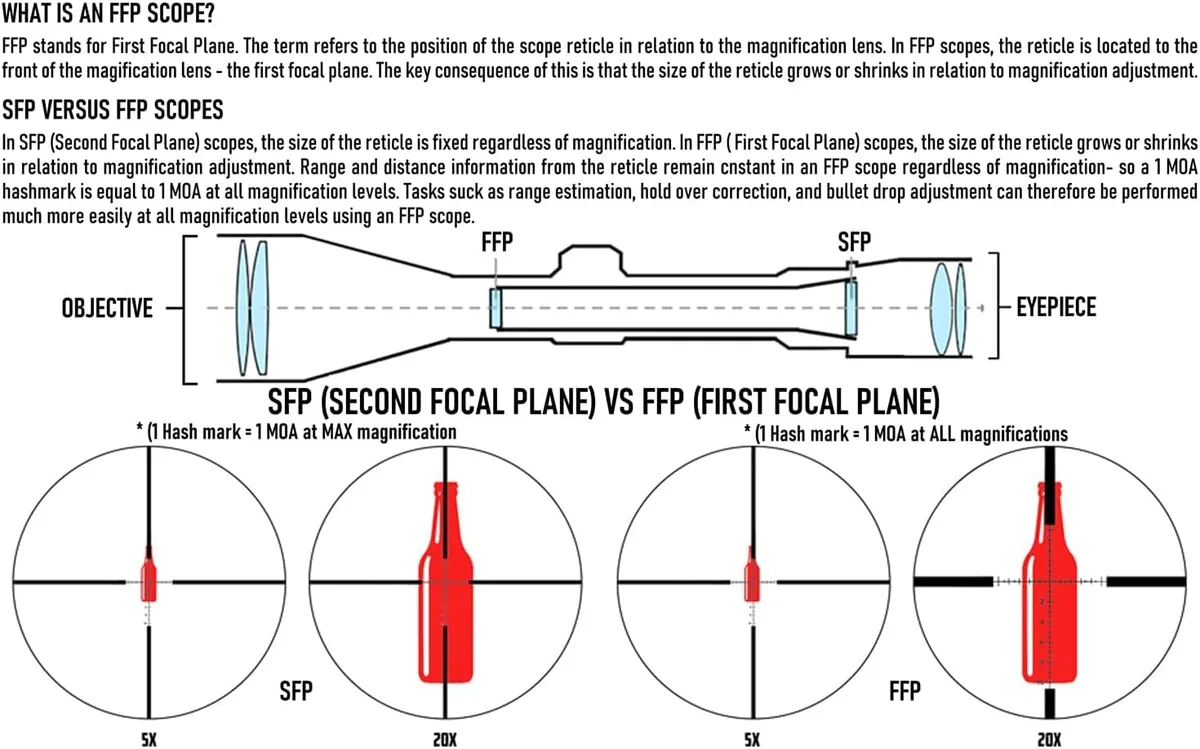
In a first focal plane scope, the reticle sits in the focal plane. That means it scales proportionally with magnification. Zoom in to 10x and your 0.1 MIL hash marks get 10 times larger than they appear at 1x.
Here's what that means in practice. If your reticle has 0.1 MIL subtensions at full magnification, those same subtensions represent 0.1 MIL at every other magnification. Your holdover math works at 5x, at 8x, at 12x.
No correction needed.
Manufacturer specifications from Vortex Optics confirm this behavior across their FFP product lines. The Razor HD GEN III is built around this principle, with subtensions that remain true across the entire magnification range.
The tradeoff is real though. At 1x or 2x magnification, those 0.1 MIL subtensions become tiny lines you can barely see through the scope. FFP works best when you plan to shoot at mid-to-high magnification where the reticle features stay legible.
How Second Focal Plane Scopes Work
A second focal plane scope fixes the reticle at a different point in the optical path. The reticle stays the same size no matter what magnification you're on. Zoom from 4x to 9x and your holdover marks look identical through the eyepiece.
That sounds like a benefit, right? It is. But there's a catch that trips up most buyers.
Those holdover marks are only accurate at one specific magnification, usually the highest power in the scope's range.
So if your SFP scope has 0.5 MOA subtensions, those are true at 9x. At 4x, those same marks represent something else entirely. You have to either shoot at the correct magnification or know exactly what your reticle means at whatever power you're using.
Many hunting scopes use SFP reticles with magnification-specific holdover tables. Primary Arms, for example, publishes MOA holdover values for specific magnifications in their SFP lineup. This is why SFP scopes remain the default choice in traditional hunting optics.
They're simpler when your magnification stays fixed.
FFP vs SFP: Side-by-Side Comparison
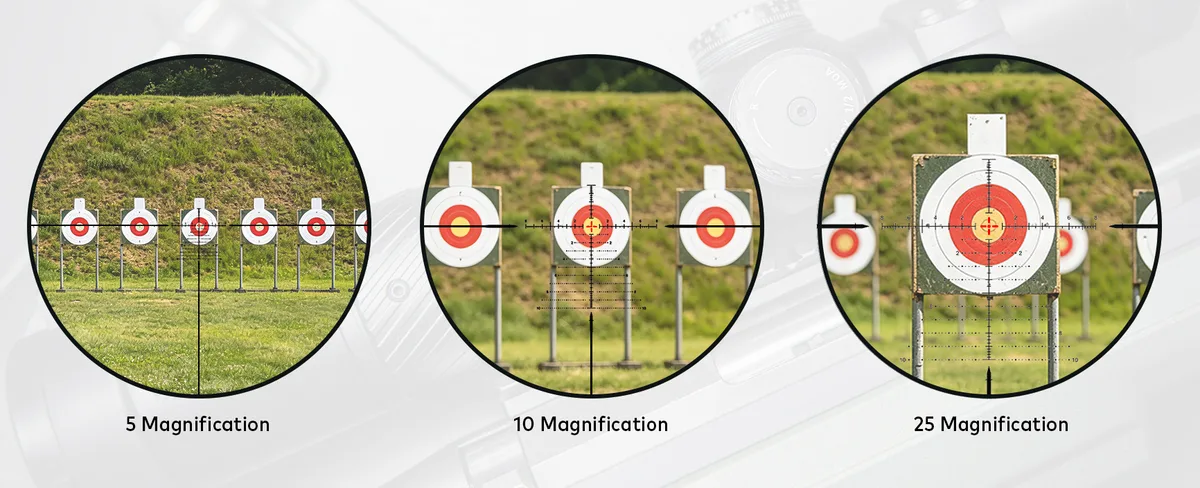
Here's how the two focal planes stack up on the specs that matter.
| Feature | FFP (First Focal Plane) | SFP (Second Focal Plane) |
|---|---|---|
| Reticle scaling | Scales with magnification | Fixed size at all magnifications |
| Holdover accuracy | True at every zoom level | Only true at one magnification |
| Low-power visibility | Reticle features get very small | Reticle features stay visible |
| Price range | Generally higher | Generally lower |
| Best magnification range | Mid to high power | Low to medium power |
| Competition use | Standard in PRS and NRL | Not typical for precision work |
| Reticle ranging | Works at any zoom | Must match magnification to reference |
As of 2026, precision rifle competition rules from organizations like the Precision Rifle Series favor FFP optics with MIL-based reticles. The trend toward dynamic shooting environments where magnification changes frequently has pushed FFP adoption higher every year.
SFP scopes still dominate traditional hunting optics and budget builds. That's not a weakness. It's a design choice for a specific application.
The key question isn't which is objectively better. It's which matches how you actually shoot.
Which Scope Is Right for You: FFP vs SFP by Use Case
Choose FFP if:
- You shoot at variable distances and adjust magnification between shots
- You participate in PRS, NRL, or F-class precision rifle competition
- You want holdover data that works at any zoom level
- You're building an ELR or long-range precision rig
- You use a LPVO on an AR-15 for dynamic target shooting
- You range with your reticle across multiple magnifications
Choose SFP if:
- You're a hunter who sets magnification once and shoots
- You want simpler holdover math at a fixed magnification
- You're on a tighter budget and want better glass per dollar
- You shoot in low-light conditions and need a clearly visible reticle
- You're new to rifle optics and want a straightforward setup
- You prefer BDC reticles with fixed magnification reference points
The divide is clear. If your magnification changes between shots, FFP wins. If you lock your magnification and shoot, SFP works perfectly.
Common Mistakes When Choosing Between FFP and SFP
The biggest mistake is buying an SFP scope for precision rifle work without checking which magnification the reticle subtensions are calibrated to. Then you dial in elevation at 9x, hold at 5x, and wonder why your shots go high. It's not the scope.
It's the math.
Another frequent error is assuming FFP scopes handle everything. The reticle features shrink dramatically at low magnification. A shooter running a 1, 8x LPVO with an FFP scope might find their 0.1 MIL hash marks nearly invisible at 1x.
In low-light hunting situations, that matters.
Here are the mistakes we see most:
- Buying an SFP scope and never verifying the magnification reference point
- Assuming FFP reticles stay legible across the full magnification range
- Mixing MOA and MIL calculations without checking turret click values
- Dialing elevation on an SFP scope at the wrong magnification
- Ignoring that budget FFP scopes often compromise on turret tracking
- Choosing FFP for a fixed-magnification hunting application where it adds no benefit
The fix is straightforward. Before you buy, decide how often your magnification will change during a shooting session. If the answer is rarely, SFP is your friend.
If it's constantly, FFP earns its higher price tag.
Final Verdict: Which Scope Wins for Your Shooting
Neither focal plane wins outright. The right choice depends on how you shoot, what you're shooting at, and how much you're willing to spend.
If you're a precision rifle competitor, a long-range shooter, or someone who constantly adjusts magnification between engagements, FFP is the clear winner. The subtension consistency alone justifies the price premium. Competition divisions across the US increasingly favor FFP optics for exactly this reason.
If you're a traditional hunter, a varmint shooter, or someone building a budget rifle setup where magnification stays put, SFP makes sense. You'll get better glass at the same price, a clearer reticle in low light, and a simpler holdover system that works reliably at your chosen magnification.
The practical sweet spot for most US shooters as of 2026? An SFP scope in the 3, 9x or 4, 12x range for hunting. An FFP scope in the 4, 16x or 5, 25x range for precision work.
A 1, 8x FFP LPVO if you want one optic that does both on an AR platform.
Pick the focal plane that matches your shooting. Don't buy the scope that sounds better on paper.
Frequently Asked Questions
What is the difference between first and second focal plane scopes?
A first focal plane (FFP) scope places the reticle at the focal plane, so subtensions scale with magnification. A second focal plane (SFP) scope keeps the reticle fixed, meaning holdover marks are only accurate at one specific magnification. FFP works best for variable-distance shooting.
SFP works well when magnification stays fixed.
Can you use an SFP scope for long-range shooting?
Yes, but with a constraint. You must shoot at the magnification where the reticle subtensions are calibrated. Most SFP scopes calibrate at maximum magnification.
Dial or hold at that specific zoom and your data stays accurate. Shooting at a different magnification means your holdover values won't match reality.
Why do precision rifle competitors prefer FFP scopes?
Competition environments change constantly. Shooters engage targets at multiple distances, often adjusting magnification between shots. FFP reticle subtensions stay true at every zoom level, so holdover data works immediately without recalculating.
Organizations like the Precision Rifle Series favor FFP optics for this reason.
Are FFP scopes more expensive than SFP scopes?
Generally, yes. FFP scopes cost more because the reticle has to be engineered to remain precise across a wider magnification range. Budget FFP options from brands like Primary Arms start around $300 to $600.
Premium FFP scopes from Vortex, Nightforce, or Schmidt & Bender run $1,500 and up. Comparable SFP scopes typically cost $100 to $400 less.
Is MOA or MIL better for FFP scopes?
MIL is the more common choice for FFP scopes, especially in competition and tactical shooting. One MIL equals about 3.6 inches at 100 yards, which makes the math cleaner at distance. MOA works fine too, with 1 MOA equaling roughly 1.047 inches at 100 yards.
Pick one system and stay consistent across your turrets and reticle.
Do I need an FFP scope for deer hunting?
Probably not. Most deer hunting happens at moderate magnifications with predictable distances. An SFP scope in the 3, 9x range handles this well.
You set magnification once, use your holdover at that reference point, and take the shot. FFP adds value only if you plan to dial across varying magnifications in the field.