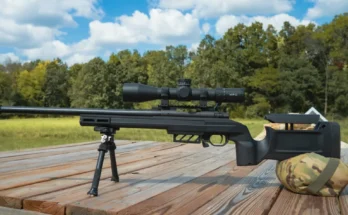
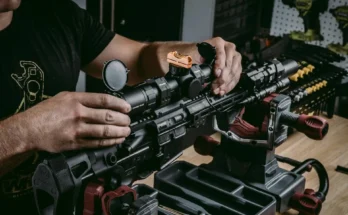
What is a Christmas tree reticle? It's a rifle scope reticle pattern that fans out below the center crosshair with dots and hash marks arranged like a small tree. The pattern helps shooters compensate for bullet drop and wind without adjusting turrets.
It's become the go-to choice in precision rifle competitions and long-range hunting setups.
Most tree reticles use either MOA or MIL spacing. As of 2026, manufacturers like Vortex and Nightforce publish detailed subtension charts for every reticle variant. First focal plane optics keep those holdover values accurate across all magnification settings.
Let's get into how the pattern actually works.
Quick Answer
A Christmas tree reticle is a rifle scope reticle pattern. It features dots and hash marks below the center crosshair. The marks form a grid that resembles a tree shape.
Shooters use it to hold for bullet drop and windage. It provides fast visual holdover references at long range.
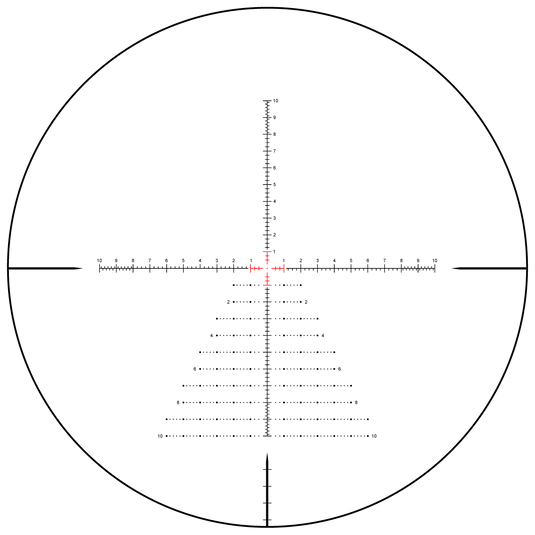
Image source: Web (Bing) / vector2007.com (Web image (fair-use with source credit))
How the Christmas Tree Pattern Actually Works
A Christmas tree reticle works on a grid system. The vertical line running down from center handles elevation holdovers. The horizontal spread handles windage corrections.
Together they form a two-axis grid that lets you adjust for both drop and wind in one glance.
Here's how you read it. Your center crosshair represents your zero distance. Each row of dots below center represents a fixed drop value.
The dots spread left and right to show windage corrections. You find the row that matches your target distance, then shift your aim based on wind.
The spacing between marks follows a consistent unit system. MOA-based trees typically use 0.5 MOA per increment. MIL-based trees usually use 0.2 MIL per increment.
Per Vortex Optics reticle documentation, spacing varies by model and reticle variant. Always check your manual before heading to the range.

Image source: Bing (Web (fair-use with source credit))
Premium designs like the Nightforce MIL-XT use tenth-marked MIL values for even finer adjustments. As of 2026, MIL-based trees dominate the competition circuit. Shooters prefer MILs because they convert cleanly to range calls and wind corrections.
First focal plane (FFP) reticles scale with magnification, so holdover values stay accurate at every power setting. Second focal plane (SFP) reticles keep the same visual size regardless of magnification. Their holdover values are only accurate at one specific power, usually the highest.
BDC (Bullet Drop Compensation) tree variants calibrate vertical spacing to one specific cartridge's drop. That's convenient but restrictive. You're locked into one load and velocity.
Generic MIL or MOA trees work with any cartridge once you've confirmed your drop data.
Why Shooters Choose Tree Reticles (And Where They Fall Short)
Tree reticles solve a real problem in long-range shooting. When targets appear at unknown distances, dialing turrets takes time and breaks your shooting rhythm. A tree reticle lets you hold for both elevation and wind without touching a single knob.
PRS competitors routinely use this speed advantage on timed stages.
The pattern also works as a visual learning tool. After shooting a tree reticle for a while, you start seeing actual drop values in your peripheral vision. Over time, shooters develop an instinct for where the bullet will land.
That internal awareness carries over even when they switch to simpler reticles.
The drawbacks are real, though. Tree reticles carry visual clutter. At lower magnifications, the pattern can blend into a mush of lines and dots.
New shooters often find it overwhelming under pressure.
There's also a learning curve to the spacing system. If you don't study your reticle's subtension chart, the tree is useless. The honest tradeoff: more speed and flexibility at long range, more complexity and setup time overall.
If you compete with unknown target distances, the pros outweigh the cons. If you mostly shoot at 100 yards, a simpler mil-dot reticle does the job just as well.
Christmas Tree Reticle vs Mil-Dot, BDC, and Other Reticles
Not every reticle serves the same purpose. The tree reticle sits at one end of a spectrum that runs from simple to complex. Here's how it stacks up against the most common alternatives.

Image source: Web (Bing) / scopeuout.co.nz (Web image (fair-use with source credit))
| Reticle Type | Elevation Holds | Windage Holds | Best For | Complexity |
|---|---|---|---|---|
| Christmas Tree | Full grid every 0.2 MIL or 0.5 MOA | Full grid both sides | PRS, unknown-distance hunting | High |
| Mil-Dot | Fixed dots at set intervals | Fixed dots at set intervals | Long-range practice, basic PRS | Medium |
| BDC | Calibrated to one cartridge | Limited or none | Hunting with a known load | Low |
| Dot-only | None | None | Close-range tactical work | Very Low |
| MOA Drop Reticle | Fine MOA marks | None or minimal | Precision shooting with known data | Medium |
A mil-dot reticle gives you fewer reference points but is faster to learn. It lacks the lateral spread that makes windage holds natural. A BDC reticle is the simplest option for hunters who want to hold and go, but it's tied to one specific cartridge and bullet velocity.
Best for each scenario? If you're competing in PRS or NRL with unknown target distances, the tree wins. If you hunt big game with a known load at moderate range, a BDC does the job.
If you're learning long-range fundamentals, a mil-dot keeps things clean.
Who Should Use a Christmas Tree Reticle (And Who Shouldn't)
The Christmas tree reticle isn't for everyone, and that's fine. Match the tool to your actual shooting goals.
Who benefits most:
- PRS and NRL competitors who need fast holdover decisions on timed stages
- Long-range hunters who engage targets at varying distances
- Shooters building full ballistics awareness who study their subtension charts
- Law enforcement marksmen who need quick elevation and wind corrections
Who should probably skip it:
- New shooters still learning basic marksmanship fundamentals
- Hunters who mostly shoot inside 300 yards with a single known load
- Anyone shooting fixed-distance steel where turret dialing is easy
- Shooters who want the simplest, cleanest optic experience
The real question is whether you'll engage targets at multiple distances on the same day and need to move fast. If yes, the tree reticle earns its complexity. If your rifle only ever shoots one distance, a simpler reticle will serve you better with less visual noise.
Common Mistakes When Reading a Christmas Tree Reticle
Mistake #1: Ignoring the magnification setting. SFP reticle holdovers only work at one specific power level, usually the highest. If your scope reads 7× and the reticle is calibrated at 10×, every mark is wrong.
FFP reticles stay accurate at any magnification, so you can zoom freely.
Mistake #2: Treating the reticle as universal. Every manufacturer designs its own spacing. A mark that equals 0.3 MIL on one scope might equal 0.5 MIL on another.
Pull your subtension chart and memorize your specific values before you head out.
Mistake #3: Skipping the ballistic profile. The tree is a reference tool. It can't fix wrong data.
If your velocity, BC, or zero distance is off, your holds will miss. Chronograph your load and confirm drop at known distances.
Mistake #4: Relying solely on holdover marks. Some shooters treat the tree like a substitute for turret dialing. For long shots, dialing is more precise.
The tree shines when speed matters, not when you need pinpoint accuracy at extreme range.
Mistake #5: Forgetting parallax adjustment. If your parallax is set for the wrong distance, the target and reticle won't align properly. Your holds will be close, but not close enough to count.
Mistake #6: Never validating reticle data at the range. You need real confirmation, not just numbers off a chart. Shoot at known yardages and build a data log you actually trust.
Frequently Asked Questions
Is a Christmas tree reticle better than a mil-dot?
A tree reticle gives you more holdover points and built-in windage marks. A mil-dot is simpler and faster to learn. If you shoot at varying distances, the tree wins.
If you mostly dial turrets at a single distance, mil-dot is cleaner and less cluttered.
What magnification should I use with a tree reticle?
Higher magnification works best for precise holds, typically 10× or above. Most competitors use their tree reticle between 10× and 25×. FFP optics make this easy because reticle values stay accurate at every setting, so you can zoom freely.
Can I use a Christmas tree reticle for hunting?
Yes, and many hunters do. The tree helps when game appears at unpredictable distances. A BDC reticle is simpler if you hunt with one known cartridge.
The tree adds flexibility but requires you to know your drop data for each distance.
Do MOA and MIL tree reticles work differently?
They function the same way, but the numbers change. MOA reticles mark in fractions of an angle, usually 0.5 MOA per step. MIL reticles mark in 0.2 MIL increments.
MILs convert more cleanly to range calls, which is why most competitors prefer them.
What is the best first focal plane Christmas tree scope?
Entry-level FFP scopes from Vortex and Primary Arms offer reliable tree reticles in the $300 to $600 range. As of 2026, the Primary Arms 3-18× FFP with the ACSS reticle is widely regarded as the best value entry point for new long-range shooters.
Choosing the Right Tree Reticle: MOA, MIL, FFP, or SFP?
The decision comes down to two questions. What unit system do you want to think in, and do you need your holds accurate at every magnification?
| Feature | MOA Tree | MIL Tree |
|---|---|---|
| Typical spacing | 0.5 MOA per mark | 0.2 MIL per mark |
| Conversion | 1 MOA ≈ 1.047 inches at 100 yards | 1 MIL ≈ 10 cm at 100 meters |
| Best for | Fine elevation tuning, shooting paper targets | Competition, wind calls, range estimation |
| Industry trend | Declining in competition use | Dominant in PRS and NRL as of 2026 |
For the magnification question, FFP wins outright. SFP tree reticles work, but you're locked into one power setting for accurate holds. If your scope reads 12× and the SFP reticle is calibrated at 15×, every mark is wrong by 20%.
If you're new, start with a MIL-based FFP tree reticle. The spacing is intuitive once you study the chart. MOA works fine too if you already think in MOA, but MIL is the direction the sport is moving.
The bottom line? Match the unit to what you already understand. Pick FFP if you can afford it.
And always, always validate your reticle data with live fire before you trust it.