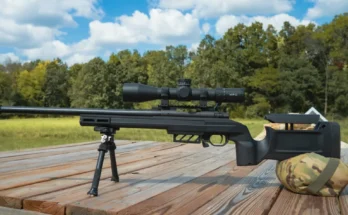
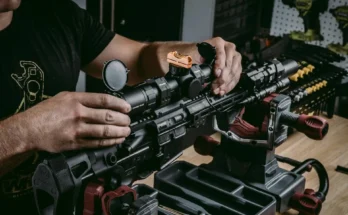
What is a mil-dot reticle? It's a scope pattern built around small dots spaced at equal intervals along the crosshair. These dots let you estimate range and compensate for bullet drop without adjusting your turrets.
If you've ever seen dots along a scope's crosshair lines, you've looked at a mil-dot reticle.
The system runs on milliradians, or "mils." One mil equals 3.6 inches at 100 yards, which makes mental math surprisingly quick in the field. As of 2026, this system remains the standard for military snipers, precision competitors, and hunters worldwide.
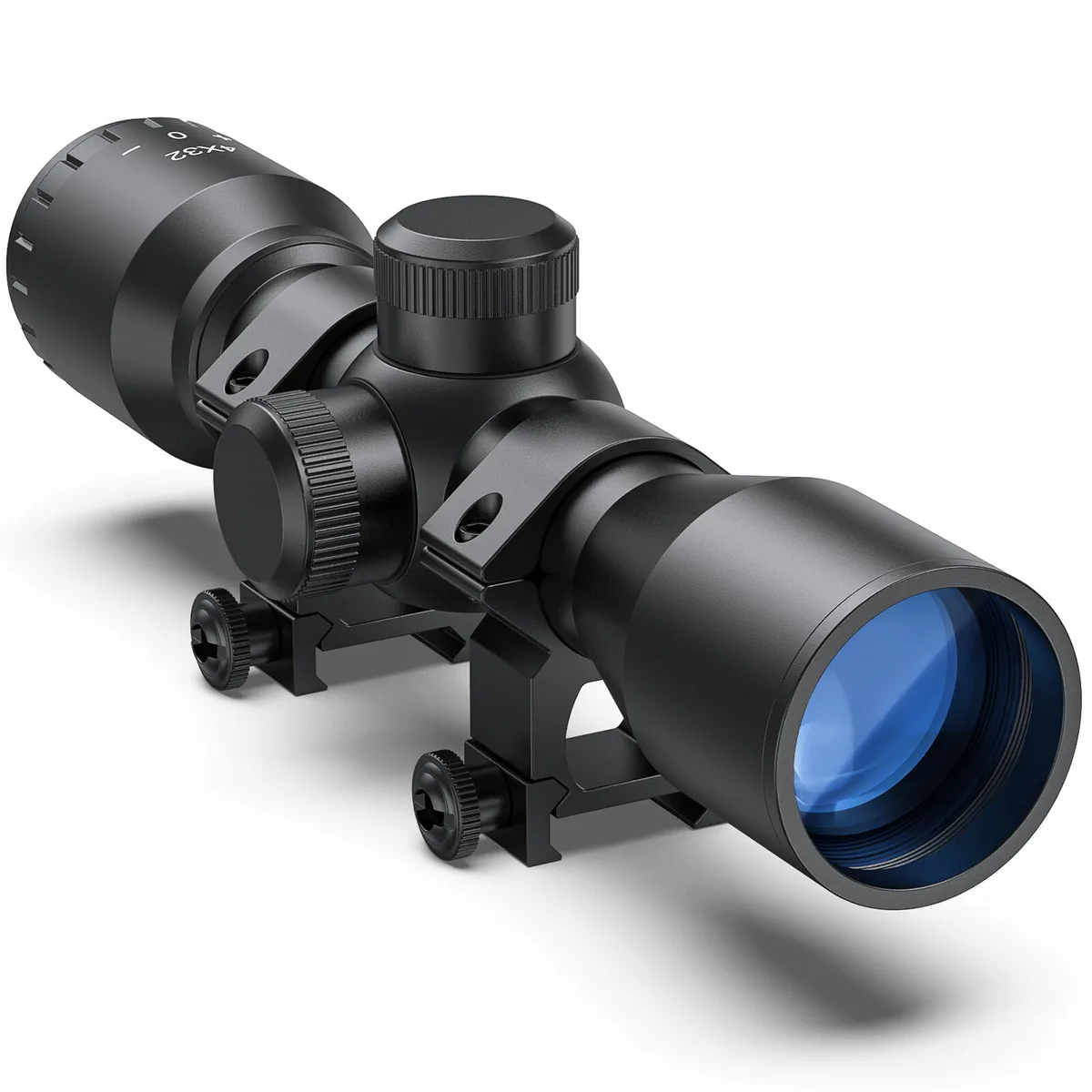
Image source: Web (Bing) / ebay.com (Web image (fair-use with source credit))
Quick Answer
A mil-dot reticle is a scope pattern with dots spaced at milliradian intervals. The dots help shooters estimate distance and hold for bullet drop. One mil equals 3.6 inches at 100 yards.
Shooters measure target size angularly, then calculate range. Military and civilian shooters use this system worldwide.
How a Mil-Dot Reticle Works: Dots, Milliradians, and Subtension
A mil-dot reticle works on a simple principle. Fixed angular spacing between dots lets you measure how large a target appears through your scope. Those measurements, called subtension, reveal how far away something is.
The core number you need is this: 1 milliradian equals 3.6 inches at 100 yards. That relationship never changes. Whether you're at 200 yards or 1,000, one mil represents the same angular space.
Manufacturer specs for most mil-dot scopes place dots 0.2 mil or 0.5 mil apart.
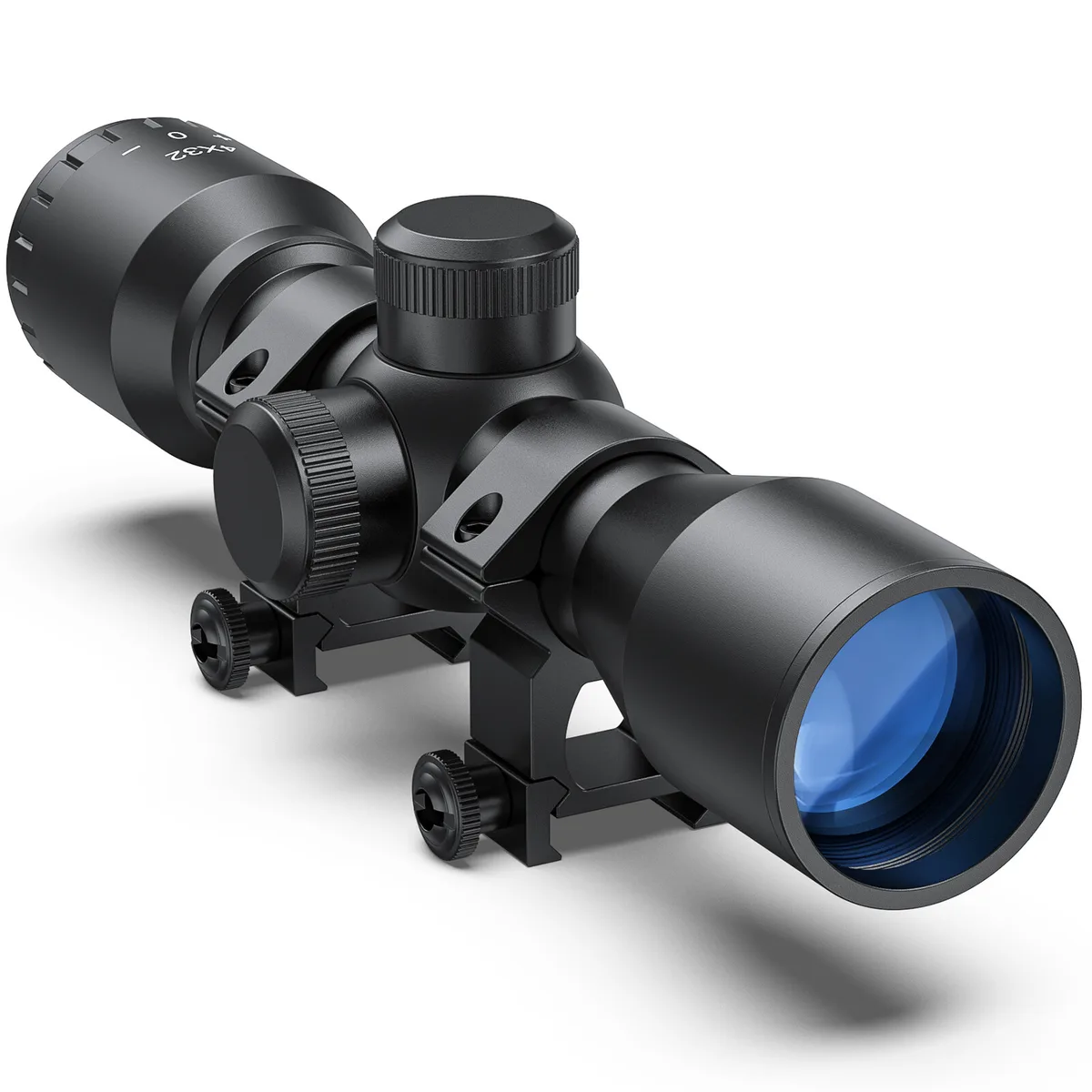
Image source: Web (Bing) / ebay.com (Web image (fair-use with source credit))
How to Range a Target
If you know a real-world target's size, you can estimate its distance. The formula uses two inputs: the target's size in inches and its angular size in mils through the reticle.
| Step | What You Do | Example |
|---|---|---|
| 1 | Measure the target's real size | 18 inches (deer chest) |
| 2 | Measure its angular size in mils | 2 mils |
| 3 | Multiply mil reading by 27.78 | 2 × 27.78 = 55.56 |
| 4 | Divide target size by that number | 18 ÷ 55.56 ≈ 306 yards |
That formula, (target size in inches × 27.78) ÷ mil reading = distance in yards, is the backbone of mil-dot ranging. Military marksmanship training programs, including those run by the U.S. Army Marksmanship Unit, teach this exact method.
The key assumption is that you know what the target's real size is. A standard door is about 80 inches tall. A 5-gallon bucket is roughly 14 inches wide.
Knowing these reference sizes is half the battle.
FFP vs. SFP Mil-Dot Scopes: Why the Focal Plane Changes Everything
The focal plane your scope uses changes how mil-dot subtensions behave. This is the single most important technical distinction in mil-dot optics.
In a first focal plane (FFP) scope, the reticle sits in front of the magnification lens. The dots grow and shrink as you zoom in or out. Because the reticle scales with the image, subtension values stay constant at every magnification.
A 0.2-mil dot reads 0.2 mil whether you're at 4x or 20x.
In a second focal plane (SFP) scope, the reticle sits behind the magnification lens. The dots stay the same size regardless of zoom. That means subtension values change with magnification.
A 0.2-mil dot at 4x reads one value. At 12x, it reads another.
| Feature | FFP Scope | SFP Scope |
|---|---|---|
| Reticle scales with zoom | Yes | No |
| Subtension values | Constant at all magnification | Change with magnification |
| Best for | Ranging and holdover at any zoom | Fixed-magnification shooting |
| Common in | Tactical, competition, precision | Hunting scopes, mid-range setups |
| Price trend | Premium-priced | Generally more affordable |
As of 2026, FFP scopes have become dominant in precision rifle competitions like the Precision Rifle Series (PRS) and National Rifle League (NRL). The reason is straightforward. Competitors need to range and hold over at varying magnification levels without recalculating.
For most hunters, an SFP mil-dot scope works fine. Learn the subtension values at your preferred magnification and stick to it.
How to Use a Mil-Dot Reticle for Ranging and Holdover
Once you understand what a mil-dot reticle is, using it comes down to two tasks: estimating distance and compensating for bullet drop. Here's the workflow.
Step-by-Step Process
- Zero your rifle first. Most shooters zero at 100 yards. This gives you a consistent starting point.
- Learn your dot spacing. Check your scope's manual for exact subtension values. Common values are 0.2 mil and 0.5 mil.
- Identify the target's real size. Use reference objects. A standard steel plate in competition is 20 inches tall.
- Measure the angular size. Place the target between dots and count how many mils it covers.
- Calculate range. Apply the formula: (target size × 27.78) ÷ mil reading = distance in yards.
- Hold over or dial. If your bullet drops 1.5 mil at that distance, place the target on the 1.5-mil dot below center.
- Confirm with live fire. Shoot, adjust, and verify your drops against actual impacts.
Holdover vs. Turret Dialing
Holdover means aiming with the reticle rather than adjusting turrets. It's faster for engaging targets at varying distances. Turret dialing means physically adjusting the scope's elevation knob.
It's more precise for known distances but slower between shots.
| Method | Speed | Precision | Best For |
|---|---|---|---|
| Holdover (reticle) | Fast | Moderate | Dynamic shooting, hunting, rapid engagements |
| Turret dialing | Slower | High | Known-distance targets, precision competitions |
Many shooters blend both. They dial for the primary distance, then use mil-dot holdover for quick adjustments.
Mil-Dot Reticle vs. MOA Reticle vs. BDC Reticle
If you're shopping for a scope, you'll run into three main reticle systems. Each has strengths. None is objectively better in every scenario.
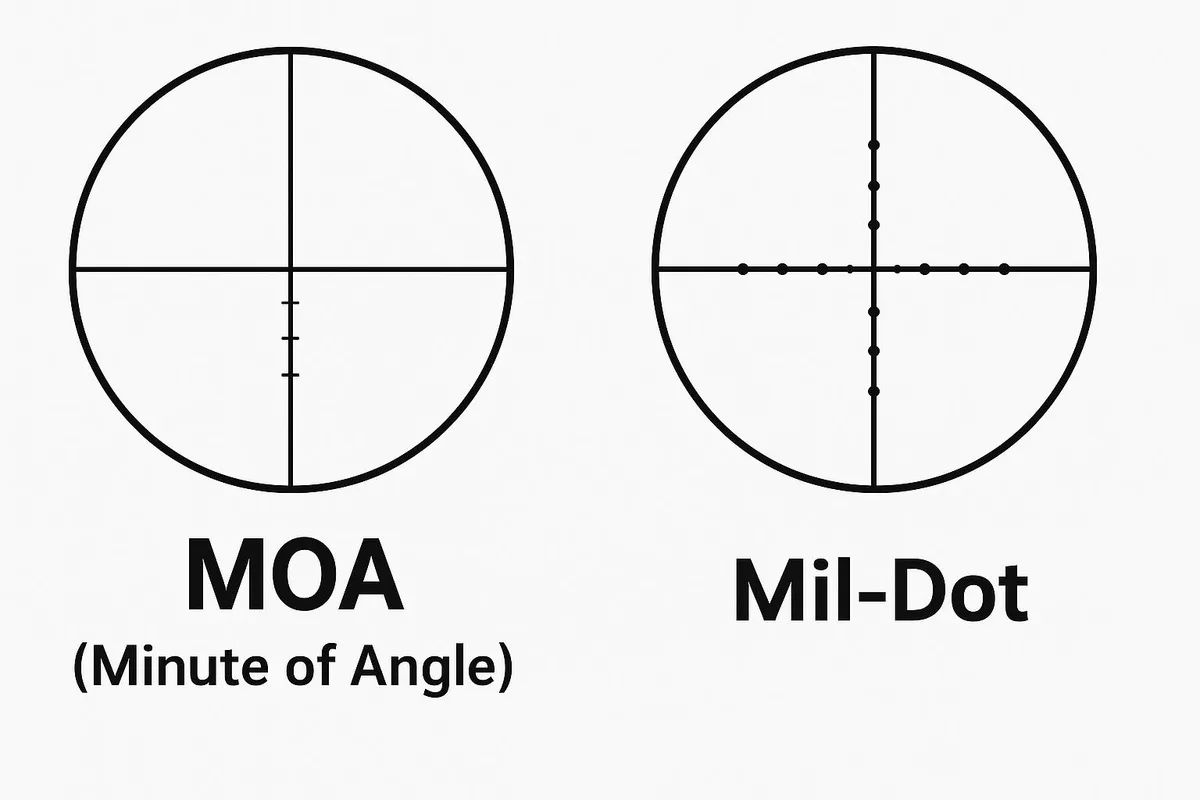
Image source: Bing (Web (fair-use with source credit))
| Feature | Mil-Dot | MOA-Based | BDC Reticle |
|---|---|---|---|
| Unit of measurement | Milliradian | Minute of Angle | Pre-set drop marks |
| Common dot spacing | 0.2 mil / 0.5 mil | 0.5 MOA / 1 MOA | Calibrated to specific cartridges |
| Mental math difficulty | Easy (base 10) | Moderate (1 MOA ≈ 1.05 inches at 100 yards) | Minimal (follow the marks) |
| Range estimation | Yes | Yes | No |
| Flexibility | Works across cartridges | Works across cartridges | Best with matched factory loads |
| Military standard | Yes (NATO-wide) | Used in US precision shooting | Not a military standard |
| Common in | Tactical scopes, PRS, NRL | Hunting scopes, US target shooting | Hunting rifles, factory-loaded setups |
Who Should Choose What
- Mil-dot: If you want the most versatile system, go mil-dot. It ranges, holds over, and works with any cartridge. Military forces worldwide standardized on this system, and Vortex Optics supports it across their tactical scope lines.
- MOA: If you think in inches rather than mils, MOA feels natural. One MOA equals about 1.047 inches at 100 yards. US-based competition shooters often prefer it.
- BDC: If you want simplicity and shoot the same factory load consistently, a BDC reticle removes the math. It's not a ranging tool though, so don't expect to use it for distance estimation.
Who Uses Mil-Dot Reticles (and When It's Overkill)
Mil-dot reticles show up in specific contexts where rapid range estimation and holdover matter.
Primary Users
- Military snipers and designated marksmen. The mil system is NATO standard. Every U.S. Army sniper qualification course teaches mil-based ranging.
- Law enforcement precision shooters. SWAT sniper teams use mil-dot scopes for urban and rural deployments.
- Competition shooters. PRS and NRL stages frequently require ranging and holdover without time to dial turrets.
- Hunters at distance. Big game hunting beyond 200 yards benefits from holdover capability.
- Long-range rimfire shooters. Training with .22 LR at distance teaches mil-dot fundamentals at low cost.
When It's Overkill
A mil-dot reticle adds complexity you may not need if:
- You shoot mostly inside 150 yards, where bullet drop is minimal.
- You already use a laser rangefinder exclusively for distance.
- You're a casual plinker with no interest in holdover shooting.
In those cases, a simple duplex reticle or basic BDC scope does the job with less fuss. There's no shame in keeping it simple. The reticle you actually use well beats the most advanced one you ignore.
Common Mil-Dot Reticle Mistakes to Avoid
Even experienced shooters make these errors. Avoiding them saves time, ammo, and frustration.
- Ignoring focal plane type. Using SFP subtension values at the wrong magnification throws every calculation off. Double-check which focal plane your scope uses before ranging.
- Miscounting dots. Counting dots under stress is where mistakes happen. Practice in low-stress environments first.
- Forgetting reference sizes. Ranging only works if you know what you're measuring. Memorize common dimensions: a standard door is 80 inches tall, a 5-gallon bucket is 14 inches wide, and a deer's chest is 16 to 20 inches.
- Trusting cheap scopes. Budget mil-dot scopes sometimes have inaccurate dot spacing. If your ranges feel consistently off by 10 to 15 percent, the scope may be the problem.
- Skipping parallax adjustment. Parallax error causes the reticle to appear to shift relative to the target. Adjust the parallax knob for your shooting distance, especially past 200 yards.
- Relying solely on reticle ranging. The mil-dot method works best with known-size targets. If you're ranging an unknown object, cross-check with a laser rangefinder when possible.
- Neglecting wind holds. Mil-dot reticles handle elevation well, but they don't account for wind drift unless your scope has horizontal hash marks. Learn to read wind separately.
Frequently Asked Questions
What is a mil-dot reticle in simple terms?
A mil-dot reticle is a scope pattern with small dots spaced at fixed intervals along the crosshair. The dots measure angular size, which helps you estimate range and compensate for bullet drop. It's the most common ranging reticle in military and precision shooting.
How far can you shoot accurately with a mil-dot reticle?
A mil-dot reticle doesn't limit your shooting distance by itself. It's an aid for range estimation and holdover. Effective shooting distance depends on your rifle, cartridge, optic quality, and shooter skill.
As of 2026, precision shooters regularly engage targets at 1,000+ yards using mil-dot scopes.
Is a mil-dot reticle good for beginners?
Yes, with patience. The concept is straightforward: dots measure angular size, and one mil equals 3.6 inches at 100 yards. The learning curve comes from mastering the ranging formula and understanding focal plane differences.
Starting with a second focal plane scope at a fixed magnification simplifies the process.
What is the difference between mil-dot and MOA reticles?
Mil-dot reticles use milliradians, where 1 mil equals 3.6 inches at 100 yards. MOA reticles use minutes of angle, where 1 MOA equals about 1.05 inches at 100 yards. Mil-based systems are easier for mental math because they use base-10 arithmetic.
Do I need a laser rangefinder if I have a mil-dot reticle?
Not necessarily. A mil-dot reticle lets you estimate range if you know the target's real size. However, a laser rangefinder provides instant, exact readings without guesswork.
Many precision shooters carry both as a cross-check.
Can I use a mil-dot reticle on any rifle scope?
Only if the scope has a mil-dot reticle pattern. Not all scopes include one. Check product specifications before buying.
Manufacturers like Nightforce Optics, Vortex, and Schmidt & Bender all offer mil-dot options across their product lines.