Do all rifle scopes have parallax adjustment? No. Plenty of scopes, especially budget and mid-range models, ship without any parallax control at all.
Whether that gap matters depends entirely on your magnification range and how far you shoot.
Most scopes with a fixed parallax setting are calibrated around 100 yards, which covers a lot of hunting situations. At higher magnification though, the error grows quickly. Industry data indicates parallax misalignment can produce 2 to 4 MOA (minute of angle) of shot displacement at 15x magnification.
Here's what you need to know.
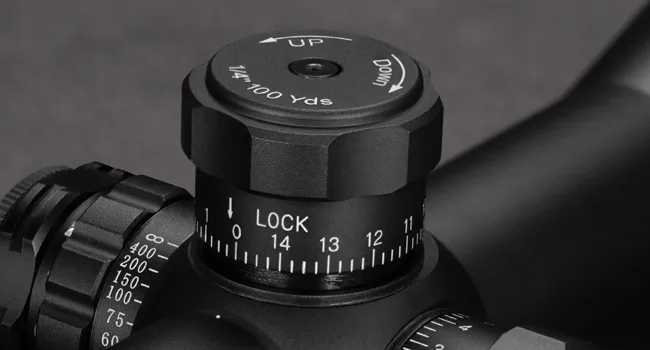
Image source: Bing (Web (fair-use with source credit))
Quick Answer
Do all rifle scopes have parallax adjustment? No. Many scopes, especially budget and mid-range models, lack this feature.
Without it, the scope locks parallax at one fixed distance, usually 100 yards. At magnifications above 10x, this causes accuracy problems. Adjustable parallax costs more but matters for long-range shooting.
What Parallax Is and Why Scope Designers Handle It Differently
Parallax is the apparent movement of a reticle when your eye shifts behind the scope eyepiece. The reticle and the target sit on different focal planes inside the optic. If your head moves off-center even slightly, the reticle appears to shift relative to the target.
Most scopes handle parallax in one of three ways:
- Side-focus knob: A dial on the turret housing that adjusts internal lenses for different target distances.
- Objective-bell turret: A rotating ring on the front of the scope that moves the objective lens to align focal planes.
- Fixed parallax: The scope is calibrated at one distance, usually around 100 yards. No adjustment knob exists.
Why do manufacturers skip adjustable parallax in cheaper models? Cost. An objective lens assembly with a parallax turret adds machining, sealing, and calibration to the build.
For scopes priced between $100 and $300, that expense hits margins hard. Leupold's published technical guides note that fixed-parallax scopes handle most hunting distances without issue.
But a scope without adjustable parallax isn't broken. It's just limited. Parallax error scales directly with magnification.
The higher you zoom, the worse the shift becomes. Low-power scopes rarely show problems because the error is too small to matter. Shoot at 3x to 9x magnification at 200 yards and you'll likely never notice it.
Real issues surface when you push magnification past 15x and extend range beyond 250 yards. That's where fixed parallax starts costing you shots.
There's also a practical difference on the range. Side-focus knobs let you dial quickly between targets at different distances. Objective-bell turrets require reaching to the front of the scope, which disrupts your shooting position.
Fixed-parallax scopes need nothing, but you're stuck with whatever calibration the manufacturer chose.
And calibration varies between models. Some scopes set fixed parallax at 50 yards. Others use 100 yards.
A few high-magnification models use 150 yards. There's no single industry standard. If your shooting distance falls outside that window, you'll see reticle shift without knowing why.
When Parallax Adjustment Actually Matters for You
The answer depends on four variables: your magnification range, your typical shooting distance, your shooting discipline, and your budget.
Magnification is the biggest factor. Below 4x, parallax error is negligible. Between 4x and 10x, it becomes noticeable but rarely critical.
Above 10x, adjustable parallax starts to matter significantly. Above 15x, it's practically essential for accurate long-range shots.
Shooting distance plays the second role. If you hunt within 200 yards and never shoot past 300, a fixed-parallax scope is probably fine. Push past 350 to 400 yards, and you'll want adjustable parallax on every shot.
Your discipline changes the priority too:
| Discipline | Parallax Adjustment Needed? | Why |
|---|---|---|
| Varmint hunting (25-300 yards) | Recommended | High magnification, quick range changes |
| Big-game hunting (100-400 yards) | Helpful | Medium magnification, moderate range |
| PRS (Precision Rifle Series) / F-Class competition | Essential | 15x to 25x magnification, 500+ yard targets |
| Rimfire target shooting | Depends | Close range, but high magnification changes things |
| 3-gun competition | Rarely needed | LPVO (low power variable optic) range, magnification stays low |
If you shoot a variable-power scope between 4x and 9x at hunting distances under 250 yards, you can probably skip adjustable parallax. Many experienced hunters run fixed-parallax scopes for years without issue.
But if you're shooting a 4x to 16x scope at 400 yards, or competing in PRS at 600 yards, parallax adjustment is non-negotiable. Without it, your shots drift unpredictably as your eye position changes behind the eyepiece.
Vortex Optics recommends adjustable parallax for any scope with magnification above 10x used beyond 250 yards. That guidance matches what we see across multiple manufacturer publications and competitive shooting resources.
Decision Guide: Matching Scope Type to Your Shooting Situation
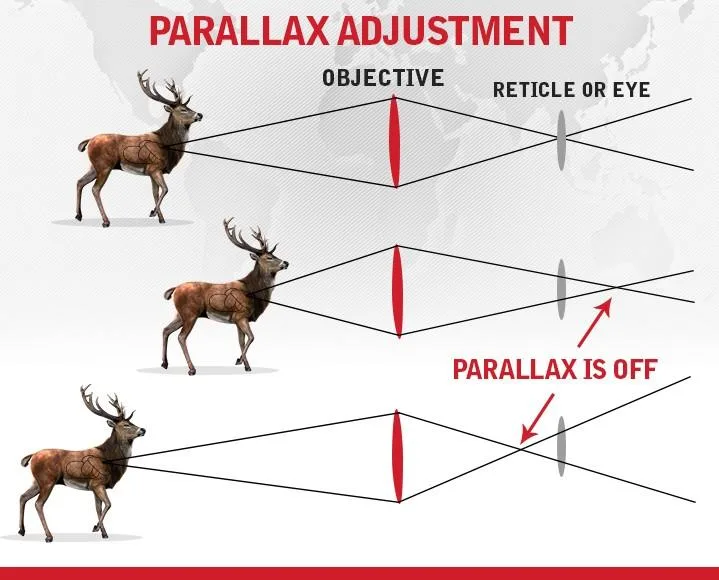
Image source: Bing (Web (fair-use with source credit))
Think of this as a decision tree. Follow the logic below and you'll know exactly what scope type you need.
Step 1: What magnification do you shoot at?
- Below 4x: Fixed parallax is fine. You won't notice the difference.
- 4x to 10x: Adjustable parallax is helpful if your ranges vary.
- 10x to 16x: Adjustable parallax becomes important. Fixed calibration will limit you.
- Above 16x: Adjustable parallax is essential.
Step 2: What distance are your typical targets?
- Under 200 yards: Most fixed-parallax scopes will work.
- 200 to 350 yards: Adjustable parallax recommended for consistent accuracy.
- 350 to 600 yards: Adjustable parallax strongly recommended. Fixed calibration will fail.
- Beyond 600 yards: Adjustable parallax is mandatory.
Step 3: How critical is each shot?
- Recreational shooting: Fixed parallax is acceptable.
- Hunting: Adjustable parallax gives you a margin for error.
- Competition: Adjustable parallax is required.
Step 4: What's your budget?
- Under $300: Mostly fixed-parallax scopes available.
- $300 to $700: Side-focus parallax appears on many models.
- $700 and above: Side-focus and objective-bell parallax are standard.
Here's a quick reference to match your situation with the right scope type:
| Scope Type | Parallax Feature | Magnification Range | Best For |
|---|---|---|---|
| LPVO | Often none | 1x to 6x | 3-gun, close-range hunting |
| Hunting scope | Fixed at 100 yards | 3x to 9x | Big-game hunting |
| Mid-range scope | Side-focus recommended | 4x to 16x | Varmint, mixed distances |
| Precision scope | Side-focus mandatory | 5x to 25x | PRS, F-Class, long range |
For example, a shooter running a 3x to 9x scope for whitetail deer at 150 yards doesn't need adjustable parallax. A PRS competitor running a 5x to 25x scope at 600 yards absolutely does. The same feature that's a luxury in one situation becomes a necessity in another.
If any two steps point toward adjustable parallax, get it. The feature rarely costs much more in the mid-range bracket. And it removes a variable that's hard to compensate for later.
Side-Focus vs. Objective-Bell Parallax vs. Fixed-Parallax Scopes

Image source: Web (Bing) / shopabunda.com (Web image (fair-use with source credit))
Here's a direct comparison of the three main parallax systems:
| Feature | Side-Focus | Objective-Bell Turret | Fixed Parallax |
|---|---|---|---|
| Adjustment location | Turret housing (left side) | Front of scope | None |
| Speed of adjustment | Fast, mid-race | Slow, requires reach | N/A |
| Price range | $400-$2,500+ | $300-$1,500+ | $80-$400+ |
| Best for | PRS, F-Class, precision | Budget precision builds | Hunting, plinking |
Side-focus parallax is the most popular option as of 2026. It sits on the left side of the turret housing, easy to reach without breaking your cheek weld. Precision shooters and PRS competitors favor this design because you can adjust parallax quickly between shots at different distances.
Leupold, Vortex, Nightforce, and most premium manufacturers use side-focus on their precision lines. Verified user reviews consistently report faster parallax adjustments with this design compared to objective-bell alternatives.
Objective-bell parallax turrets rotate the front lens assembly. They're more common on older scope designs and some budget precision builds. The downside is reach.
You have to stretch to the front of the scope, which disrupts your position.
Fixed-parallax scopes cost the least and require zero adjustment. They're the most common design under $300. The parallax is set at the factory, usually at 100 yards.
For most hunting situations at low to medium magnification, that's acceptable.
The tradeoff is simple. More adjustability means more money and slightly more complexity. Less adjustability means a lower price but real limitations at high magnification and long range.
If you shoot within 250 yards at under 10x magnification, fixed parallax is probably fine. If you push past 350 yards at 15x or above, side-focus parallax is the way to go.