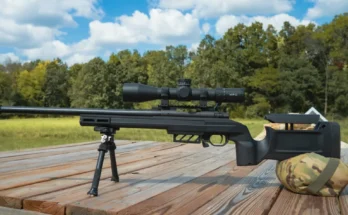
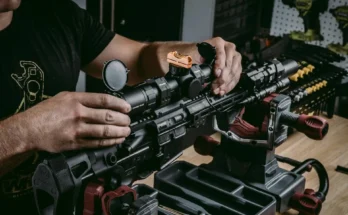
What does 20x magnification mean on a rifle scope? In plain terms, it means objects appear 20 times larger than they do to the naked eye. That sounds impressive until you understand the tradeoffs.
Higher magnification costs you in stability, brightness, and practical usability.
Manufacturer specifications from optics companies like Vortex Optics and Leupold show that a 20x scope operates within strict optical limits. Exit pupil diameter, eye relief, and field of view all change as magnification climbs. Understanding these details helps you avoid a scope that looks powerful on paper but disappoints in the field.

Image source: Web (Bing) / airsoftgi.com (Web image (fair-use with source credit))
Quick Answer: What 20x Actually Means (and What It Doesn't)
20x magnification means objects appear 20 times larger than to the naked eye. At 20x, a target at 100 yards looks like it's at 5 yards. But full 20x magnification rarely delivers usable 20x performance in practice.
Eye relief shrinks, image shake increases, and the field of view narrows significantly. Most shooters find 10x to 15x is the practical ceiling for stable, accurate shooting.
Why the Magnification Number on Your Scope Is More Misleading Than You Think
The magnification rating on a rifle scope is a theoretical maximum, not a performance promise. When a scope advertises "20x," it means the optics can physically enlarge an image by 20 times under ideal conditions. Those ideal conditions almost never exist in real shooting environments.
What "20x" Doesn't Tell You
The number alone says nothing about image brightness, target clarity, or how steady you'll be behind the scope. Several factors determine whether you can actually use full magnification:
- Exit pupil size, which controls how much light reaches your eye
- Eye relief, the distance your eye needs to sit from the scope
- Field of view, or how much of the scene you can see at once
- Image stability, meaning how much shake you experience at full power
The Exit Pupil Problem at 20x
Exit pupil diameter is calculated by dividing the objective lens size by the magnification. It's the circle of light that reaches your eye through the scope. Specifications from Vortex Optics show how this plays out.
A scope with a 50mm objective lens at 20x magnification produces an exit pupil of just 2.5mm.
For comparison, the human pupil dilates to 5 to 7mm in bright light and up to 8mm in low light.
| Objective Lens Size | At 10x Magnification | At 20x Magnification |
|---|---|---|
| 32mm | 3.2mm | 1.6mm |
| 40mm | 4.0mm | 2.0mm |
| 50mm | 5.0mm | 2.5mm |
That 2.5mm exit pupil at full 20x magnification means significantly less light reaches your eye compared to a lower setting. The image gets dimmer. In low-light conditions, it becomes harder to see clearly.
The Eye Relief Squeeze
As magnification increases, eye relief typically decreases. Most scopes designed for 20x capability list eye relief of 3.0 to 3.5 inches at maximum power. That's workable for most shooters, but it changes the sight picture you're used to.
If you're transitioning from a lower setting, the adjustment can be jarring.
The Bottom Line on Scope Marketing
Magnification numbers are easy to print on a box. What's harder to communicate is how usable that magnification is under real-world conditions. The number is real.
The usability is conditional.
How Scope Magnification Works: The Math Behind the Spec
Scope magnification is based on angular enlargement. When you look through a scope at 20x, the target appears to subtend an angle 20 times larger than it would with the naked eye. That's the fundamental definition.

Image source: Web (Bing) / outdoorsmans.com (Web image (fair-use with source credit))
The Simple Math
If you can see a 12-inch target at 300 yards unaided, a 20x scope makes it appear as though it's only 15 yards away. The formula is straightforward:
Apparent target distance = Actual distance ÷ Magnification
| Actual Distance | At 10x | At 20x |
|---|---|---|
| 100 yards | Looks like 10 yards | Looks like 5 yards |
| 200 yards | Looks like 20 yards | Looks like 10 yards |
| 400 yards | Looks like 40 yards | Looks like 20 yards |
That table makes the magnification effect obvious. At 20x, a target at 400 yards appears to be at 20 yards. For precision shooting, that's where the advantage becomes real.
Why More Magnification Isn't Always Better
Every increase in magnification comes with tradeoffs:
- Smaller field of view: at 20x, the visible area shrinks dramatically compared to 10x or 15x
- Increased image shake: any movement in your body or the wind gets amplified by 20 times
- Dimmer image: higher magnification reduces the exit pupil, which means less light reaches your eye
As of 2026, most precision rifle competitors set their scopes to 12x to 18x at long range and adjust lower for close-in shots. The full 20x setting exists for a specific purpose, not as a daily default.
FFP vs SFP: How Reticle Subtensions Behave at 20x
On a Second Focal Plane (SFP) scope, reticle markings are calibrated for one specific magnification level. If that level isn't 20x, your holdover points and range estimation marks are off at full power. On a First Focal Plane (FFP) scope, the reticle scales with magnification, so markings stay accurate at any setting including 20x.
If you're buying a scope to actually use at 20x, FFP gives you more flexibility. If 20x is mostly for spotting, an SFP scope works perfectly fine.
The Real-World Performance of 20x Magnification (What You'll Actually Experience)
In practice, 20x magnification is useful in specific situations. It's not a universal "more is better" setting. Verified feedback from competitive shooters and hunting communities consistently reports that maximum magnification is reserved for deliberate, steady shots at known distances.
Where 20x Shines
- Benchrest shooting: stable rest positions let you exploit full magnification. This is where 20x and higher make real sense.
- Varmint hunting: small, distant targets like coyotes or prairie dogs at 400+ yards benefit from the extra clarity.
- Spotting bullet impacts: at the range, 20x helps you see your own hits on steel targets. This is arguably the most practical use for a 20x scope.
- Competitive precision rifle series (PRS and NRL): shooters dial magnification up for long shots and down for close ones.
Where 20x Falls Short
- Low-light hunting: early morning and dusk are when most game animals move. At 20x, the reduced exit pupil and smaller field of view make it harder to locate targets.
- Moving game: tracking an animal on the move at 20x is nearly impossible. The narrow field of view means you lose the target the moment it steps out of frame.
- Unsteady shooting positions: standing or unsupported shots at 20x will look like a shaky mess. The magnification amplifies every movement.
A Practical Rule of Thumb
Many experienced shooters follow a simple guideline. Multiply the target's size in inches by 200, then divide by the target distance in yards. The result gives a rough starting magnification.
For a 24-inch target at 300 yards, that calculation suggests 16x.
That doesn't mean 20x is wrong. It means 20x is more magnification than most targets actually need. You're buying a capability ceiling, not a setting you'll use on every shot.
Common Mistakes Shooters Make When Choosing a 20x Scope
Buying a scope based on the magnification number alone is the most common mistake we see. Here are the errors that cause the biggest problems.
Mistake 1: Assuming Higher Magnification Equals Better Accuracy
Accuracy comes from fundamentals, not optics. A rifle that's properly zeroed, a shooter with good breathing and trigger control, and a solid position will outperform a higher-magnification scope on an unstable setup every time. Training guidance from the National Shooting Sports Foundation reinforces this point.
Fundamentals beat magnification.
Mistake 2: Ignoring Exit Pupil and Light Transmission
As covered earlier, a 20x scope with a small objective lens produces a tiny exit pupil. If you're hunting at dawn or dusk, that means a dark, muddy image. Always check the manufacturer's light transmission rating alongside the magnification number.
Mistake 3: Overlooking Eye Relief and Mounting
At full magnification, eye relief narrows. If your scope rings are set at the wrong distance, you'll get scope bite on every shot. Scope bite is when the scope recoils directly into your eye.
Proper mounting at the correct eye relief distance for maximum magnification is critical.
Mistake 4: Choosing Fixed 20x Over Variable Power
A fixed 20x scope locks you into one magnification level. You can't dial down for close shots or adjust to changing conditions. Unless your shooting is exclusively long-range benchrest, a variable-power scope gives you far more flexibility.
We'll break this down in detail in the next section.
Mistake 5: Buying Premium Glass for a Magnification Number You Won't Use
User reviews consistently show that many shooters who buy 20x scopes for general-purpose shooting end up using 10x to 14x most of the time. You're paying for glass you'll rarely dial up to. Unless you have a specific reason for full 20x, spend the budget on better glass quality at a lower magnification instead.
Fixed-Power vs Variable-Power: Is 20x Right for Your Shooting Style?
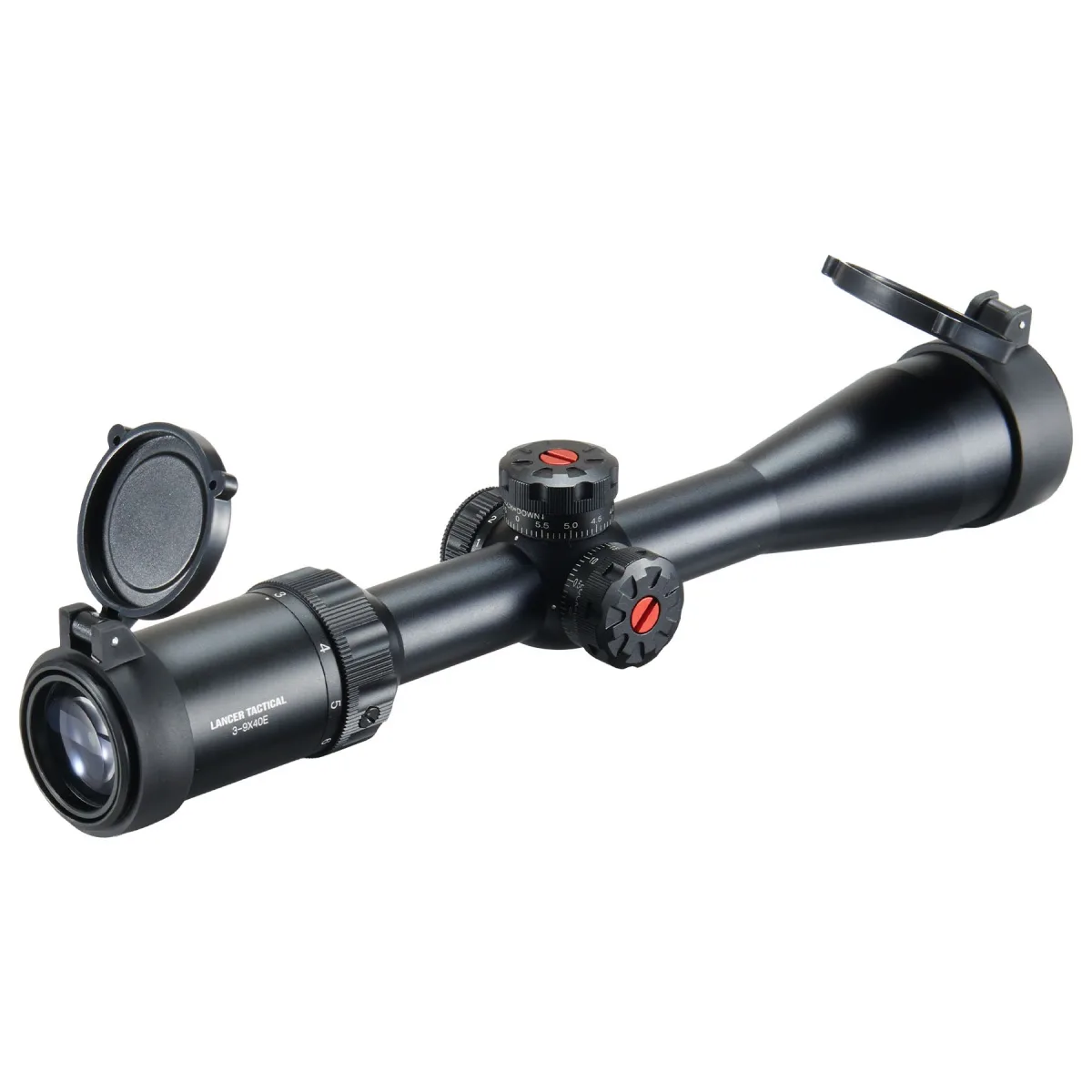
Image source: Web (Bing) / airsoftmegastore.com (Web image (fair-use with source credit))
Now that we've covered what 20x magnification actually means, let's look at the two ways scopes deliver it. The choice between fixed-power and variable-power matters more than most buyers realize.
Fixed-Power Scopes
A fixed-power scope stays at one magnification level permanently. If it says 20x, you're locked at 20x.
Pros:
- Simpler internal design, which often means better optical quality per dollar
- Lighter weight with fewer moving parts
- Less chance of mechanical failure since there's no zoom mechanism
Cons:
- No flexibility for different distances
- Harder to use for both close-range and long-range shots
- You're committed to the one setting no matter what the situation demands
Variable-Power Scopes
A variable-power scope lets you dial the magnification between a range, like 3x to 24x or 5x to 25x.
Pros:
- Dial down for close shots and up for long ones
- Adjust to changing light and target conditions on the fly
- More useful for hunting where distances vary widely
Cons:
- More complex optical path, which can mean slight image degradation at extreme settings
- Typically heavier and bulkier
- Eye relief and field of view change as you adjust magnification
Which One Fits Your Shooting?
| Shooting Style | Best Choice | Why |
|---|---|---|
| Benchrest at a known distance | Fixed 20x | You only shoot at one distance, so stability matters more than flexibility |
| Varmint hunting at varied ranges | Variable 24x | You need to adjust as targets move or distances change |
| General hunting | Variable 3–24x | Versatility matters more than peak magnification |
| PRS competition | Variable 24x or 25x | You'll dial magnification for each stage |
| Range sessions and fun shooting | Variable 3–24x | You'll use the full range of magnification regularly |
If your shooting is specialized and distance-specific, a fixed-power scope makes sense. If you hunt or shoot at varied distances, variable power wins every time. As of 2026, most optics manufacturers offer variable-power options in the 20x range, reflecting where the market demand actually sits.
Scope Magnification Safety, Setup, and Legal Considerations
High magnification brings specific safety and setup challenges that low-power scopes don't have.
Eye Relief Safety
Scope bite happens when the scope's rear lens housing hits your eye during recoil. At 20x, eye relief is tighter, so the margin for error shrinks. Set your eye relief at maximum magnification first, then verify it at lower settings.
Keep at least one inch of clearance between your eye and the rear lens under recoil conditions.
Eye Safety During Bright Light
Never look at the sun through a scope, even briefly. At 20x, concentrated sunlight can cause permanent retinal damage in seconds. This is true for any magnified optic, but the risk increases with higher power.
Mounting and Torque Specs
Scope rings must be torqued to manufacturer specifications. Over-tightening can crush the tube. Under-tightening lets the scope shift under recoil, which changes your zero.
Most manufacturers specify 15 to 20 in-lbs for ring screws.
Legal Considerations
Hunting regulations vary by state and country. Some regions restrict certain optic types or magnification levels for specific game animals. The US Army field manual FM 3-22.9 covers marksmanship principles and optics use, which reinforces proper setup and safety fundamentals that translate to civilian shooting.
Check your state's Department of Natural Resources or wildlife agency for current regulations before hunting with high-magnification optics in restricted areas.
Frequently Asked Questions
What magnification do I actually need for hunting?
Most hunting in North America happens between 50 and 250 yards. A variable scope ranging from 3x to 9x covers this range comfortably. For long-range hunting beyond 300 yards, 4x to 16x gives you more headroom without the practical limitations of 20x.
Reserve extreme magnification for varmint hunting or competitive shooting.
Can you use a 20x scope for close-range shooting?
Yes, but it's not ideal. At close range, the narrow field of view makes target acquisition slow and difficult. If your scope is variable, dial down to 5x to 8x for close shots.
If it's fixed at 20x, you'll struggle with anything inside 50 yards.
What is the practical magnification limit for most shooters?
Most experienced shooters find that 12x to 15x is the highest magnification they can use stably and accurately in the field. Beyond that, image shake and a shrinking field of view reduce real-world performance. This applies to unsupported or moving shooting positions.
Benchrest shooting changes the equation since the rifle is stabilized.
How does 20x magnification affect eye relief?
Eye relief at 20x is typically shorter than at lower magnification settings. Most scopes list 3.0 to 3.5 inches at maximum power. This means you need to position your eye closer to the scope, which can increase the risk of scope bite during recoil if not mounted properly.
Is a 20x fixed-power scope better than a variable 5–25x scope?
For most shooters, no. The variable 5, 25x gives you the same 20x ceiling plus the flexibility to dial down when needed. Fixed 20x only wins if your shooting is exclusively long-range benchrest and you prioritize optical simplicity over versatility.
What exit pupil do I need for low-light hunting at 20x?
A minimum exit pupil of 2.0mm is the general guideline for usable low-light performance. At 20x, you'll need at least a 40mm objective lens to achieve that. Smaller objective lenses produce exit pupils below 2.0mm at full power, which makes the image too dim for dawn or dusk hunts.