What is the best reticle for a rifle scope? There's no single reticle that works best for everyone. The right choice depends on your shooting discipline, the distances you shoot, and how much complexity you can handle while pulling the trigger.
Manufacturer specs from Vortex, Leupold, and Nightforce all confirm the same thing. Your ideal reticle matches how you actually shoot, not what looks impressive on paper. Let's break down the main types and find your best fit.

Image source: Web (Bing) / revellphotography.com (Web image (fair-use with source credit))
Quick Answer
The best reticle for a rifle scope depends on your shooting style and distance needs. For hunting between 100 and 300 yards, a simple Duplex or BDC reticle works well. For precision shooting beyond 500 yards, an MOA or MIL reticle in a First Focal Plane scope is the standard choice.
Match the reticle to your discipline, not the other way around.
There Is No Single Best Reticle. Here's How to Find Yours
A reticle is the aiming point built into your scope's optics. Some are simple crosshairs. Others carry detailed markings for windage and elevation holds.
What separates a good reticle from a bad one comes down to three practical factors.
- Shooting discipline. A hunter taking 150-yard shots through brush doesn't need a Christmas tree reticle. A PRS competitor does.
- Distance profile. Long-range shooting demands more holdover information. Close-range work favors simplicity and speed.
- Speed under pressure. A complex reticle adds useful data. It also adds decision time when the shot counts.
Research across competitive shooting communities shows that top-level PRS and NRL shooters favor MIL and MOA reticles in First Focal Plane scopes. These give them consistent holdover data at every magnification setting.
For a typical whitetail hunter at 200 yards, that same complex reticle is overkill. You don't pick a reticle because it's popular. You pick it because it solves your shooting problem.
How Rifle Scope Reticles Actually Work: MOA, MIL, BDC, and FFP vs SFP
Four reticle systems dominate the market. Understanding each one helps you narrow your choice quickly.
MOA (Minute of Angle) is an angular measurement. One MOA equals about 1.047 inches at 100 yards. Most MOA turrets click in 1/4 MOA increments.
This system feels intuitive for shooters who think in inches.
MIL/MRAD (Milliradian) is the other mainstream standard. One MIL equals about 3.6 inches at 100 yards. Turrets typically click in 0.1 MIL increments.
MIL is the preferred system in most competitive circuits as of 2026.
BDC (Bullet Drop Compensation) reticles carry pre-calibrated holdover marks matched to specific ammunition loads. You check the data card from your scope manufacturer or ammo brand, find your range on the reticle, and hold at that mark.
First Focal Plane (FFP) vs Second Focal Plane (SFP) is the next major decision. In FFP scopes, the reticle scales with magnification, so holdover marks stay accurate at any setting. In SFP scopes, those marks are only reliable at one magnification, usually the highest.
For detailed subtension breakdowns on specific scope models, Vortex Optics publishes comprehensive guides on their platform.
Side-by-Side: Comparing the Most Popular Reticle Types for Hunting and Competition
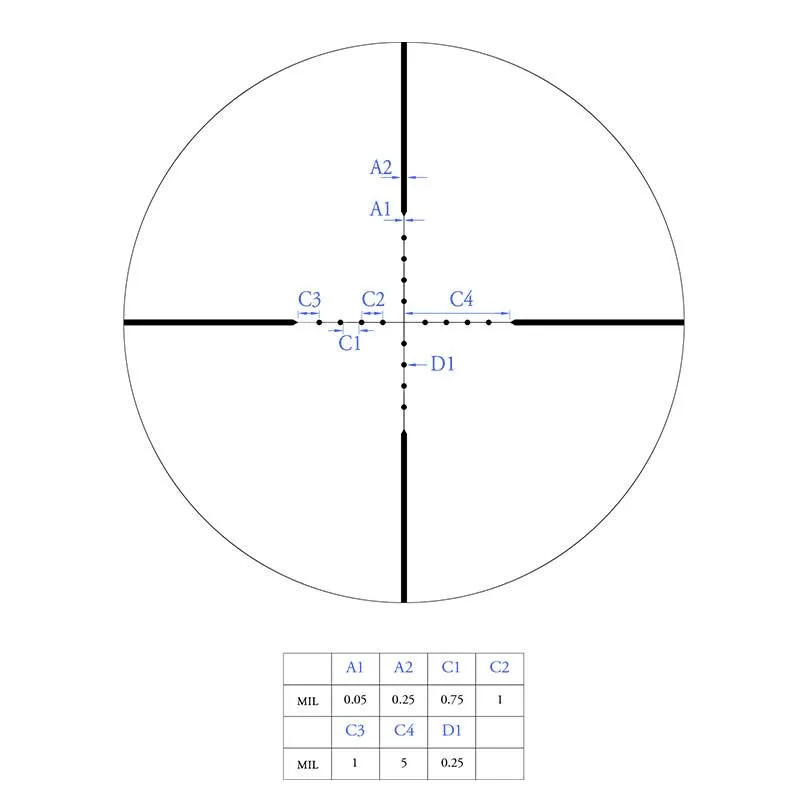
Image source: Bing (Web (fair-use with source credit))
The table below shows how the most common reticle types stack up across key factors.
| Reticle Type | Best For | Main Advantage | Main Trade-Off |
|---|---|---|---|
| Duplex | General hunting | Fast target acquisition | No holdover marks |
| BDC | Medium-range hunting | Caliber-specific holds | Limited to specific loads |
| MIL-Dot | Long-range and tactical | Versatile holdover data | Requires range estimation |
| MOA Reticle | Precision shooting | Intuitive inch-based math | Not ideal for metric users |
| Christmas Tree | PRS and NRL competition | Full windage and elevation holds | Visually cluttered |
| Rangefinding | Variable distances | Built-in range estimation | Steeper learning curve |
For recreational hunters shooting under 300 yards, a Duplex or simple BDC keeps things straightforward. If you regularly shoot past 500 yards or compete, a MIL or MOA reticle with holdover marks gives you more flexibility under time pressure.
Illuminated reticles are available across most of these types. They add red or green aiming points for low-light conditions. You'll pay a bit more, and you'll need batteries, but the benefit at dawn or dusk is real.
Best Reticle by Use Case: Hunting, PRS Competition, Long-Range, and AR-15 Shooting

Image source: Bing (Web (fair-use with source credit))
Whitetail or deer hunting (100 to 300 yards): A Duplex reticle or simple BDC is your best option. You need fast target acquisition, not mental math. A plain crosshair with thicker outer stadia lines helps in low light and thick cover.
PRS and NRL competition: The Christmas tree reticle in a MIL format is the go-to choice. Shooters need to hold elevation and windage simultaneously at varying distances. First Focal Plane is non-negotiable in this environment.
Long-range precision (1,000+ yards): A MIL or MOA reticle with a Rangefinding scale lets you estimate range and apply holds without relying on a laser rangefinder. FFP ensures your subtension data stays accurate at any magnification.
AR-15 and LPVO shooting: A 1x to 8x LPVO with a simple dot-plus-crosshair reticle covers close quarters and mid-range work. The National Shooting Sports Foundation reports rising demand for this setup across defensive shooting and 3-Gun circuits.
Common Reticle Mistakes That Cost You Accuracy
Even the best reticle loses its advantage if you make these errors.
- Picking a complex reticle when you don't need one. A new hunter struggling to find holdmarks under pressure will shoot worse with a Christmas tree reticle than with a simple Duplex.
- Using SFP holdover marks at the wrong magnification. Those marks are only accurate at one setting. Dial to the highest magnification every time you need to hold over.
- Ignoring BDC data mismatch. BDC reticles are calibrated to specific bullet weights and velocities. Switch your ammunition load, and your holdover marks shift. The data card shipped with the scope is not optional.
- Skipping confirmation shots at the range. Any reticle fails if the rifle is zeroed incorrectly. Confirm your zero at your intended hunting distance before trusting the markings.
- Never drilling holdover application. Knowing your reticle has holdover data doesn't mean you can find it quickly under stress. Dry-fire and live-fire drills build the speed you need.
The key is practice. Reticle knowledge only helps when it becomes second nature.
Expert Tips for Choosing, Zeroing, and Using Your Reticle Under Real Conditions
Knowing which reticle to pick is half the battle. Making it work in the field is the other half. Here's what experienced shooters and competitive competitors do differently.
Zero at the right distance for your use case. A PRS competitor zeroing at 100 yards can hold elevation from their data card. A whitetail hunter zeroed at 200 yards can point of aim to point of impact without thinking about holdover. Choose your zero distance based on your most common shot.
Verify your zero before every hunting season. A scope that shifted during summer transport will throw you off. Shoot three to five confirmatory rounds at your chosen distance. Adjust only if needed.
Learn your subtensions cold. Every MIL or MOA reticle comes with a subtension chart from the manufacturer. Measure the gap between marks. Know the exact angular value.
You can't apply holdover data you haven't memorized. Dry-fire drills at home build this knowledge fastest.
Dial and hold as a combined system. Competitors often dial for elevation and hold for windage. Some hunters dial for wind and hold for elevation. Pick a system and stick to it.
Inconsistency under stress causes most holdover errors.
For detailed reticle illumination controls and turret reset procedures, Leupold's technical documentation walks through proper setup and calibration for their full reticle lineup.
FAQ: Reticle Selection Questions Shooters Ask Most
What is the best reticle for deer hunting?
A Duplex or simple BDC reticle is the best choice for deer hunting. Both give you fast target acquisition at typical hunting distances of 100 to 300 yards. Illuminated options help in low-light dawn and dusk conditions where deer are most active.
Is MIL or MOA better for long-range shooting?
MIL is the preferred system for most competitive long-range shooters as of 2026. It's the standard in PRS, NRL, and military precision courses. MOA still works well and feels more intuitive for hunters who think in inches at short to medium distances.
Do I need a First Focal Plane scope?
If you shoot past 200 yards or compete in precision matches, yes. FFP scopes keep holdover marks accurate at every magnification setting. For casual hunting at 200 yards or closer, an SFP scope is simpler, lighter, and cheaper.
Can I use a BDC reticle with any ammunition?
No. BDC reticles are calibrated to specific bullet weights and velocities. Swapping loads without new data card matching means your holdover marks will be off.
Always verify your chosen ammunition against the manufacturer's calibration chart.
What magnification should I use with a MIL reticle?
For FFP MIL reticles, magnification doesn't affect holdover accuracy. For SFP reticles, use the magnification marked on your data card. That's typically the highest power setting on the scope.
FFP shooters often dial to mid-power for the best balance of clarity and field of view.
Are illuminated reticles worth the extra cost?
For hunting and low-light shooting, yes. They add a bright aiming point when the reticle gets lost in shadows or brush. For bright-day competition, illumination is optional.
It adds a battery dependency you don't always need.
Decision Guide: Which Reticle Type Should You Actually Buy?
We've covered the major reticle types, their strengths, and where each one performs. The decision tree is straightforward.
If your shots are under 300 yards: Choose a Duplex reticle. It's fast, simple, and reliable. No learning curve.
No battery dependency.
If you hunt variable distances and use specific factory loads: A BDC reticle matched to your ammunition gives you holdover confidence without turret dialing.
If you shoot past 500 yards or compete in PRS, NRL, or F-Class: A MIL reticle in a First Focal Plane scope is the standard. The Christmas tree version gives you the most holdover flexibility under time pressure.
If you want inch-based math and hunt between 100 and 400 yards: An MOA reticle in a mid-power magnification scope covers your needs well.
If you shoot AR-15 with a 1x to 8x LPVO: A dot-plus-crosshair reticle handles close quarters and mid-range work without fuss.
The reticle that serves you best is the one that matches your distances, your discipline, and your comfort level under pressure. Pick for function. Practice with it until it becomes instinct.
That's when you'll know you've got the right one.




