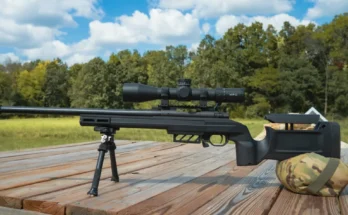
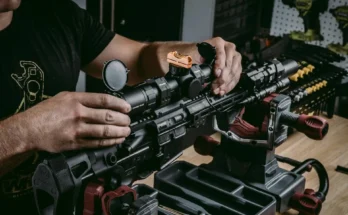
What is a rifle scope reticle? It's the aiming pattern built into your scope's optics. Think of it as the crosshairs, dots, or grid lines you look through when you shoulder a rifle.
The reticle gives you a reference point to line up with your target and adjust for distance and wind.
Most modern rifle scopes use either a first focal plane or second focal plane reticle, each behaving differently at magnification as of 2026. Scope manufacturers now offer dozens of reticle styles, from simple duplex crosshairs to complex tactical grids marked in mils and MOA. Understanding what a reticle is and how it works forms the foundation for every other scope decision you'll make.
Quick Answer
A rifle scope reticle is the aiming pattern inside a rifle scope's optics. It provides a reference point for aiming at targets. Reticles come in many styles, from simple crosshairs to complex tactical grids.
Your reticle choice affects aiming, range estimation, and bullet drop compensation. Understanding the differences helps you choose the right scope for your shooting style.
What Is a Rifle Scope Reticle? (The Short Answer You Actually Need)
A rifle scope reticle is the aiming pattern you look through when you peer into your scope. It sits inside the optic, typically etched onto a small glass element or formed by thin wire. You see it overlaid on your target image every time you shoulder the rifle.
The reticle is the most interactive part of any rifle scope. Every time you fire, you're using it to aim, hold for distance, and account for wind drift. It's not decoration.
It's the tool that turns your scope from a magnifying glass into a precision instrument.
Here's what you'd see when you're set up behind a rifle:
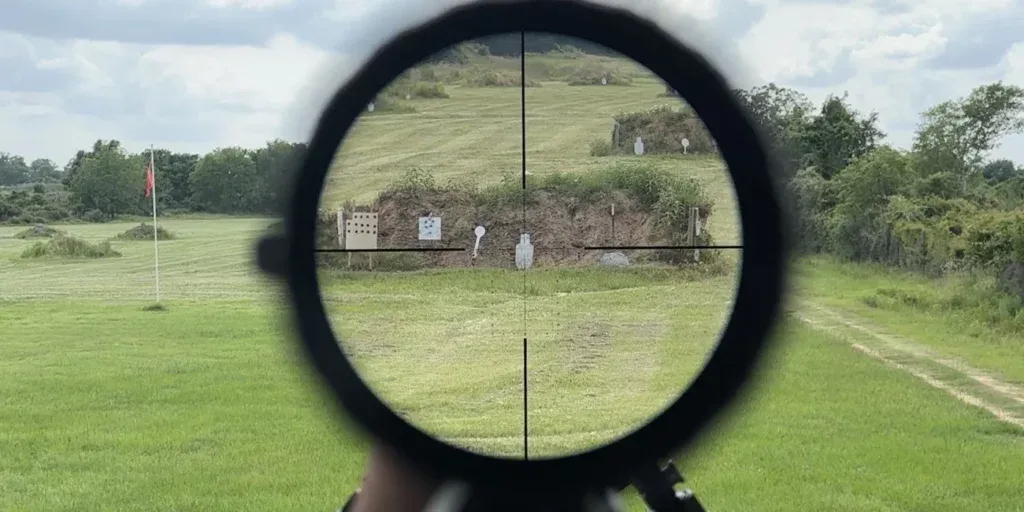
Image source: Web (Bing) / blog.primaryarms.com (Web image (fair-use with source credit))
Most modern scopes mount the reticle near the scope's focal plane, where the target image comes into sharp focus. In first focal plane (FFP) scopes, the reticle sits at the front focal plane, which means it scales with magnification. In second focal plane (SFP) scopes, the reticle sits at the rear focal plane, and it stays the same size no matter what magnification you use.
Manufacturers design different reticle patterns for different shooting purposes. Vortex Optics, Leupold, Nightforce, and Primary Arms each publish detailed reticle guides on their official websites. Vortex Optics documents the subtension spacing and holdover values for their entire product line, which gives you real data before you buy.
Subtensions, by the way, are the measured markings on your reticle. They tell you exactly how much the reticle covers at a given distance, usually in mils or minutes of angle (MOA). You'll use these numbers for range estimation and holdover, so it pays to know what they mean.
The reticle determines how fast you acquire targets, how precisely you can hold over for distance, and how much mental math you need in the field. Choosing the wrong reticle for your shooting style costs you time and accuracy. Choosing the right one makes shooting feel intuitive.
For hunters, target shooters, and tactical professionals, the reticle is where optics meet real-world shooting. A duplex reticle might suit a whitetail hunter at 200 yards. A Christmas tree reticle might work better for a PRS competitor dialing out to 800 yards.
The right pattern depends on your situation.
How a Reticle Works Inside Your Scope (And Why the Magnification Setting Changes Everything)
When you look through a scope, you're seeing two images at once. The first is the target, magnified by the scope's lens system. The second is the reticle, projected on the same visual field.
Both must come together perfectly for the scope to work.
Most modern rifle scopes use glass-etched reticles. The pattern is laser-etched onto a small piece of glass placed inside the scope's optical path. Wire reticles, where thin metal strands form the crosshair pattern, are older but still found in some hunting scopes.
Wire reticles tend to be more fragile and less precise than etched versions.
Light enters through the objective lens at the front. It passes through prisms and an erector tube that flip and magnify the image. Finally, the light reaches your eye through the eyepiece.
The reticle glass sits within this path, so the aiming pattern appears sharp and centered regardless of magnification.
The reticle placement inside the scope matters enormously. In first focal plane (FFP) scopes, the reticle sits at the front focal plane, the same location where the target image forms. This means the reticle magnifies and shrinks along with the target image as you adjust magnification.
On an SFP scope, the reticle sits at the rear focal plane, near the eyepiece. It remains the same size regardless of magnification. This single difference changes everything about how you use the scope.
If you're on an SFP scope at low magnification, your reticle subtensions are too small to be useful. You're effectively guessing your holdovers. On an FFP scope, the reticle scales consistently, so the holdover markings work at any magnification.
Illuminated reticles add another layer of functionality. Many modern scopes include battery-powered illumination, usually powered by a CR2032 or CR123A battery. Brightness is adjustable, and some scopes offer red, green, or multi-color illumination.
Illuminated reticles help in low-light conditions like dawn hunts or dusk target sessions.
Parallax and diopter settings also affect what you see through the reticle. Parallax adjustment ensures the reticle and target image stay aligned when your eye moves off-center. The diopter adjustment, located on the eyepiece, tunes the reticle image to your specific eye.
Both adjustments need to be dialed in for the clearest reticle picture.
First Focal Plane vs. Second Focal Plane Reticles (This Is the Big One)
First focal plane (FFP) and second focal plane (SFP) describe where the reticle sits inside the scope. This single design choice changes how the reticle behaves at every magnification setting. It's the most important distinction you'll make when choosing a scope.
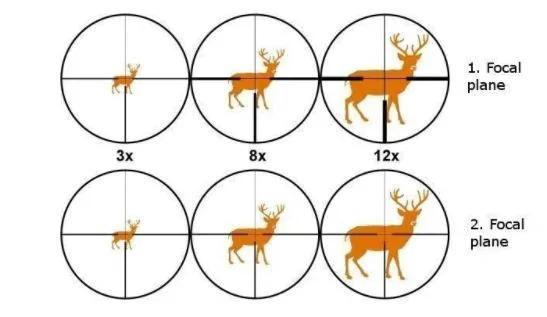
Image source: Web (Bing) / billingsoptics.com (Web image (fair-use with source credit))
Here's what the visual difference looks like. On an FFP scope, the reticle grows and shrinks with magnification. At 5x, the reticle appears fine and subtle.
At 25x, it looks larger and more prominent. Because the reticle scales with the target image, the subtensions stay accurate at every magnification setting.
On an SFP scope, the reticle stays the same size no matter what magnification you're using. At 5x and at 25x, the reticle pattern looks identical. The problem is that the target image changes size, so the reticle markings no longer represent the same real-world distance values.
SFP subtensions are only accurate at one magnification, usually the maximum setting.
| Feature | First Focal Plane (FFP) | Second Focal Plane (SFP) |
|---|---|---|
| Reticle size at magnification | Grows and shrinks with target image | Stays constant |
| Subtension accuracy | Accurate at all magnifications | Accurate at max magnification only |
| Holdover usability | Works at any power setting | Must be at rated magnification |
| Best for | Long-range, tactical, PRS | Hunting, general use, budget builds |
| Typical price range | $400 to $3,000+ | $150 to $800+ |
| Low-magnification behavior | Reticle can become very fine | Reticle always readable |
As of 2026, FFP reticles have become the standard in tactical and precision shooting. Military and law enforcement programs that follow U.S. Army marksmanship standards, specifically TC 3-22.9, favor FFP optics for consistent holdover calculations across magnification ranges.
That doesn't mean SFP is bad. If you're a whitetail hunter who shoots at 100 to 300 yards and keeps your scope at maximum power for the final shot, an SFP scope with a clean duplex reticle might be simpler and just as effective. The key is knowing which magnification you'll actually use.
Some popular FFP reticles include Vortex's EBR-2C, Nightforce's Mil-XT, and Primary Arms' ACSS pattern. Common SFP options include Leupold's Duplex, Vortex's Dead-Hold BDC, and Bushnell's Drop Zone. Each manufacturer publishes subtension diagrams on their site, so you can verify the markings before you buy.
Reticle Types You'll See in the Wild (Duplex to Christmas Tree)
Not all reticles are created equal. The pattern you choose shapes how you aim, how quickly you can range targets, and how much math you need to do in the field. Here are the main reticle types you'll encounter.
Duplex reticle. This is the most common pattern on hunting scopes. It features thin crosshairs in the center that thicken toward the edges of the field of view. The thick outer lines draw your eye to the center quickly.
Duplex reticles are simple, clean, and effective for shots under 400 yards.
Mil-dot reticle. A mil-dot reticle uses evenly spaced dots along the vertical and horizontal crosshair lines. Each dot represents a specific angular measurement in milliradians (mils). Shooters use these dots to estimate range and hold over for bullet drop.
One mil covers 3.6 inches at 100 yards. Here's what a mil-dot pattern looks like:
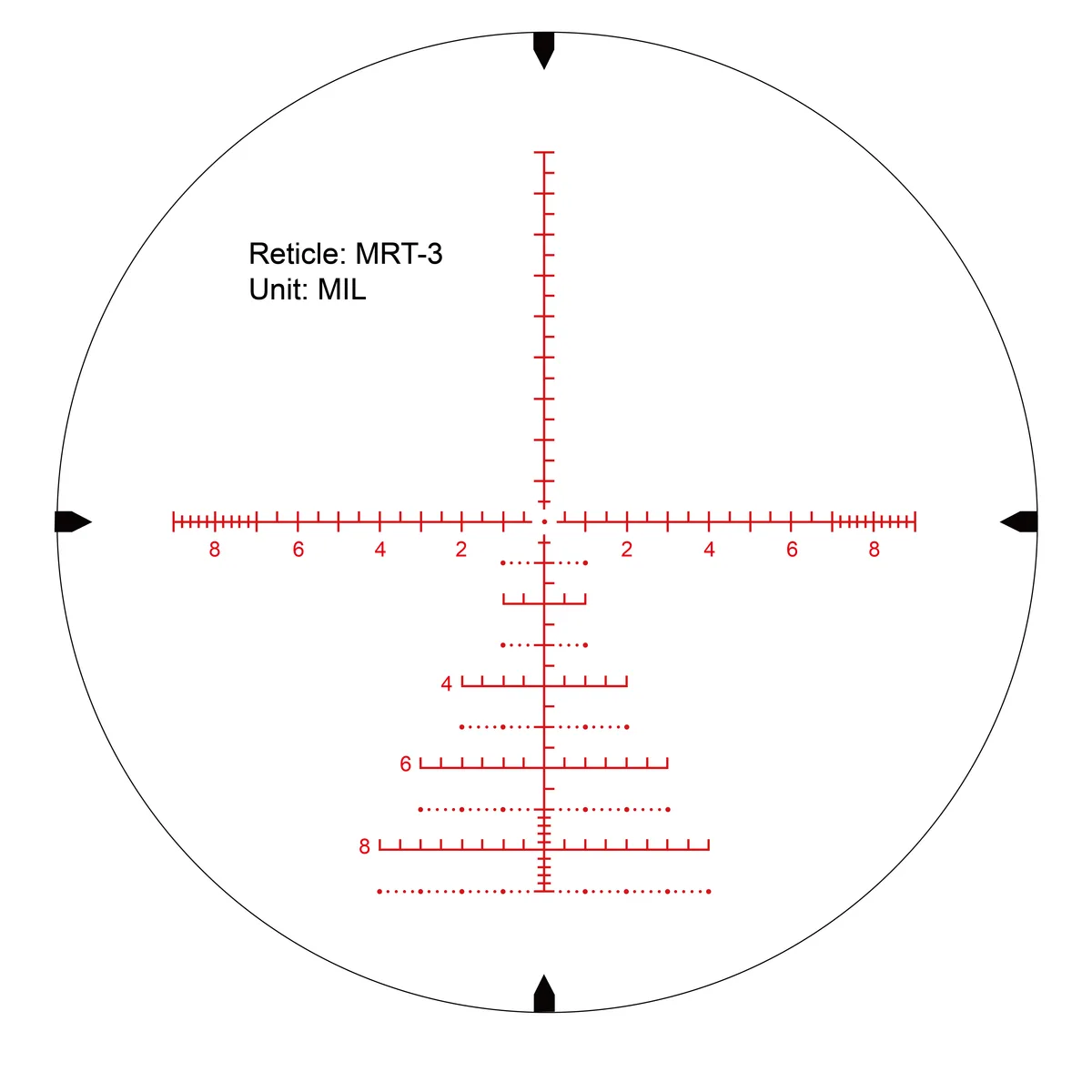
Image source: Web (Bing) / ar.inspiredpencil.com (Web image (fair-use with source credit))
MOA dot reticle. Similar in concept to mil-dot, but the spacing is measured in minutes of angle (MOA) instead of mils. One MOA covers just over an inch at 100 yards. MOA-based reticles work well for shooters who already think in MOA and use MOA-based turrets.
BDC reticle. Bullet drop compensator reticles feature pre-calibrated holdover marks at specific distances. A BDC reticle calibrated for a .308 Winchester load might have markings at 100, 200, 300, 400, and 500 yards. You place the correct mark on your target and fire.
No dialing required.
Christmas tree reticle. This pattern adds windage and elevation dots below and to the sides of the center crosshair, creating a grid that looks like a Christmas tree. Tactical and long-range shooters use it to hold for both drop and wind at the same time without touching their turrets.
Circle-dot reticle. A bold outer circle with a center dot, commonly found on red dot sights and some low-power variable optics. It's designed for fast target acquisition in close to mid-range situations.
| Reticle Type | Best For | Holdover Method | Complexity |
|---|---|---|---|
| Duplex | Hunting, general use | Dial turrets | Low |
| Mil-dot | Range estimation, mid-range | Holdover | Medium |
| MOA dot | Shooters thinking in MOA | Holdover | Medium |
| BDC | Fixed-load hunting, tactical | Holdover (calibrated) | Low |
| Christmas tree | Long-range, PRS, tactical | Holdover + turret | High |
| Circle-dot | CQB, fast acquisition | Minimal holdover | Low |
The pattern you pick depends on what you're doing with the rifle. If you're chasing whitetail deer, a duplex or BDC reticle keeps things simple. If you're running PRS matches, you'll want a Christmas tree or advanced mil reticle.
Match the reticle to the job.
How to Read a Scope Reticle (Holdover, Ranging, and Subtension Basics)
Reading a scope reticle is straightforward once you understand the basic parts. Every reticle, from the simplest crosshair to the most complex tactical grid, uses the same fundamental components.
The center crosshair. This is your zero point. When you zero your scope at 100 yards, the center crosshair aligns with the bullet's point of impact at that distance. Every other mark on the reticle works relative to this center.
Elevation holdover lines. These are horizontal marks below the center crosshair. Each mark represents a specific distance beyond your zero. On a BDC reticle calibrated for a hunting load, the first mark might be 200 yards, the second 300, and so on.
To use them, place the appropriate mark on your target.
Windage marks. These are vertical marks to the left and right of center. They let you hold into or away from a crosswind without dialing your windage turret. The spacing between windage marks varies by reticle type and manufacturer.
Subtensions. Subtensions are the measured values that tell you exactly how much space each mark covers on your target. In a mil-dot reticle, the dots are typically spaced at 1 mil intervals. In an MOA reticle, one MOA covers just over an inch at 100 yards.
Primary Arms publishes subtension diagrams for all their reticle patterns, which makes verification straightforward.
Mil-dot ranging. If you know the size of your target, you can use the mil-dot reticle to estimate distance. The math is simple. A 20-inch tall target that measures 1 mil in your reticle is roughly 550 yards away.
Either do the calculation yourself or use a ranging chart. Mil-dot reticles make distance estimation possible without a rangefinder.
Holdover vs dialing. Holdover means using the reticle markings to aim higher for distance. Dialing means adjusting your scope's turret to the correct elevation for that distance. Holdover is faster but requires you to know your reticle's subtension values.
Dialing is more precise but takes time. Most competitive shooters use a combination of both. Per U.S.
Army marksmanship guidance in TC 3-22.9, holding is the preferred method for rapid engagement, while dialing remains the standard for deliberate, long-range precision shots.