Choosing the right rifle scope reticle comes down to matching the aiming system to your shooting discipline, distance, and turret clicks. Most shooters focus on magnification, tube size, or price, and ignore the reticle entirely. That's a costly mistake.
The reticle is the actual aiming system. It determines how you acquire targets, range distances, and hold for wind.
First focal plane (FFP) reticles maintain true subtension values at every magnification. Second focal plane (SFP) reticles only hold those values at the scope's maximum power. Manufacturer specs from Vortex, Leupold, and Nightforce all publish subtension data that tells you exactly what those holdover marks mean.
Let's break down the major types, how they scale, and which one fits your shooting.
Quick Answer
What are the different types of rifle scope reticles? The main types are crosshair and duplex reticles, mil-dot and mil-hash reticles, MOA reticles, BDC (Bullet Drop Compensating) reticles, tree or Christmas tree reticles, and illuminated center-dot reticles. Each type works differently for ranging, holdover, and target acquisition.
Reticles also come in first focal plane (FFP) or second focal plane (SFP) configurations. This affects how holdover marks behave across magnification levels.
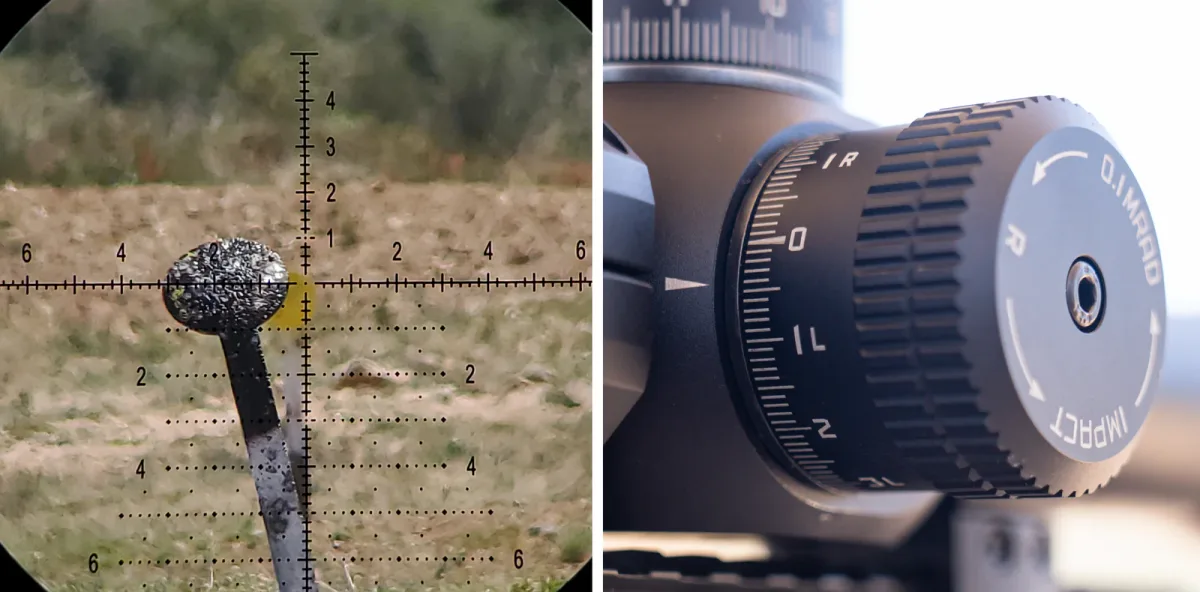
Image source: Web (Bing) / billingsoptics.com (Web image (fair-use with source credit))
Why Your Reticle Choice Matters More Than Most Shooters Realize
Most people pick a scope for magnification, tube size, or price. The reticle gets barely a second thought. That shows up fast in the field, whether you're ranging a coyote at 400 yards or calling wind on a PRS stage.
The reticle determines your ability to range, hold over, and acquire targets under pressure. Per manufacturer specifications, an SFP reticle's holdover marks are only accurate at the scope's maximum magnification. If you're holding for a 300-yard shot at 6x on a 4-16x scope, those marks are wrong.
Here's why this matters in practice:
- You can't range a target without a rangefinder if your reticle lacks usable subtension markings
- Wrong holdover marks at the wrong magnification lead to missed shots on clean opportunities
- Picking a reticle built for PRS competition when you only hunt whitetail adds unnecessary clutter to your sight picture
- Confusing MIL and MOA holdover systems on the same rifle creates costly errors under stress
The reticle type you pick shapes everything, from how you range targets to how you hold for wind. Get it wrong, and you'll see it on your group at 300 yards. Get it right, and your shooting gets more consistent and faster.
The Major Rifle Scope Reticle Types (And What Each One Does Best)
There are six main reticle types you'll encounter across hunting, tactical, and competitive scopes. Each one solves a specific problem.
Crosshair and Duplex Reticles
Crosshair reticles are the simplest aiming system available. Thin intersecting lines meet at a center point. Duplex reticles add a subtle taper: thick on the outside, thin at the center.
This combination is fast to acquire and intuitive for most shooters.
Duplex reticles are the standard for deer and elk hunting because they're clean, fast, and effective at close to mid ranges. They don't offer holdover marks or ranging capability, though. If you're shooting beyond 200 yards, you're doing the math yourself.
Mil-Dot and Mil-Hash Reticles
Mil-dot reticles place evenly spaced dots or hash marks along the vertical and horizontal stadia lines. The spacing is calibrated in milliradians (MILs). One mil equals 3.6 inches at 100 yards.
This lets you estimate range using the mil relation formula.
Per manufacturer documentation from Vortex and Leupold, subtension values vary between products. Two scopes both labeled "mil-dot" can have different dot spacing. Always check your specific scope's manual before relying on holdover marks.
Mil-hash reticles use hash lines instead of round dots. They're easier to read at distance and provide more precise holdover references.
MOA Reticles
MOA reticles use Minutes of Angle spacing instead of mils. One MOA equals 1.047 inches at 100 yards. American shooters often prefer this system because it aligns with how many already think about shooting distances.
MOA reticles offer finer holdover resolution than MIL reticles. A 0.25 MOA spacing gives you very precise holdover references. If your turret clicks are also in MOA, everything stays consistent.
BDC (Bullet Drop Compensating) Reticles
BDC reticles feature a holdover ladder with numbered marks for specific distances. You match the mark to your bullet's drop at that range. This system is popular on AR-15 platforms in .223/5.56 and on bolt guns chambered in .308 or 6.5 Creedmoor.
The catch: BDC reticles are calibrated for specific bullet weights and barrel lengths. Switching ammunition or using a different barrel length than the scope was designed for throws off the entire system.
Tree and Christmas Tree Reticles
Tree reticles add a grid pattern below the center crosshair. You get elevation holdover marks and windage holdoff marks in a single grid. This lets PRS and NRL competitors range, hold for wind, and hold for elevation without touching the turrets.
Tree reticles are powerful but cluttered. In close-range hunting scenarios, that extra detail can slow you down rather than speed you up.
Illuminated Center-Dot and Circle-Dot Reticles
Illuminated reticles add a glowing dot or circle at the center point. Red, green, and blue illumination options help your eye find the aiming point fast in low light. Dawn and dusk hunting is where this feature shines.
The downside: illumination washes out in bright daylight. Batteries die in cold weather. If your shooting happens mostly in broad daylight, you may not need illumination at all.
| Reticle Type | Best For | Range Capability | Holdover Marks | Illumination Available |
|---|---|---|---|---|
| Crosshair / Duplex | Deer, elk, close to mid-range | 0 to 200 yards | No | Rare |
| Mil-Dot / Mil-Hash | Ranging, tactical, long-range | 100 to 800+ yards | Yes (MIL) | Yes |
| MOA | Precision, rimfire, American hunting | 100 to 600+ yards | Yes (MOA) | Yes |
| BDC | AR-15, .308, 6.5 Creedmoor | 200 to 600 yards | Yes (calibrated) | Yes |
| Tree / Christmas Tree | PRS, NRL, competitive long-range | 200 to 1,200+ yards | Yes (elevation + windage) | Yes |
| Illuminated Center-Dot | Low-light hunting, varmint | Varies by base reticle | Varies | Yes (red/green/blue) |
First Focal Plane vs. Second Focal Plane: How Reticle Scaling Actually Works
This is the one distinction that trips up more shooters than any other. Where the reticle sits in the scope's optical path determines how holdover marks behave across magnification levels.
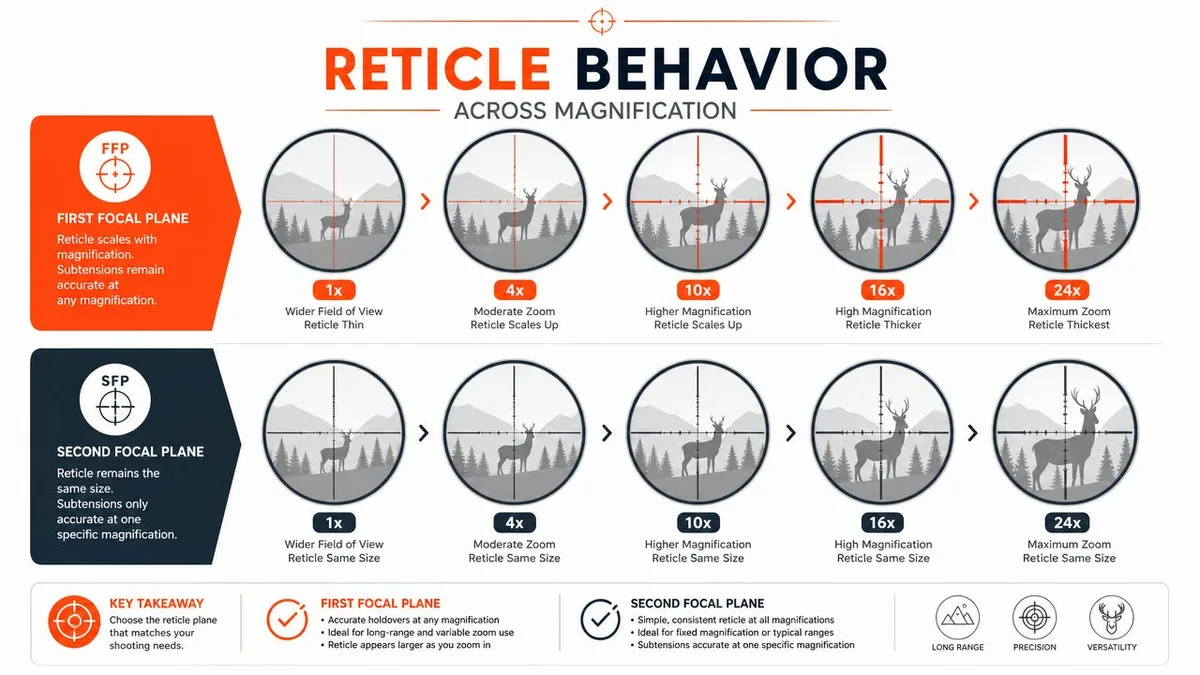
Image source: Bing (Web (fair-use with source credit))
First Focal Plane (FFP)
FFP reticles are placed in front of the magnification lens group. This means the reticle scales with the image. Your subtension values, or how many inches one hashmark represents at a given distance, stay true at every magnification setting.
If your reticle says one hashmark equals 0.5 mil, it equals 0.5 mil at 4x and at 25x. Manufacturer documentation from Nightforce and Primary Arms confirms this behavior across their FFP product lines.
The tradeoff: at low magnification, an FFP reticle can look thick and cluttered. At high magnification, the same reticle can look too fine to see clearly on a bright target.
Second Focal Plane (SFP)
SFP reticles sit behind the magnification group. The reticle stays the same size regardless of magnification. This means subtension values only hold true at one specific magnification level, usually the scope's maximum power.
On a 4-16x SFP scope, holdover marks are calibrated for 16x. Use them at 8x, and the spacing is off by half. This catches hunters off guard all the time.
Which One Fits Your Shooting?
| Use Case | FFP | SFP |
|---|---|---|
| Long-range precision (PRS/NRL) | Best choice | Not recommended |
| Deer / elk hunting (under 300 yards) | Versatile but complex | Simpler, often cheaper |
| AR-15 BDC holdovers | Works at any power | Fine if zeroed at calibrated power |
| Varmint / predator hunting | Ranging on the fly | Simple duplex works fine |
If you hunt inside 200 yards, an SFP with a simple crosshair is all you need. If you're ranging targets and calling wind at varying distances, FFP is the only way to go.
MIL vs. MOA Reticles: Which System Matches Your Shooting Style?
Once you've picked a reticle style, you'll face the MIL versus MOA decision. This comes down to how your brain processes distance and how your scope's turrets are calibrated.
How Each System Works
MIL reticles use milliradians. One mil equals 3.6 inches at 100 yards. MIL-based scopes typically have 0.1 mil turret clicks.
The spacing between hashmarks is usually 0.5 or 0.2 mil.
MOA reticles use minutes of angle. One MOA equals 1.047 inches at 100 yards. MOA-based scopes usually have 0.25 or 0.5 MOA turret clicks.
Spacing is often 0.25 or 0.5 MOA.
When MIL Makes More Sense
- Long-range tactical shooting where windage calls happen fast
- If your turret clicks are already in MIL
- Competitive PRS and NRL shooters who think in mils
- Range estimation using the mil relation formula
When MOA Makes More Sense
- Hunters who think in inches
- Rimfire and precision rifle shooters who want fine holdover marks
- If your turret clicks are already in MOA
- Beginners who find MOA math more intuitive
The Golden Rule
Match your reticle system to your turret system. A MIL reticle paired with MOA turrets creates confusion that costs you time and accuracy under stress. Mixed systems are a recipe for fumbled math at the worst possible moment.
Common Reticle Mistakes That Cost Accuracy in the Field
These errors show up in aggregate user reviews and manufacturer support tickets more than you'd think. Avoiding them saves you time, ammo, and confidence.
- Picking an FFP tree-dot reticle when you only hunt whitetail at 150 yards. You don't need that complexity for close to mid-range shots.
- Using SFP holdover marks at the wrong magnification. Per Leupold's owner's manual, SFP holdovers are calibrated to one power setting. Check which one before you shoot.
- Zeroing a BDC reticle for a different bullet weight or barrel length than it was designed for. This throws off every holdover mark downstream.
- Trusting mil-dot spacing values without checking your specific scope's manual. Two "mil-dot" scopes can have different subtension values.
- Buying an illuminated reticle but never turning on the illumination. If your hunting mostly happens in daylight, you paid for a feature you won't use.
- Ignoring how reticle thickness interacts with target size at distance. An FFP reticle that's perfect at 15x can obscure a small varmint at 5x.
- Assuming more hash marks means better. Clutter slows you down. A clean reticle you understand beats a complex one you second-guess.
- Forgetting to re-verify holdover marks after swapping ammunition. Different bullets drop differently. Your DOPE changes.
- Mixing MIL and MOA systems on the same rifle. Always align your reticle language with your turret clicks.
- Trusting old DOPE without re-confirming zero. Always shoot a confirmation group before hunting season.
Best Reticle for Each Shooting Use Case (Quick Decision Guide)
Picking the right reticle gets simpler when you match it to your primary shooting discipline and distance. Here's what the data shows across common scenarios as of 2026.
By Shooting Discipline
- PRS and NRL competitors: An FFP tree-dot or Christmas tree reticle is the standard. Brands like Nightforce publish detailed subtension diagrams for their MIL-XT reticle, which competitors rely on for ranging and wind calls in stages past 800 yards.
- Deer and elk hunting (under 300 yards): A simple duplex or BDC reticle works. You don't need a Christmas tree grid for shots inside 250 yards.
- AR-15 platforms (5.56 and .308): A BDC reticle like the Vortex Dead-Hold BDC or the Sig Sauer BDX gives you fast holdover without a ballistic app in the field.
- Varmint and predator hunting (300 to 600 yards): A MIL or MOA reticle with fine hash marks gives you the ranging precision these shots demand.
- Tactical and law enforcement: An FFP illuminated MIL reticle is the common standard. Nightforce and Leupold both build options around this configuration.
- Rimfire precision: A fine MOA reticle with 0.25 MOA spacing handles rimfire drops at precision rifle distances.
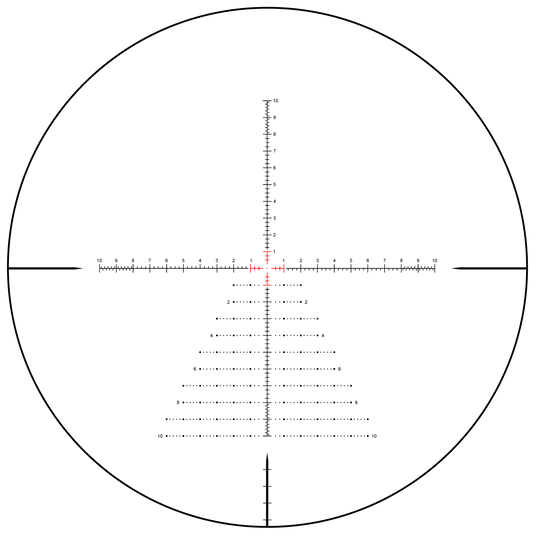
Image source: Bing (Web (fair-use with source credit))
By Budget Tier
| Price Range | Typical Reticle | FFP or SFP |
|---|---|---|
| $200 to $500 | Duplex, non-illuminated mil-dot | SFP |
| $500 to $1,000 | Illuminated mil-dot, BDC | SFP or FFP |
| $1,000 to $2,000 | FFP tree-dot, glass-etched, full illumination | FFP |
| $2,000+ | Premium FFP MIL/MOA with high-end illumination | FFP |
If your shooting happens at known distances on a familiar rifle, a simpler reticle with clear holdover marks beats a complex one you never fully learn to use.
Frequently Asked Questions
What is the most versatile rifle scope reticle type?
A mil-hash or MOA reticle on a first focal plane scope is the most versatile option. FFP means your holdover marks stay accurate at every magnification. MIL or MOA spacing gives you ranging and wind holdover in one system.
Most long-range shooters as of 2026 lean toward this combination.
Do I need an illuminated reticle for hunting?
Not always. Illuminated reticles help in low-light conditions like dawn and dusk. But aggregate reviews show that most daylight hunting doesn't require it.
If you hunt in open terrain during legal shooting hours, a non-illuminated reticle with clear black lines often works just fine.
Can I use a BDC reticle with different ammunition than it was designed for?
Not without recalibrating. BDC reticles are built for specific bullet weights and barrel lengths. Switching to a heavier bullet or different barrel changes your drop at every distance.
Always reconfirm holdover marks with live fire before relying on them in the field.
Are MIL reticles better than MOA reticles?
Neither is universally better. MIL reticles favor long-range tactical shooting where fast windage calls matter. MOA reticles favor hunters who think in inches and want finer holdover resolution.
The right choice depends on your turret clicks and how you process distance. Match the reticle to your turret system and stick with it.
What is the difference between a mil-dot and a mil-hash reticle?
Mil-dot reticles use round dots along the stadia lines. Mil-hash reticles use hash lines instead. The spacing values are the same in both, but hash lines are easier to read precisely at distance.
Mil-hash designs dominate modern precision scopes as of 2026 because they give cleaner holdover references.
How do I know what subtension values my scope's reticle uses?
Check your scope's owner's manual or the manufacturer's website. Vortex, Leupold, and Nightforce all publish reticle diagrams with exact subtension values per hashmark. Don't guess based on the reticle name.
Two scopes labeled "mil-dot" can have different spacing between dots.
Is a first focal plane reticle worth the extra cost?
If you range targets, call wind, or shoot at varying distances, yes. FFP reticles keep holdover marks true at every magnification, which you can't get with SFP. If you only hunt at close to mid ranges on a known rifle, an SFP with a simple duplex reticle is perfectly adequate.




