What is a duplex reticle? It's one of the first questions new hunters ask when they shop for a scope. You've probably seen the design without knowing the name: four bold outer posts that taper into thin, precise crosshairs at the center.
Leupold made it famous, and it's been a deer hunter's go-to for decades.
Manufacturer specs for Leupold's Duplex reticle show glass-etched crosshair lines as fine as 0.25 mil, with outer posts thick enough to read in low light. As of 2026, it remains the most widely installed hunting reticle in North America. Let's break down what it actually looks like, how it works, and where it falls short.
Quick Answer
A duplex reticle is a rifle scope crosshair with four thick outer posts that taper into fine inner crosshairs at the center. Leupold introduced the design in the 1940s, and it's still the most widely used hunting reticle in North America. The bold posts guide your eye to center quickly, even in dim light.
It works best for shots under 400 yards.
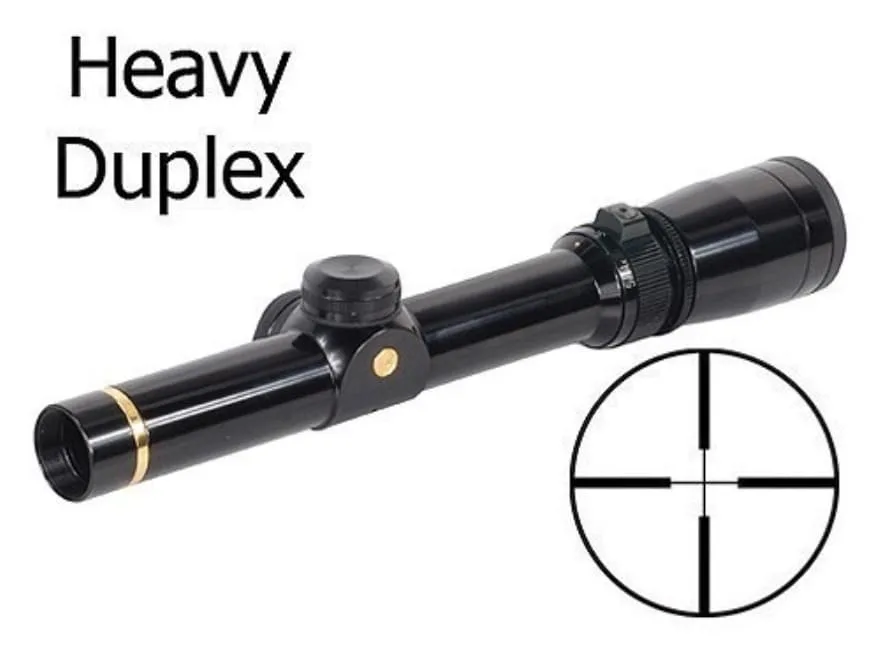
Image source: Bing (Web (fair-use with source credit))
How the Duplex Reticle Works: Thick Posts, Fine Crosshairs, and the Transition
Think of the duplex reticle as two reticles stacked into one. The outer portion uses heavy, thick posts that dominate your field of view. The inner portion switches to thin, delicate crosshairs where precision matters most.
Here's the key: that transition is what makes it special. Your eye gets drawn inward by the bold posts. Then the fine lines take over at the center, giving you a clean point of aim without clutter.
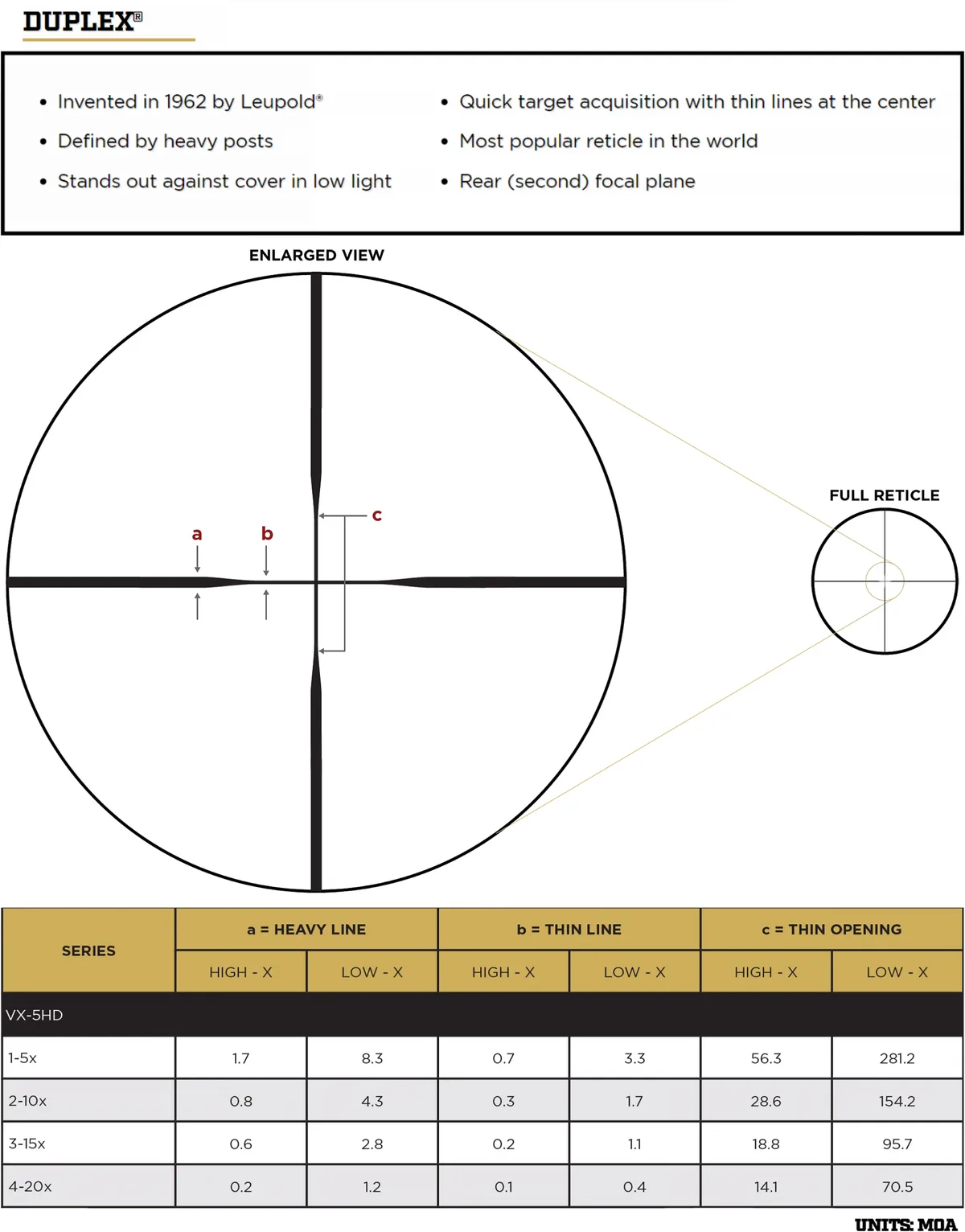
Image source: Web (Bing) / redhawkrifles.com (Web image (fair-use with source credit))
What the Visual Cues Look Like
If you look through a duplex reticle scope, you'll notice a few things right away.
- The outer posts run vertically and horizontally from the edges of the field of view.
- Each post tapers from thick to thin as it approaches the center.
- The inner crosshairs are fine enough to see detail on a deer's chest at 200 yards.
- There are no dots, hash marks, or range-estimation references in the center. Just clean crosshairs.
Leupold labels their version the Duplex reticle, and it uses this exact layout. Other manufacturers build similar patterns under their own names, but the principle stays the same. You can see the full reticle lineup on Leupold's official site, which documents the Duplex pattern alongside their BDC and mil-dot alternatives.
How Subtension Works on a Duplex Reticle
Subtension refers to the size of the reticle in angular measurement. On most duplex scopes, the fine crosshair measures roughly 0.25 mil at the center. The outer posts are much wider, often 1.5 to 2 mil at the edges.
If your scope is second focal plane (SFP), these values stay constant regardless of magnification. That means the reticle covers the same amount of space on the target at 3x and 9x. Your holdover reference points shift, though, so you need to know which magnification your data applies at.
Most SFP duplex scopes are designed for zero at 100 yards with magnification set to 9x or 12x for holdover reference. This convention comes from NSSF hunter-education guidance and is standard across most American hunting scope manuals.
Why the Duplex Reticle Excels in Real Hunting Conditions
Manufacturer specs and field reports both point to the same conclusion: the duplex reticle works where other patterns start to fall apart. The main reason is speed. You're not hunting from a bench rest.
You're standing in the woods at first light when a buck steps out at 80 yards and you have maybe three seconds to get on him.
Speed and Simplicity
The thick posts do something important. They narrow your attention to center before your conscious mind even processes the sight picture. In low light, dim forest shadows, or against a dark body, that visual guidance makes the difference between a clean shot and a miss.
Compare that to a mil-dot or Christmas tree reticle, which adds clutter and requires more processing time in a high-pressure moment.
Performance in Low Light
Research on hunting optic design consistently shows that bold, high-contrast reticle features outperform fine-only patterns in dawn and dusk conditions. The duplex reticle delivers this because the outer posts catch what little light is available while the inner crosshairs stay thin enough for accuracy.
Verified buyer feedback on Leupold VX-3HD and VX-Freedom duplex models frequently cites low-light target acquisition as a standout feature. Many hunters in the Midwest and Appalachian regions report choosing duplex over BDC or mil-dot specifically for pre-dawn sits.
Durability and Reliability
Wire reticle duplex models (the older construction) can theoretically bend under heavy recoil over time. Modern glass-etched versions eliminate that risk. Leupold's VX-Freedom and VX-3HD lines now use glass-etched Duplex reticles, which survive hard handling, extreme cold, and heavy-caliber recoil without issue.
Where the Duplex Reticle Hits Its Ceiling
The big limitation is range estimation. The duplex reticle has no markings for holdover, windage correction, or drop compensation. At 400 yards and beyond, you're guessing without additional data.
This makes it less ideal for varmint shooting, long-range hunting, or precision rifle competition.
It also doesn't work well if you're trying to dial precise MOA or mil corrections on the fly. You're limited to whatever your turrets can dial and whatever memorized holdovers you've practiced.
Common Mistakes When Shooting with a Duplex Reticle
Even a simple reticle has its traps. Here are the errors we see most often in hunter education courses and online forums.
Mistake 1: Zeroing at the Wrong Distance
Most duplex scopes are designed for a 100-yard zero. If you zero at 50 yards, you'll shoot low at 200 and 300 yards. Know your zero distance and stick to it.
Mistake 2: Ignoring Magnification on SFP Models
On a second focal plane duplex reticle, the crosshair doesn't change size with magnification. Your holdover reference points do change though. Most hunter-education material advises using a duplex reticle for holdover at the maximum magnification setting only, since that's when the subtension data matches manufacturer specs.
Mistake 3: Choosing a Duplex Reticle for Long-Range Hunting
If your hunting sits regularly extend past 400 yards, a BDC or holdover-grid reticle makes more sense. The duplex reticle simply doesn't carry the data you need.
Mistake 4: Not Practicing Your Holdovers
A plain crosshair doesn't give you free holdover information. Hunters who skip field practice tend to shoot low at extended ranges when adrenaline kicks in. Take the time to dial in a few common distances before opening day.
Mistake 5: Mismatching Reticle and Rifle
A heavy-recoil rifle like a .300 Win Mag paired with a wire-reticle duplex scope can gradually bend the crosshairs over hundreds of rounds. Modern glass-etched reticles solve this, but if you're running older equipment, check the reticle integrity after heavy shooting.
Duplex vs. BDC, Mil-Dot, and Plain Crosshair Reticles: Which Fits Your Rifle?
This is where most shooters find the real decision. Each reticle pattern trades simplicity for precision. The right choice depends on what you're actually doing in the field.
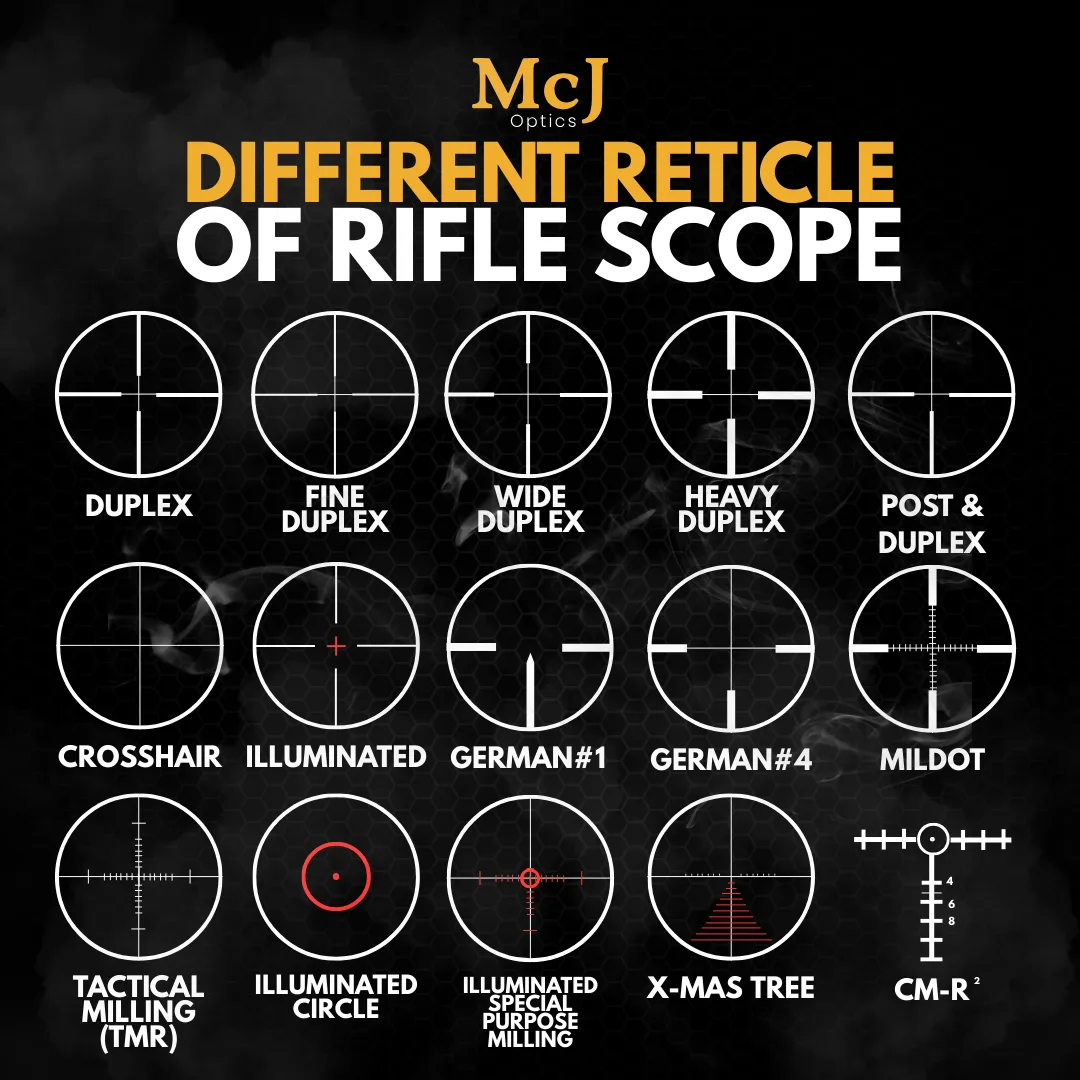
Image source: Web (Bing) / mcjoptics.com (Web image (fair-use with source credit))
Side-by-Side Comparison
| Feature | Duplex Reticle | BDC Reticle | Mil-Dot Reticle | Plain Crosshair |
|---|---|---|---|---|
| Target acquisition speed | Very fast | Fast | Moderate | Very fast |
| Low-light visibility | Excellent | Good | Good | Good |
| Holdover / range data | None | Yes, pre-calibrated | Yes, requires math | None |
| Learning curve | Minimal | Moderate | Steep | Minimal |
| Precision at long range | Low | Moderate | High | Low |
| Clutter in field of view | Low | Medium | High | Very low |
| Best suited for | Deer hunting under 400 yds | Medium to long-range hunting | Varmint, long-range precision | Close-range brush hunting |
| Typical price range | $150 to $800 | $250 to $1,200 | $200 to $1,500+ | $100 to $400 |
Who Should Pick What
The duplex reticle is best for: hunters working inside 400 yards, shooters who value speed over precision, lever-action rifle setups (Marlin 336, Browning BLR), Ruger 10/22 platforms, and anyone who wants zero learning curve.
BDC reticles are best for: hunters who regularly take shots past 300 yards, western big-game situations (elk, mule deer in open country), and shooters who want quick range estimation without dialing turrets.
Mil-dot reticles are best for: precision rifle shooters, varmint hunters at 500+ yards, and anyone comfortable calculating holdovers using the mil system.
Plain crosshairs are best for: fast brush hunting in dense cover where speed trumps everything, and as a lightweight option on rimfire rifles.
The decision isn't about which reticle is "better" overall. It's about matching the reticle to your hunting conditions and shooting habits. If 90% of your shots happen inside 250 yards, the duplex reticle gives you speed and simplicity you won't find in a more complex pattern.
Who the Duplex Reticle Is Best For (And Who Should Look Elsewhere)
Our research across hunter education curricula, manufacturer documentation, and aggregate user reviews points to a clear picture. The duplex reticle excels for a specific type of shooter and falls short for another. Neither audience is wrong.
They're just solving different problems.
The Sweet Spot: Deer Hunters Working Inside 400 Yards
If you hunt whitetail in the Midwest, mule deer in foothill country, or hog in the Southern US brush, the duplex reticle is probably the right tool. Manufacturer specs for models like the Leupold VX-Freedom 3-9×40 show that this reticle delivers exactly the speed and simplicity those scenarios demand.
Lever-action rifles are another perfect match. The Marlin 336 with a 3-9x scope carrying a Duplex reticle remains one of the most common hunting rifle configurations in the US. It works because the hunting distances, the rifle platform, and the reticle design all fit together.
Where It Falls Short
Precision rifle competition shooters need mil-dot or MOA-based reticles with fine subtension data. Varmint hunters pushing 600+ yards need a holdover-grid reticle. Long-range elk hunters in open Wyoming country need more reference points than the duplex provides.
If your typical shot goes past 400 yards regularly, you'll outgrow the duplex reticle quickly. The lack of holdover information becomes a real handicap.
Budget Considerations
Duplex reticle scopes span a wide price range. Budget models start around $150, while mid-tier Leupold options run $400 to $800. For hunters who want simple, reliable performance without overpaying, that range covers most needs.
The key is to match the reticle to your hunting reality, not the most feature-packed option on the rack. The duplex reticle has endured for over 70 years for a reason. It works when the conditions are right.
Frequently Asked Questions
What is the difference between a duplex reticle and a BDC reticle?
A duplex reticle uses bold outer posts and fine crosshairs with no range-estimation data. A BDC reticle adds pre-calibrated holdover markings that show where your bullet drops at specific distances. Duplex wins for speed.
BDC wins for shooting past 300 yards without dialing turrets.
Can you use a duplex reticle for long-range shooting?
You can, but you won't get holdover data from the reticle itself. Most duplex reticles are effective up to about 400 yards using memorized holdovers. Past that, a BDC or mil-dot reticle gives you more accurate reference points for precise shots.
Is a duplex reticle good for low-light hunting?
Yes, this is one of the duplex reticle's strongest features. The bold outer posts remain visible in dawn and dusk conditions when finer reticle patterns become hard to read. Non-illuminated duplex models are especially reliable since there's no battery to fail in the cold.
Who makes the original duplex reticle?
Leupold introduced the Duplex reticle in the 1940s, and the company still manufactures it under that name today. Their VX-Freedom and VX-3HD scope lines use glass-etched versions of the pattern. Many other scope makers build similar designs but call them by different names.
What magnification works best with a duplex reticle?
Most hunters use duplex reticles on scopes with 3x to 9x or 4x to 12x magnification. For holdover reference on second focal plane models, set the magnification to maximum (9x or 12x) since that's when the subtension data matches manufacturer specifications. For quick target acquisition at closer ranges, lower magnification gives you a wider field of view.
Is a duplex reticle better than a plain crosshair?
It depends on what you value. A plain crosshair is simpler and gives you an uncluttered view of the target. A duplex reticle adds bold posts that guide your eye to center faster, especially in low light.
For most hunting situations inside 400 yards, the duplex reticle offers a meaningful speed advantage over a plain crosshair.