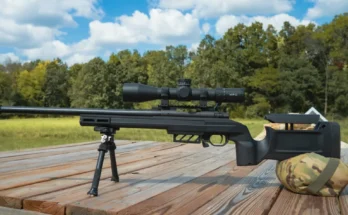
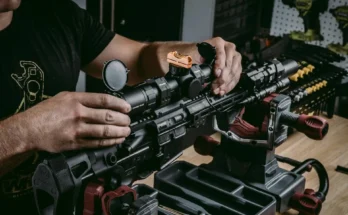
What is adjustable parallax on a rifle scope? It's a dial that lets you eliminate reticle drift when your eye sits even slightly off-center behind the eyepiece. Without it, your reticle appears to shift off target whenever your head moves, and that error gets worse the farther your target sits.
Most modern precision scopes carry a side focus turret marked in yards. Manufacturer specs for popular tactical rifle scopes as of 2026 typically list adjustment ranges from 10 or 25 yards out to infinity. Here's how the whole system actually works inside your optic.

Image source: Web (Bing) / cvlife.com (Web image (fair-use with source credit))
Quick Answer
Adjustable parallax is a dial that corrects reticle-to-target misalignment on a rifle scope. It shifts an internal lens to keep the reticle locked on target. The most common form is a side focus turret marked in yardage.
Scopes without this feature have a fixed parallax setting, usually optimized for one distance. This matters most beyond 300 yards, where small errors compound into real misses.
How Parallax Error Works Inside Your Scope (And Why Visuals Matter)
Parallax error happens when your reticle and the target image sit on different optical planes inside the scope. Shift your eye slightly left, and the reticle appears to drift right relative to the target. That's the core problem adjustable parallax exists to solve.
Think of it like looking through a car windshield at a distant tree. Move your head left inside the car, and the tree seems to shift right against the background. Your scope does the same thing, except now your reticle is the thing that floats while the target stays put.
The severity scales with distance. At 100 yards, a small head shift barely matters. At 600 yards, that same movement can throw your point of impact off by several inches.
Long-range and precision rifle shooters feel this most acutely, and PRS-style competitions punish the mistake immediately.
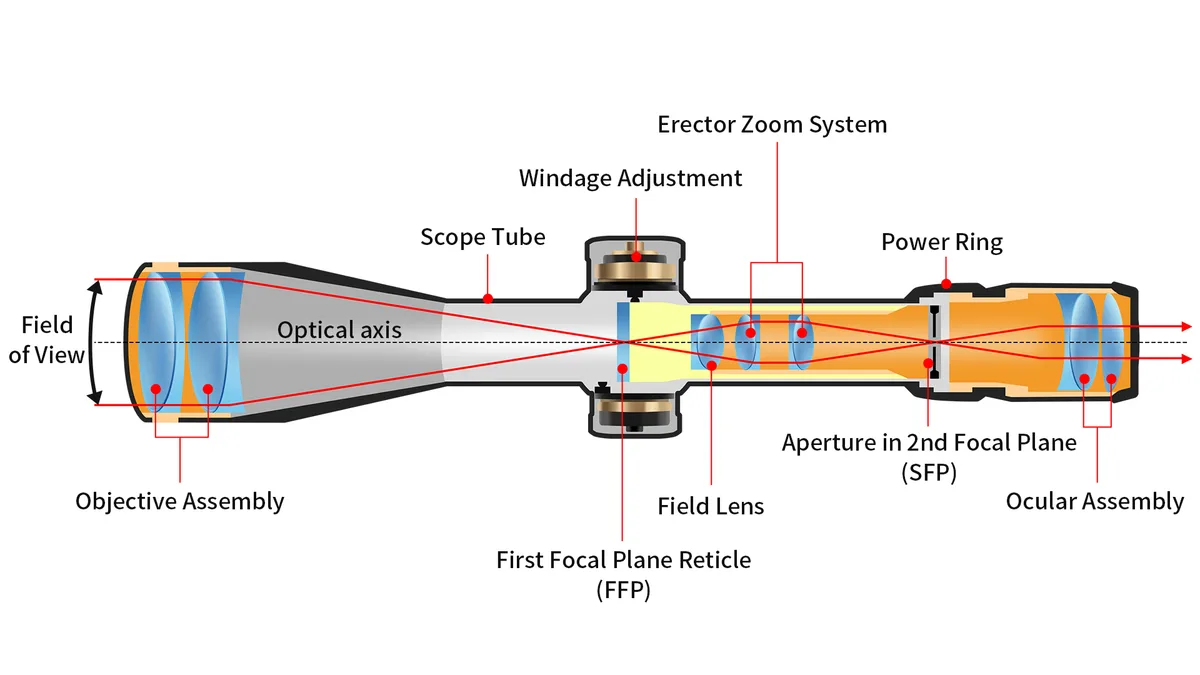
Image source: Web (Bing) / focuhunteroptics.com (Web image (fair-use with source credit))
Why Visuals Matter Here
Text can only go so far when explaining optical alignment. A diagram showing the reticle in one position versus another under two different eye placements makes the concept click faster than any paragraph. Manufacturers publish cross-section diagrams of their internal lens systems for exactly this reason.
You can test for parallax error yourself. Set your scope on a distant target, keep the rifle steady, and move your head slightly left and right. If the reticle appears to move against the target, you have parallax to deal with.
An adjustable turret lets you dial it out. The fix is quick and doesn't require re-zeroing the rifle.
Inside the System: Side Focus Turrets, Front Rings, and What Controls the Parallax
Most adjustable parallax scopes use a side focus turret. It sits on the left side of the scope housing and rotates to shift an internal lens element along the optical axis. The markings on the turret correspond to yardage values, so you dial the scope to match your target distance directly.
A smaller number of scopes use a front adjustment ring instead. This ring sits around the objective lens at the front of the scope. Functionally, it does the same thing, but the ergonomics differ.
Side focus turrets are faster to reach without breaking your shooting position, which is why they dominate the market as of 2026.
| Feature | Side Focus Turret | Front Adjustment Ring |
|---|---|---|
| Location | Left side of scope body | Around objective lens |
| Ergonomics | Reachable while in position | Requires reaching forward |
| Common on | Tactical, precision, FFP scopes | Older or specialized hunting scopes |
| Adjustment speed | Fast, often detented | Slower, friction-based |
| Locking mechanism | Locking dial on most models | Usually friction fit |
What Happens Optically
When you rotate the turret, a lens group inside the scope moves along the optical axis. When you dial to the correct distance, the reticle and the target image land on the same focal plane. Your eye position stops mattering because both elements are now optically locked together.
The turret doesn't move the reticle itself. That's a common misconception. It moves an internal lens to align two separate optical planes.
The net effect looks like the reticle stopped drifting, but the mechanism is a lens adjustment.
Scopes with FFP reticles benefit even more from proper parallax adjustment. Because the reticle scales with magnification, getting parallax right keeps those subtensions accurate at every zoom level. That matters when shooters dial holds at varying magnifications.
The National Shooting Sports Foundation emphasizes proper scope setup as a foundation for accurate shooting, and parallax control is a core part of that setup.
Step-by-Step: How to Dial Your Parallax Turret to the Right Distance
Dialing parallax takes under 10 seconds once you know the process. Here's the sequence most competitive and tactical shooters follow.
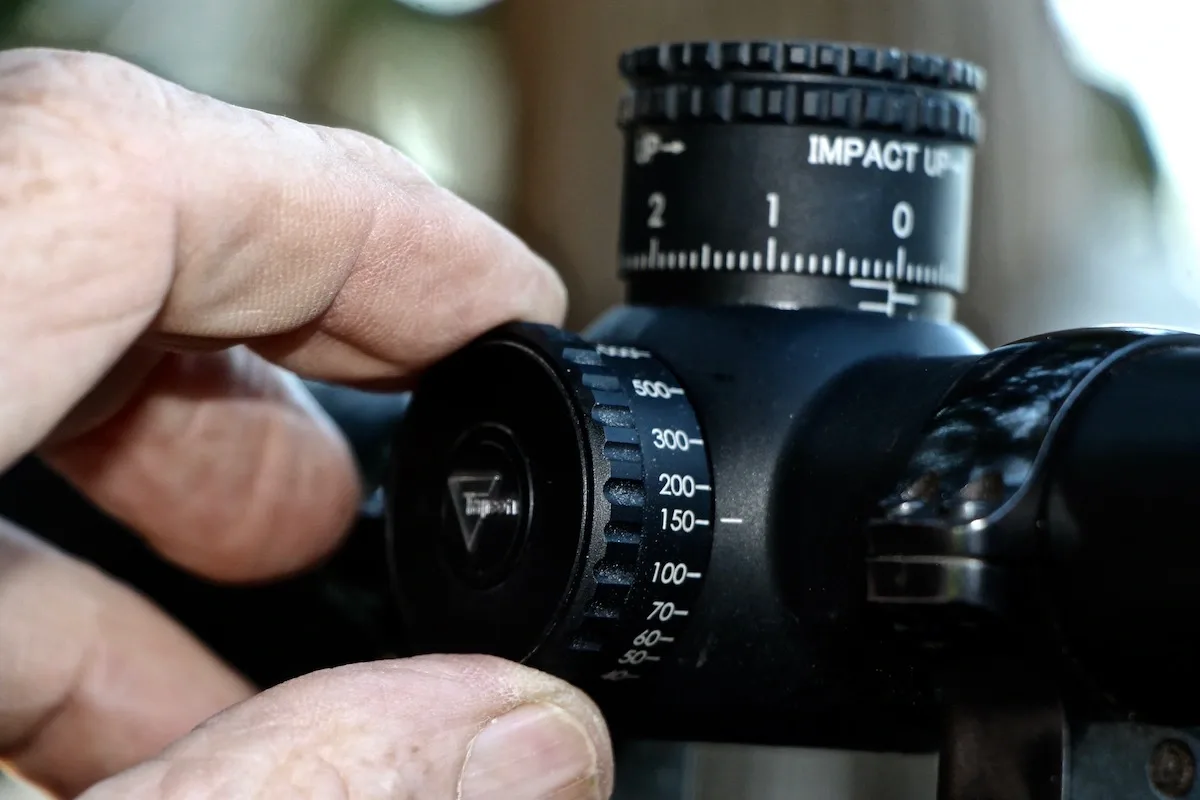
Image source: Bing (Web (fair-use with source credit))
The Steps
Range the target. Use a laser rangefinder to get the exact distance. Guessing the range here defeats the whole purpose.
Read the turret marking. Most parallax turrets are marked in yards. Find the number closest to your target distance on the dial.
Rotate the turret to match. Turn it until the distance marking aligns with the fixed index mark on the scope housing. Some turrets click into detents. Others move smoothly.
Verify the alignment. Get behind the scope and shift your head slightly left, right, up, and down. If the reticle stays on target, parallax is set correctly. If it still drifts, fine-tune by a small amount.
Confirm at multiple distances. If you're shooting between 200 and 600 yards in a single session, reset the turret each time you change distance. Leaving it at the wrong setting is one of the most common mistakes shooters make.
Quick Reference
| Target Distance | Typical Turret Action |
|---|---|
| Under 50 yards | Dial to closest low-yardage marking |
| 100 yards | Dial to 100 |
| 200 to 400 yards | Dial to nearest marked increment |
| 500 to 800 yards | Dial to exact yardage if marked |
| 1000+ yards | Dial to infinity or highest setting |
You don't always need to dial parallax. At short to medium ranges, many scopes are already close to parallax-free at their default setting. But if you're shooting beyond 300 yards and precision matters, dialing it in is worth the few seconds it takes.
Adjustable Parallax vs. Fixed Parallax: What You're Actually Buying
The biggest question shooters ask when shopping for a scope is whether the parallax adjustment feature is worth paying for. The answer depends entirely on what you're doing with the rifle.
Fixed parallax scopes have their parallax correction locked at one distance from the factory, usually 100 yards. That works fine for close-range hunting where targets sit inside 200 yards. At those distances, parallax error is minimal and rarely affects point of impact in a meaningful way.
Adjustable parallax scopes let you correct for any distance. This matters when your targets sit at 400, 600, 800, or 1000+ yards. It also matters when precision rifle competition, PRS, NRL, or long-range tactical shooting is in the picture.
| Factor | Fixed Parallax | Adjustable Parallax |
|---|---|---|
| Best for | Close-range hunting, casual shooting | Long-range, PRS, NRL, tactical |
| Parallax range | Factory-set (usually 100 yards) | User-adjustable (10 yds to infinity) |
| Price impact | Lower cost | Higher cost |
| Precision at distance | Limited beyond 300 yards | Reliable at any marked distance |
| Common on | Budget and mid-range hunting scopes | Tactical, FFP, competition scopes |
Who Should Care About This Feature
If your shooting stays inside 200 yards, fixed parallax scopes serve you well. You'll save money and lose very little practical accuracy. Varmint hunters at known, relatively close distances fall into this camp comfortably.
If your targets stretch past 300 yards, adjustable parallax becomes genuinely useful rather than just a nice-to-have. The difference shows up in first-round hit probability and in how confidently you can communicate a miss to a spotter. Leupold, Vortex Optics, and Athlon Optics all offer quality scopes with side focus turrets starting around $400 to $500.
The gap between fixed and adjustable has narrowed significantly in recent years.