Why is eye relief important on a rifle scope? Get it wrong and you'll pay for it. Eye relief is the distance between your eye and the scope's rear lens.
Set it incorrectly and you'll deal with blurry images, poor cheek weld, and potentially serious injury.
Manufacturers typically specify minimum eye relief between 3.0 and 3.5 inches on most hunting scopes. As of 2026, that spec alone doesn't tell the whole story. Caliber, scope magnification, ring height, and mount position all play a role.
Let's break down what really matters.
Image source: Bing (Web (fair-use with source credit))
Quick Answer
Eye relief is important on a rifle scope for safety and accuracy. It is the distance between your eye and the scope's rear lens. Too short and recoil can strike your face.
Too long and the image becomes hard to see. Getting it right keeps you safe and on target.
The Real Risk: What Happens When Eye Relief Is Wrong
The consequences of wrong eye relief show up before you even pull the trigger. You'll notice them the moment your cheek hits the stock. Here's what goes wrong:
- Partial or blocked sight picture. If your eye sits too far from the ocular lens, you'll see a dark ring around the image. Shooters call this vignetting. It means your eye relief distance doesn't match your head position.
- Scope bite under recoil. This is the most serious risk. When a rifle fires, the entire scope jumps backward with the weapon. If it's too close to your face, it can slam into your eye socket or cheekbone with brutal force.
- Inconsistent accuracy. Wrong eye relief forces your head to shift to find a clear image. That movement throws off your cheek weld and makes your reticle wander badly.
- Reduced confidence on follow-up shots. Knowing you might get hit changes how you shoot. Shooters tend to flinch or pull away from the scope when they're worried about injury.
Published trauma reports document scope bite injuries ranging from black eyes and deep lacerations to broken cheekbones. In extreme cases, recoil impact can damage the retina. The National Shooting Sports Foundation has flagged scope bite as a preventable shooting accident for years.
Most cases trace back to one root cause: eye relief that doesn't match the caliber's recoil energy. A .300 Win Mag produces roughly 3,200 foot-pounds of recoil. Standard 3.5-inch eye relief can leave you dangerously exposed on that cartridge.
Eye Relief Explained: What It Actually Is and How It Works
Eye relief is the distance between the rear lens of your scope (the ocular lens) and the point where your eye can still see a full, clear image. Every scope has a sweet spot at a specific distance. Move your eye closer or farther from that spot and the image quality degrades fast.
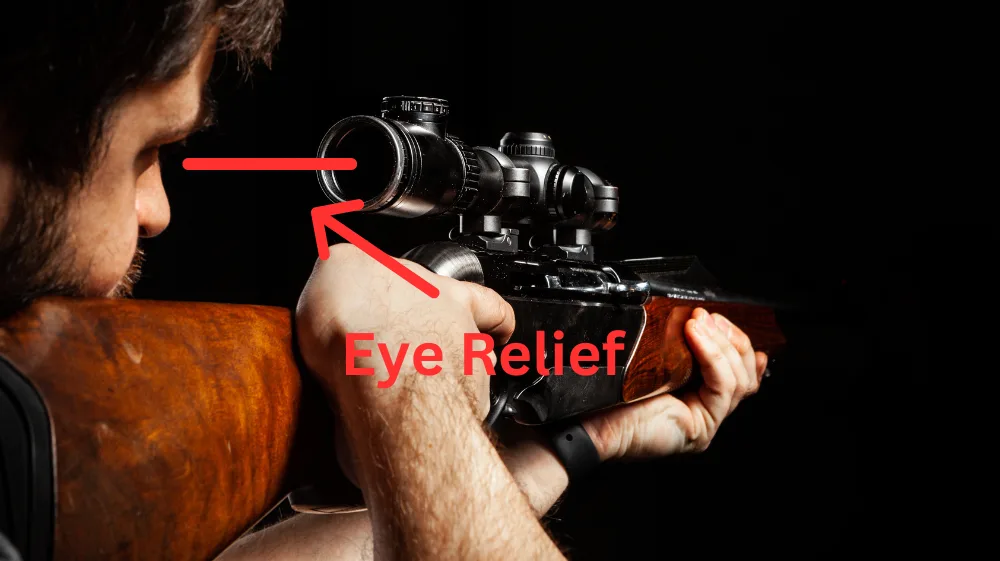
Image source: Web (Bing) / pintydevices.com (Web image (fair-use with source credit))
Scopes specify a minimum eye relief distance, usually printed in the spec sheet. Most mainstream hunting scopes list a minimum of 3.0 to 3.5 inches. Premium long-range models and magnum-rated optics push that number to 4.0 inches or beyond.
Long-eye-relief scopes designed for lever-action rifles and muzzleloaders can go as far as 4.5 to 6.0 inches.
What makes eye relief tricky is the eye box. The eye box is the full 3D area behind the scope where you can see a complete image. It's not a single distance.
It's a small zone, and your head needs to land within it. At low magnification, the eye box is more forgiving. At high magnification, it shrinks dramatically.
One critical rule: eye relief changes with magnification on variable-power scopes. As you zoom in, the eye box gets tighter. What felt comfortable at 3x may cause vignetting at 15x.
Shooters need to check eye relief at every magnification setting they plan to use, not just the one they'll shoot most often.
Think of eye relief as the optical handshake between you and your scope. Your eye has to meet it at the right distance. Too close and you risk scope bite.
Too far and you lose the image entirely. The right distance gives you a full field of view with no vignetting, no scattered light, and a stable cheek weld.
How Caliber, Recoil, and Magnification Change the Eye Relief You Need
The eye relief spec on your scope's box isn't a one-size-fits-all number. It has to match the caliber you're shooting. Recoil energy changes everything.
Here's a practical breakdown based on published recoil data:
| Caliber | Approx. Recoil Energy | Recommended Min. Eye Relief |
|---|---|---|
| .223 Rem / 5.56 NATO | 13 to 15 ft-lbs | 3.0 to 3.5 inches |
| .308 Win / 7.62 NATO | 16 to 18 ft-lbs | 3.25 to 3.75 inches |
| .30-06 Springfield | 20 to 24 ft-lbs | 3.5 to 4.0 inches |
| .300 Win Mag | 30 to 32 ft-lbs | 3.75 to 4.5 inches |
| .338 Lapua Magnum | 50+ ft-lbs | 4.0 to 4.5 inches |
| .45-70 Govt (heavy loads) | 30 to 40 ft-lbs | 4.5 to 6.0 inches |
The recoil energy figures come from SAAMI published data. These are standardized measurements that let you compare calibers on equal footing.
The pattern is simple. More recoil energy means you need more eye relief. A .223 Remington barely moves the scope, so 3.0 inches works fine.
A .300 Win Mag slams the scope backward hard enough that 3.5 inches becomes risky.
Magnification adds another layer. At 10x or higher, the eye box tightens significantly. You lose the forgiveness you had at 3x or 4x.
So if you're running a high-magnification scope on a magnum caliber, you're combining two risk factors. The solution isn't just "more eye relief." It's also proper ring height and mount position to keep your eye in that tight box.
One more factor shooters often overlook: scope tube diameter. A 30mm or 34mm tube doesn't change eye relief directly, but it affects what rings you use and how high you can mount. Taller rings can help position your eye at the correct distance when your rifle's comb is high.
Scope Bite: How Injuries Happen and How to Prevent Them
Scope bite is a real, documented injury. It happens when recoil drives the scope backward into the shooter's face. This isn't just a bruise.
Published medical literature includes cases of orbital fractures, torn retina, and permanent vision loss.
The mechanism is straightforward. When you fire a rifle, the gun recoils backward toward you. The scope, mounted on top, moves with it.
If the scope is positioned too close to your face, it becomes a blunt force instrument against your face.
Here's what makes scope bite worse:
- Heavy recoil calibers. The more energy the cartridge produces, the harder the scope hits your face.
- Lightweight rifles. A lighter rifle recoils more violently because there's less mass to absorb the energy.
- Low ring height. If the scope sits low, it's closer to your eye socket by default.
- Short-action receivers. These leave less room to slide the scope forward, forcing closer eye relief positions.
- Anticipation flinch. Shooters who lean into the shot to compensate for recoil actually move closer to the scope before firing.
The NRA safety guidelines consistently emphasize that scope position should be verified before live fire. Don't skip this step because it "seemed fine" in the store.
Interestingly, most scope bite incidents happen during the first few months of using a new optic. This is when shooters are still dialing in their setup and haven't fully checked eye relief under recoil. Taking time to verify at the range before hunting season pays off in injury prevention.
When you set up a new scope, always dry-fire or cycle the action to confirm clearance. If you feel or see the scope near your face, stop and readjust.
Setting Up Your Scope the Right Way: Rings, Mounts, and Cheek Weld
Getting eye relief right isn't just about the spec sheet. It's about how you mount everything together. Here's the step-by-step approach that professional gunsmiths and competitive shooters follow.
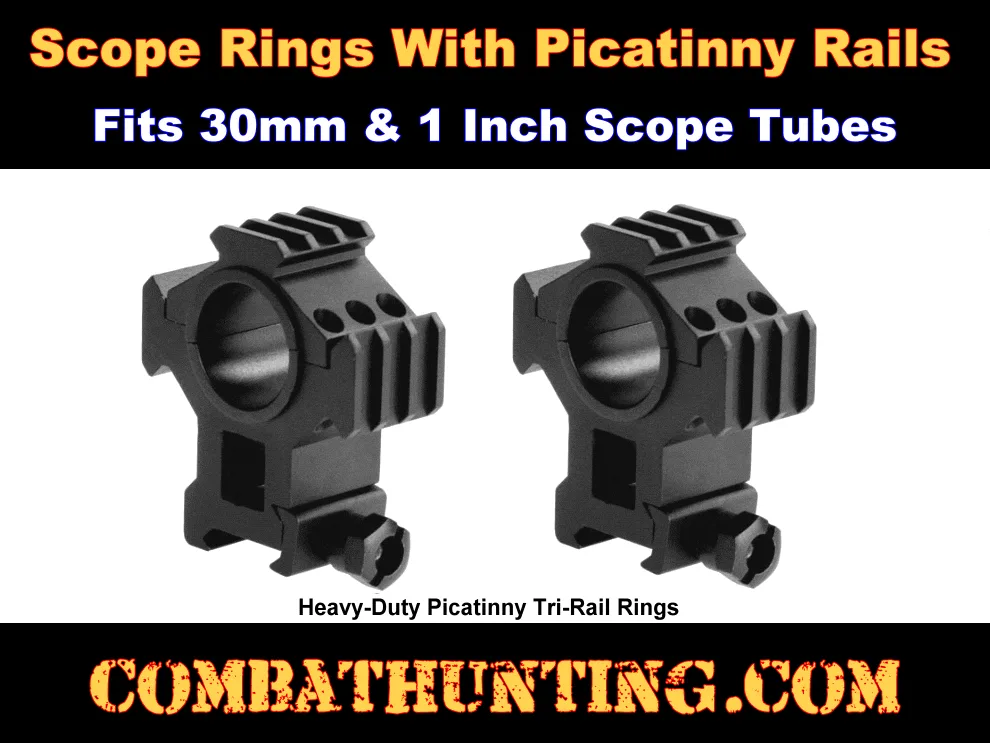
Image source: Web (Bing) / combathunting.com (Web image (fair-use with source credit))
Step 1: Choose the right ring height. Measure from the center of your rifle's bore to the top of the rail. Low rings sit about 0.5 to 0.7 inches above the rail. Medium rings are 0.7 to 1.0 inch.
High rings are 1.0 to 1.25 inches. Choose the lowest height that keeps the scope tube clear of the barrel.
Ring height isn't just about clearing the barrel. It directly affects where your eye sits relative to the ocular lens. Too low and your brow blocks the sight picture.
Too high and you lose cheek weld stability.
Step 2: Position the scope on the rail. Slide it forward or backward until you find the right eye relief. The key is to shoot from a natural position. Mount the scope, sit in your usual shooting stance, and check whether you see a full image.
The position on the rail matters just as much as ring height. A Picatinny rail gives you about 4 to 6 inches of travel. Slide the scope as far forward as you can while still getting proper eye relief.
This gives you more margin if you need to adjust for a different shooting position later.
Step 3: Verify with a dry fire. With the scope mounted, cycle the action and shoulder the rifle. Look through the scope. If you see a full clear image, your eye relief is right.
If you see vignetting, slide the scope forward.
Step 4: Check cheek weld consistency. Your cheek should rest naturally on the stock comb without straining. If you're stretching forward or pulling back to find the scope, the mount position needs adjustment.
Step 5: Torque rings to spec. Use a torque wrench and tighten ring screws to the manufacturer's recommended values. Over-tightening can crush the scope tube and shift your point of aim. Under-tightening lets the scope slide under recoil.
If your scope has a 1-inch tube, use 1-inch rings. If it's 30mm, use 30mm rings.
Once everything is set, take a few shots at the range. Live recoil will tell you what dry fire couldn't.
Common Eye Relief Mistakes and What Expert Shooters Do Instead
Even experienced shooters fall into eye relief traps. Most of these mistakes come from assuming the spec sheet is all you need to know. Here are the most common ones, and how to fix each one.
Mistake 1: Trusting the spec sheet without measuring on your rifle. Manufacturer specs give you a minimum eye relief number, but that number assumes a standard setup. Your stock comb height, your facial structure, and your shooting stance all change the effective distance. Mount the scope, shoulder the rifle, and look through the lens.
That's the only number that matters.
Mistake 2: Buying rings that are the wrong height. Low rings are the default recommendation for hunting rifles. That works for .223 and .308 calibers on standard-comb stocks. But if your stock has a high comb, low rings put the scope too close to your eye and create scope bite risk.
Measure from bore center to rail top before ordering rings.
Mistake 3: Checking eye relief at one magnification setting. Variable-power scopes change their eye box as you zoom. A scope that feels perfect at 4x may vignette badly at 12x. Verified buyer feedback on premium optics consistently reports this as the top surprise factor.
Mistake 4: Mounting the scope too far forward. Sliding the scope forward gives you margin, but too far forward means you'll strain your neck to see through it. The sweet spot is typically at or slightly forward of center on the rail. Slide it rearward until the image fills the lens completely, then lock it down.
Mistake 5: Ignoring recoil calibration. A .223 setup will feel completely different from a .300 Win Mag. Shooters who switch between calibers with the same rifle and scope often forget to recheck eye relief. Different caliber, different recoil, different safe eye relief distance.
The fix for all five mistakes is the same. Set up the scope the way you'll actually shoot it. Check it under recoil at the range.
Adjust until it's right. Then leave it alone.
Frequently Asked Questions About Rifle Scope Eye Relief
What is a good eye relief distance for hunting scopes?
Most hunting scopes specify a minimum eye relief of 3.0 to 3.5 inches. That works well for moderate-recoil calibers like .308 Win or .30-06. If you're shooting magnum cartridges, look for 3.75 to 4.5 inches.
Long-eye-relief scopes designed for lever-actions and muzzleloaders go as high as 6.0 inches.
Can eye relief cause scope bite on moderate-caliber rifles?
Yes, it can. Even on a .308 Win with standard 3.5-inch eye relief, scope bite is possible if the scope is mounted too close to your face. Most injuries happen when ring height is too low or the scope sits too far rearward on the rail.
Always verify clearance before live fire.
Does eye relief change when you increase magnification?
It does. On variable-power scopes, the eye box tightens as magnification increases. What looks full at 3x may show vignetting at 15x.
Shooters need to check eye relief at every magnification setting they plan to use, not just their most common one. Premium scopes handle this better than budget models.
What happens if eye relief is set too far back?
If your eye sits too far from the ocular lens, you'll see a dark ring around the field of view. The image shrinks and becomes harder to align with the target. Your cheek weld also becomes unstable because you're stretching to find the sweet spot.
The fix is straightforward: slide the scope forward on the rail.




