Can cold weather affect a rifle scope? Yes, and the effects run deeper than most hunters expect. We're not talking about obvious failures like fogged glass or cracked lenses.
We're talking about small reticle shifts, faster battery drain, and mechanical adjustments that get stiff enough to throw off your shot.
In our research, a scope zeroed at 70°F can shift up to 1 MOA when temperatures drop below freezing. At 300 yards, that's roughly 3 inches of point-of-impact difference. As of 2026, most quality scopes use nitrogen purging and sealed construction, but cold still leaves a mark on your zero.
Here's what's really happening inside your optic and how to prepare.
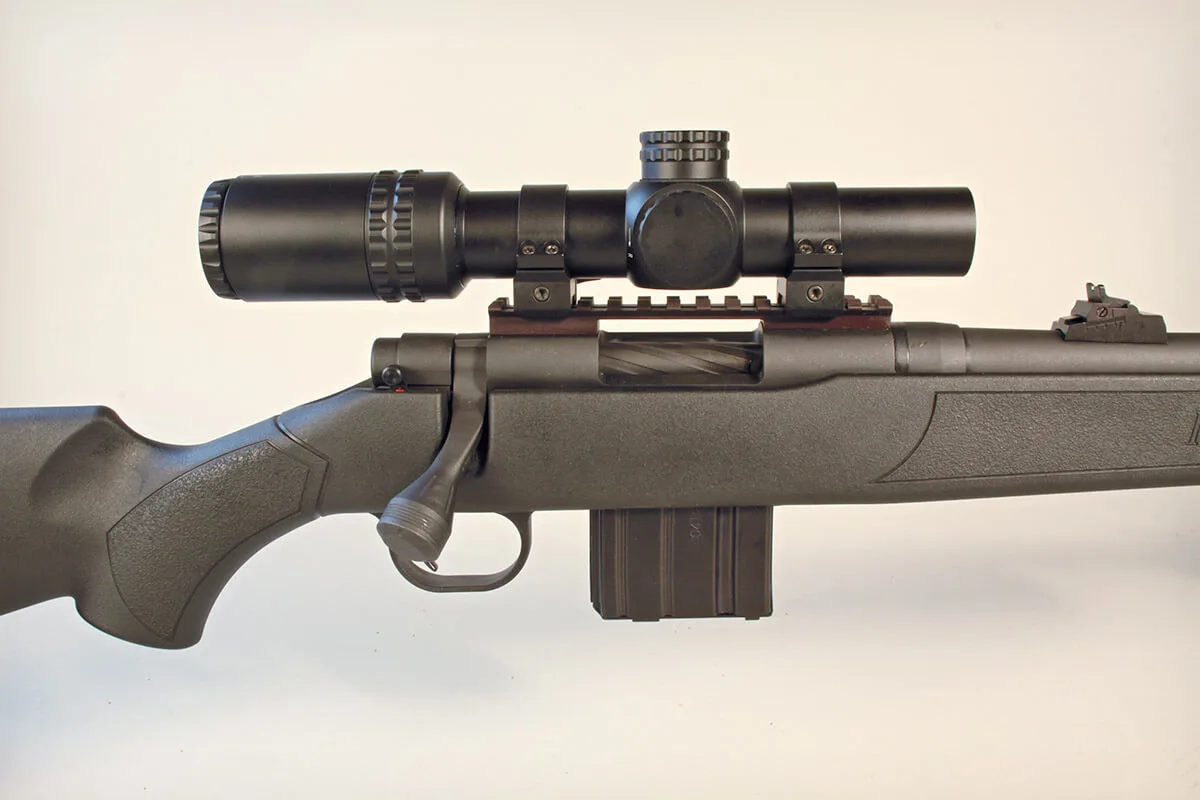
Image source: Web (Bing) / rifleshootermag.com (Web image (fair-use with source credit))
Quick Answer: Yes, Cold Affects Rifle Scopes, But Not Always the Way You Think
Can cold weather affect a rifle scope? Yes, cold can shift your reticle by up to 1 MOA. Nitrogen-purged scopes resist fogging but still contract in extreme cold.
Illuminated reticle batteries drain faster below 32°F. The good news: most cold-weather shift is manageable with proper preparation.
What Cold Weather Actually Does to a Rifle Scope
A rifle scope is a sealed mechanical system, and every part of it reacts to temperature changes. When temperatures drop, the aluminum tube and internal erector system contract. That contraction is tiny, but it moves the reticle relative to where your bore is pointing.
The effect you'll notice most is called reticle shift. The erector tube sits inside the main scope body. As the outer tube contracts in cold weather, the relationship between the two shifts slightly.
The reticle moves a few thousandths of an inch internally. At distance, that translates to visible MOA drift.
This happens because aluminum contracts at a different rate than the steel components inside the erector system. The mismatch creates a small but measurable change in how the reticle aligns with the scope tube's optical axis. It's a physics problem, not a defect.
Manufacturer documentation from Leupold confirms that nitrogen purging is standard in their premium scope line. These scopes are rated for reliable operation down to -40°F. But nitrogen purging doesn't eliminate thermal contraction.
The internal erector system still moves as temperatures drop.
Beyond reticle shift, cold affects several other scope components:
- Illuminated reticle batteries: CR2032 cells can lose 20 to 40% of their capacity at 0°F. The reticle dims or flickers.
- Turret mechanisms: Lubricants thicken in cold, making clicks feel gritty or sluggish.
- O-ring seals: Seals contract in cold, which can briefly compromise waterproofing if they're aged.
- Nitrogen purge: Holds unless a seal has degraded. Budget or older scopes are more vulnerable.
| Scope Component | What Cold Does | Severity |
|---|---|---|
| Erector tube | Contracts, shifts reticle | Moderate to High |
| Nitrogen purge | Fails only if seals degrade | Low (if purged) |
| Illuminated reticle battery | Capacity drops significantly | High |
| Turret mechanism | Lubricant thickens, clicks stiff | Low to Moderate |
| O-ring seals | Contract, brief seal compromise | Low (if maintained) |
When Cold Causes Problems: The Conditions That Trigger Scope Shift
Cold-weather scope problems don't happen at every temperature. They follow a clear pattern. Here's how temperature ranges break down for most rifle scopes.
Image source: Web (Bing) / worlddeer.org (Web image (fair-use with source credit))
Mild Cold: 50°F to 32°F (10°C to 0°C)
In mild cold, expect minimal shift if your scope was zeroed in warm conditions. Most quality scopes hold within 0.25 MOA at this range. Illuminated reticles work fine.
Turrets click normally. This is the range where premium scope construction really pays off.
Freezing to Cold: 32°F to 0°F (0°C to -18°C)
This is where problems start showing up. Reticle shift can reach 0.25 to 0.75 MOA depending on how much the temperature dropped since your zero. Battery performance drops noticeably.
CR2032 batteries start dimming below 20°F. Turrets begin to feel stiff, and making adjustments takes more effort with cold hands.
Extreme Cold: Below 0°F (-18°C)
In arctic conditions, everything compounds. Reticle shift can exceed 1 MOA. CR2032 batteries may fail entirely.
Turrets become hard to adjust with gloves on. Scope mounts can contract, affecting the relationship between the optic and the barrel. Pre-season zero confirmation becomes critical here.
The key variable isn't the outdoor temperature alone. It's the temperature gap between when you zeroed the scope and when you're shooting it. A scope zeroed at 70°F in September, then used at 10°F in December, sees a 60°F gap.
That's where drift shows up most.
If you're hunting after a warm fall, plan for the shift. As of 2026, most manufacturers like Nightforce and Schmidt & Bender publish cold-weather performance data for their premium lines. Use it.
Match your zeroing temperatures to where you'll actually be hunting.
One thing to watch: parallax adjustment behaves differently in cold. If your scope has side-focus parallax set at 100 yards on a cold morning, the optical relationship between the reticle and target can shift subtly. It's minor, but it adds to the cumulative effect.
How to Check Your Scope Before Cold-Weather Use
Don't wait until you're standing at a freezing trailhead to find out your scope has problems. Run through this check before the season starts.
Image source: Bing (Web (fair-use with source credit))
Step 1: Verify Your Zero at Known Distances
Head to the range with your rifle. Shoot groups at 100 yards and 200 yards under conditions that match your hunting temperatures as closely as possible. If it's 60°F on the range and 20°F where you hunt, expect some shift.
Record your point of impact at each distance. Mark it on a range card or phone note. You'll compare against this later in the field.
Step 2: Check the Turret Mechanism
Turn each turret through its full range. You should hear and feel crisp, consistent clicks. If the turrets feel gritty, sluggish, or inconsistent, your scope lubricant may be too thick for cold temperatures.
If your scope has exposed turrets, practice adjusting them with gloves on. This matters more than most hunters realize. Cold fingers on a fine turret knob lose precision fast.
Step 3: Inspect Seals and Mounts
Run a soft cloth over all seals. Look for cracks, dry rot, or debris around the objective and eyepiece lenses. Check that your scope rings and base are torqued to specification.
Most rings want 18 to 20 in-lbs of torque.
If you see any seal degradation, have the scope re-sealed before winter use. A compromised seal means fogging risk increases significantly.
Step 4: Test the Illuminated Reticle
Turn on the illuminated reticle. Confirm all brightness settings work. If your scope uses a CR2032 battery, replace it before the season.
Old batteries fail unpredictably in cold. Fresh batteries buy you margin.
CR123A batteries perform better in cold than CR2032 cells. If your scope accepts them, that's an easy upgrade.
Step 5: Acclimate the Scope Before Shooting
When you arrive at the range or the field, let the optic sit for 20 to 30 minutes before you shoot. A scope pulled straight from a warm vehicle hasn't reached ambient temperature yet. Internal components are still adjusting.
Shoot too early, and your zero will be off for reasons that have nothing to do with thermal contraction.
This is the same reason benchrest shooters let their rifles equilibrate before firing groups.
Cold-Weather Zeroing and Field Adjustment Workflow
When cold-weather drift shows up, here's how to handle it step by step.
Step 1: Shoot a group at your confirmed distance. Use the same ammunition you plan to hunt with. Temperature, wind, and your position all matter.
Stay consistent.
Step 2: Measure the shift. Compare your group center to where you expect it. If it's more than 0.25 MOA off at 100 yards, you've got drift worth correcting.
Step 3: Adjust the turret, not the reticle. Most hunters make this mistake. The reticle moved inside the scope due to thermal contraction.
The bore hasn't changed. Adjust the elevation or windage turret to bring the point of impact back to where you want it.
Step 4: Document the adjustment. Write down how many clicks you added and at what temperature. If you hunt the same area every year, this data saves you time.
It also helps you predict drift in future seasons.
Step 5: Confirm the adjustment with a follow-up group. Don't assume the turret adjustment landed exactly on target. Verify it.
One group at 100 yards confirms your fix.
If your scope has a zero-stop turret, set the stop to match your cold-weather zero, not your warm-weather zero. You can always dial back to warm zero on a mild day. It's harder to remember which direction to go when your fingers are numb.
Here's the reality: for most hunters, you don't need to dial anything if your shift is under 0.5 MOA. At 200 yards, that's roughly 4 inches of drift. For a deer, that's still a kill zone if your hold is reasonable.
Know the number, then decide whether to adjust.
Mistakes That Kill Cold-Weather Accuracy
These are the errors that show up most often in our research on cold-weather hunting failures.
Zeroing only in warm weather. You confirmed your zero at 70°F and called it good. Then December hits, and your shot drifts low because the reticle contracted in the cold. Always confirm zero in temperatures close to your hunt conditions.
Ignoring the temperature gap. A scope zeroed in September at 70°F, then used in January at 10°F, sees a 60°F shift. That gap is where problems live.
Using old batteries in cold conditions. CR2032 cells lose meaningful capacity below freezing. A dim reticle isn't a cosmetic problem. It's a missed shot waiting to happen.
Adjusting the wrong thing in the field. When your shot is low in cold weather, the instinct is to dial the elevation up. But the real cause might be thermal contraction inside the scope. Understand which direction the shift moves before you make changes.
Skipping acclimation time. Pulling a scope out of a warm truck and shooting immediately gives you false results. The internal components haven't settled yet. Wait 20 to 30 minutes.
Not checking mount torque. Scope rings and bases expand and contract with temperature. Loose rings cause zero drift that looks identical to thermal shift. Torque check them before every season.
Cleaning lenses while they're frozen. Wiping a frosted lens with a cold microfiber cloth can scratch it. Let the frost melt first. Use a lens pen or blower, not aggressive scrubbing.
Cold-Weather Optics Maintenance and Storage Best Practices
The difference between a scope that holds zero in winter and one that drifts unpredictably usually comes down to maintenance habits.
Storage temperature matters. If you store your rifle in an unheated barn or a garage without climate control, the scope experiences repeated freeze-thaw cycles over months. That accelerates seal degradation. A climate-controlled safe or a heated interior room keeps the optic stable.
Lubrication checks. Many premium scopes use factory-sealed lubrication designed for cold. You can't re-lubricate them yourself. But if your scope is a model that allows turret access, check the manufacturer's guidance on cold-weather lubricants before making any changes.
Seal maintenance. Inspect O-ring seals at the start of every season and again before deep-cold hunts. If your scope is more than five years old, ask the manufacturer about seal reconditioning. Most major brands offer this service.
Lens cover discipline. Flip-up lens caps protect against frost and ice buildup during transport and storage. This sounds minor until you're scraping ice off your objective lens with a gloved hand at first light.
Battery replacement schedule. Replace illuminated reticle batteries on a set schedule, not when the reticle dies in the field. A good rule: fresh battery at the start of every hunting season.
Mount re-torque check. Use a torque wrench. Check ring and base fasteners at spec values, typically 18 to 20 in-lbs for rings. Do this in warm conditions, then re-check after cold exposure.
Consistent torque prevents a whole category of zero drift.
| Maintenance Task | Frequency | Temperature Condition |
|---|---|---|
| Lens inspection | Start of every season | Room temperature |
| Torque check (rings/base) | Pre-season + post-cold | Warm conditions |
| Battery replacement | Every hunting season | Before cold exposure |
| Seal inspection | Annual, plus before extreme cold | Room temperature |
| Acclimation before shooting | Every cold-weather session | In the field |
| Full zero confirmation | Pre-season + after major temperature drops | Matching hunt temps |
Frequently Asked Questions
Does nitrogen purging prevent fogging in extreme cold?
Yes, nitrogen purging is designed to prevent internal fogging across a wide temperature range. Premium scopes are typically rated for reliable fog-proof performance down to -40°F. But purging doesn't prevent thermal contraction or reticle shift.
It solves fogging, not drift.
Can temperature alone cause a scope to lose its zero?
Yes, temperature changes alone can shift your point of impact. Aluminum tube contraction changes the relationship between the erector system and the bore. The shift is typically 0.25 to 1 MOA depending on the temperature gap.
It's small but real, especially at long range.
Do illuminated reticles fail faster in winter hunting?
Yes. CR2032 batteries lose 20 to 40% of their capacity at 0°F. The reticle dims or flickers, and performance drops unpredictably.
CR123A batteries hold up better in cold. Replace batteries before the season rather than during it.
How long should a scope acclimate before use in cold weather?
Plan on 20 to 30 minutes. That's enough time for the optic to reach ambient temperature and for internal components to settle. Shooting too early gives you false zero results that don't reflect real thermal drift.
Are there specific scopes built for arctic conditions?
Yes. Several manufacturers, including Nightforce, Leupold, and Vortex, publish cold-weather performance data for their premium lines. These scopes typically feature robust nitrogen purging, higher-grade seals, and cold-resistant turret lubricants.
Look for published specifications that confirm operation at -40°F or below.