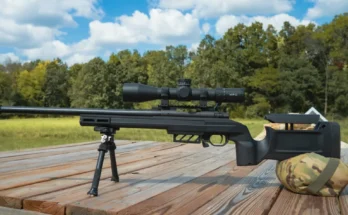
What is the ideal magnification for hunting? The honest answer is that no single number fits every hunt. Your terrain, your target species, and your typical shot distance all change the equation.
Anyone who gives you a universal answer is leaving out the parts that matter.
As of 2026, the 3-9x scope remains the most popular variable power option among North American hunters. But open-country hunters are increasingly gravitating toward 4-16x ranges. The real skill is matching magnification to where you actually shoot.
Let's get into it.
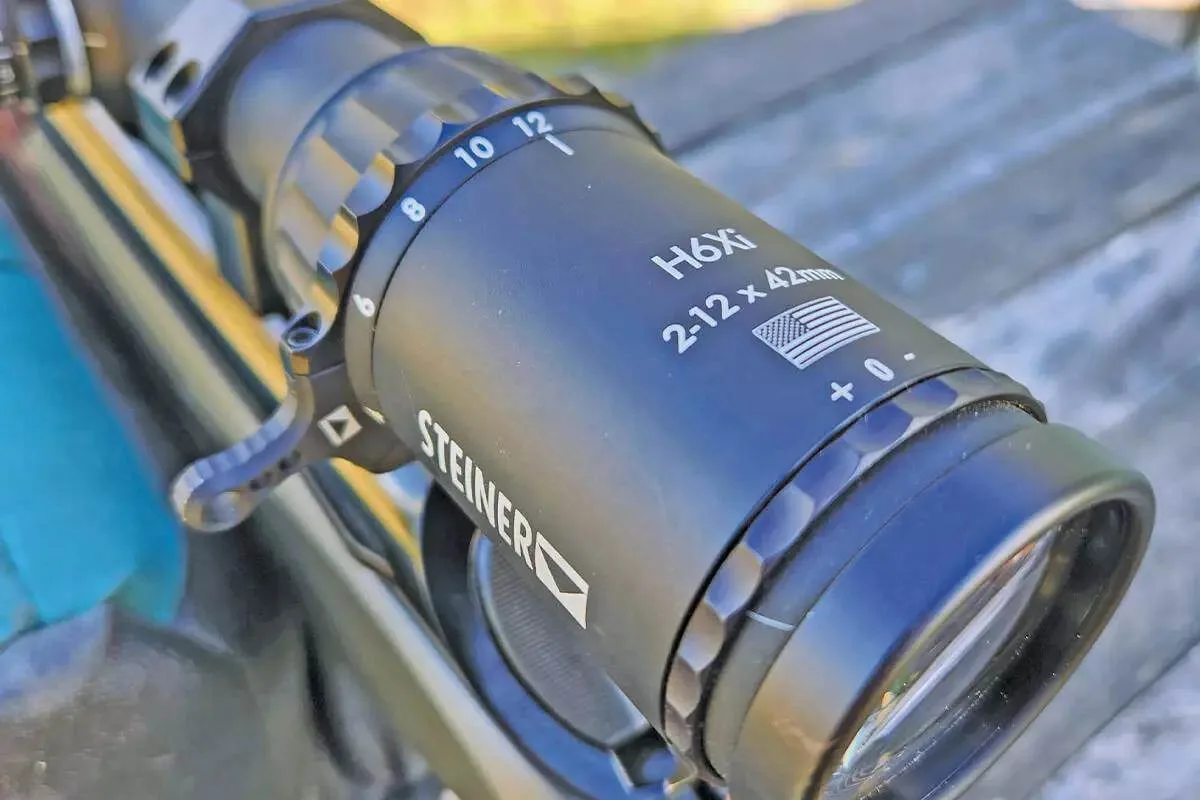
Image source: Bing (Web (fair-use with source credit))
Quick Answer
The ideal magnification for hunting depends on your terrain, species, and typical shot distance. For timber and brush hunting, 1-6x or 2-7x works well. For open-country hunting at 300 yards or more, 4-16x is a stronger choice.
Most hunters do well with a 3-9x variable scope. Match it to where you hunt, not the highest number on the box.
Too Much Magnification Can Be a Liability in the Timber
More magnification feels like more capability on paper. In practice, it often works against you when the animal shows up close. This is the biggest reason new hunters overbuy optics.
At 12x or higher, your field of view shrinks dramatically. In thick timber or brush, that narrow window makes target acquisition much harder. An animal stepping out at 40 yards in heavy cover will be nearly impossible to find through a high-power scope.
Higher magnification doesn't improve your rifle's accuracy. It improves your ability to see the target clearly at long range. At close range, that benefit doesn't exist.
You're just narrowing your window for no real return.
Per the National Shooting Sports Foundation, educational materials emphasize matching optics to realistic field conditions rather than to maximum theoretical range. Most ethical big game shots in Eastern timber settings happen inside 150 yards. At that distance, a 3-9x scope dialed to 4-5x does the job cleanly.
There's also the eye fatigue factor. Sustained use at 15x or higher tires your eyes faster. In a long dawn sit, that fatigue affects your ability to spot movement and react.
Magnification beyond what the environment demands adds noise, not useful information.
High magnification also narrows the exit pupil. That's the circle of light reaching your eye. At 10x with a 40mm objective lens, the exit pupil is only 4mm wide.
In low light, that means a darker, less useful image.
And don't forget the weight. Higher-magnification scopes are generally heavier. A 4-16x optic can weigh 28 to 35 ounces.
A 2-7x scope with comparable build quality might weigh 18 to 24 ounces. Over a daylong hunt in rough country, that difference compounds fast.
If your hunt involves timber, brush, or any environment where shots typically land inside 150 yards, stay in the 1-6x or 2-7x range. You'll acquire targets faster, see more of the field, and stay comfortable through a long sit.
Four Variables That Determine Your Ideal Magnification
Choosing the right magnification comes down to four practical variables. Each one pushes your answer in a different direction. Get these right, and the scope choice becomes obvious.
Terrain and environment. Dense timber and thick brush demand wide field of view, which means lower magnification. Open prairie and long ridge lines reward higher magnification because your shots stretch out and targets shrink in the frame.
Target species and size. A coyote at 300 yards presents a small, fast-moving target. A whitetail buck at 75 yards in a food plot presents a large, relatively still one. Different animals, different magnification needs.
Typical engagement distance. This is the variable most hunters get wrong. They buy a scope for the one long shot they might take, not for the 90% of shots they'll actually take. Be honest about where your shots really happen.
Shooting style and conditions. Some hunters move constantly through the timber and need quick acquisition. Others glass from a tripod for long periods and can afford the time to dial in. Your style shapes the right magnification.
Here's a practical reference that maps these variables to magnification ranges:
| Your Scenario | Typical Distance | Recommended Magnification |
|---|---|---|
| Dense timber / brush | 25-100 yards | 1-6x or 2-7x |
| Mixed woods / agricultural edges | 50-250 yards | 2-7x or 3-9x |
| Open prairie / rolling hills | 150-400 yards | 3-9x or 4-12x |
| Mountain / long-range country | 300-600+ yards | 4-16x or 5-25x |
Manufacturer specs across Leupold, Vortex, and Nightforce product lines confirm that most hunting applications fall between 2-7x and 4-16x. Rarely does anyone need to go above 16x in the field.
Matching Magnification to Your Hunting Scenario: The Decision Guide
Now let's walk through a practical decision tree. Answer these questions in order, and you'll land on the right magnification range faster than any salesperson can push you toward one.
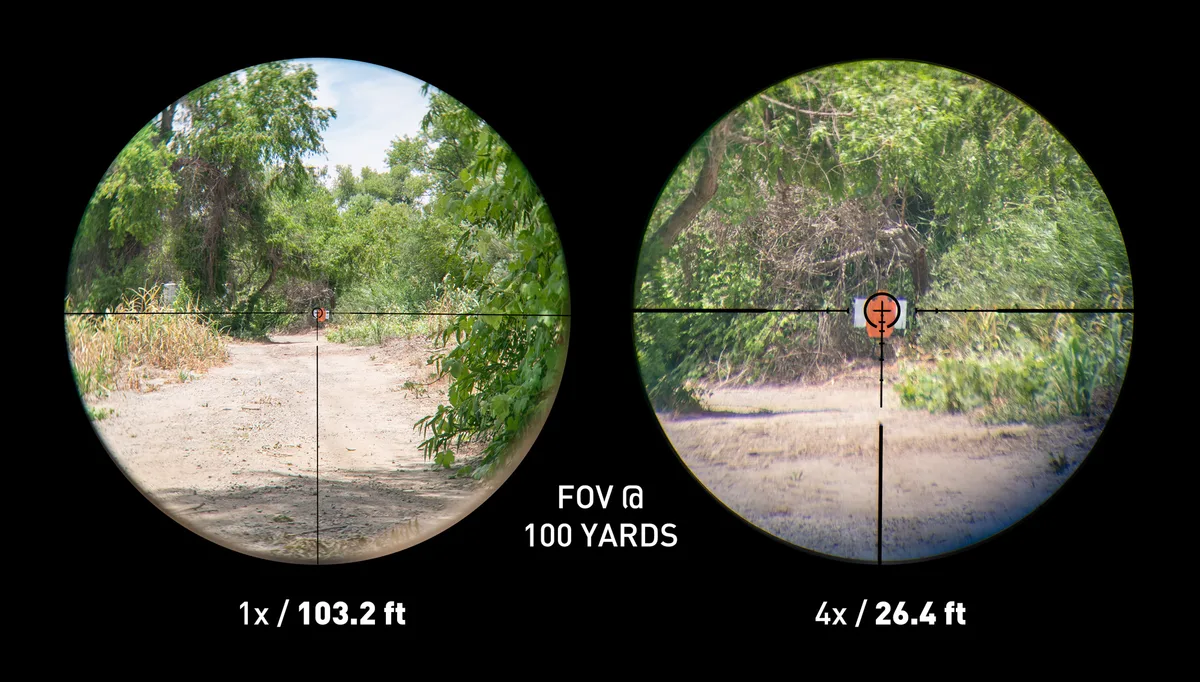
Image source: Bing (Web (fair-use with source credit))
Step 1: Assess your terrain.
If you hunt primarily in timber, thick brush, or closed-country environments, go with 1-6x or 2-7x. Low magnification keeps your field of view wide. You'll find targets fast in cluttered settings.
If you hunt rolling hills, agricultural edges, or mixed habitat, 3-9x covers most real-world needs. It gives you enough reach for 200 to 300 yard shots while staying manageable at close range.
If you hunt open plains, high-country ridges, or long desert washes, 4-16x becomes worthwhile. At that level, you can identify and place shots on targets out to 400 yards and beyond.
Step 2: Match to your most common species.
Predator hunters pursuing coyotes at distance will lean higher, often 4-12x or 4-16x. Deer and elk hunters in mixed habitat usually do well with 3-9x. Hog and timber deer hunters thrive in the 1-6x or 2-7x range.
Step 3: Consider your shooting conditions.
If you move and shoot (still-hunting, spot-and-stalk), lower magnification is your friend. You need speed. If you glass and then shoot from a tripod, higher magnification works because you have time to stabilize.
Step 4: Dial back.
Whatever range you settle on, remember that most of your actual shots will happen at 2-6x. Even in open country, shots rarely exceed the first third of your magnification range. Don't buy for the 500-yard shot you'll take once a decade.
A good rule: if you're debating between two ranges, choose the lower one. You'll almost always wish you had more field of view than more zoom.
How Objective Lens Size, Exit Pupil, and Field of View Change Everything
Magnification is only half the story. The objective lens and how it interacts with your magnification choice determines how much useful light reaches your eye. This is where a lot of scope conversations get lost.
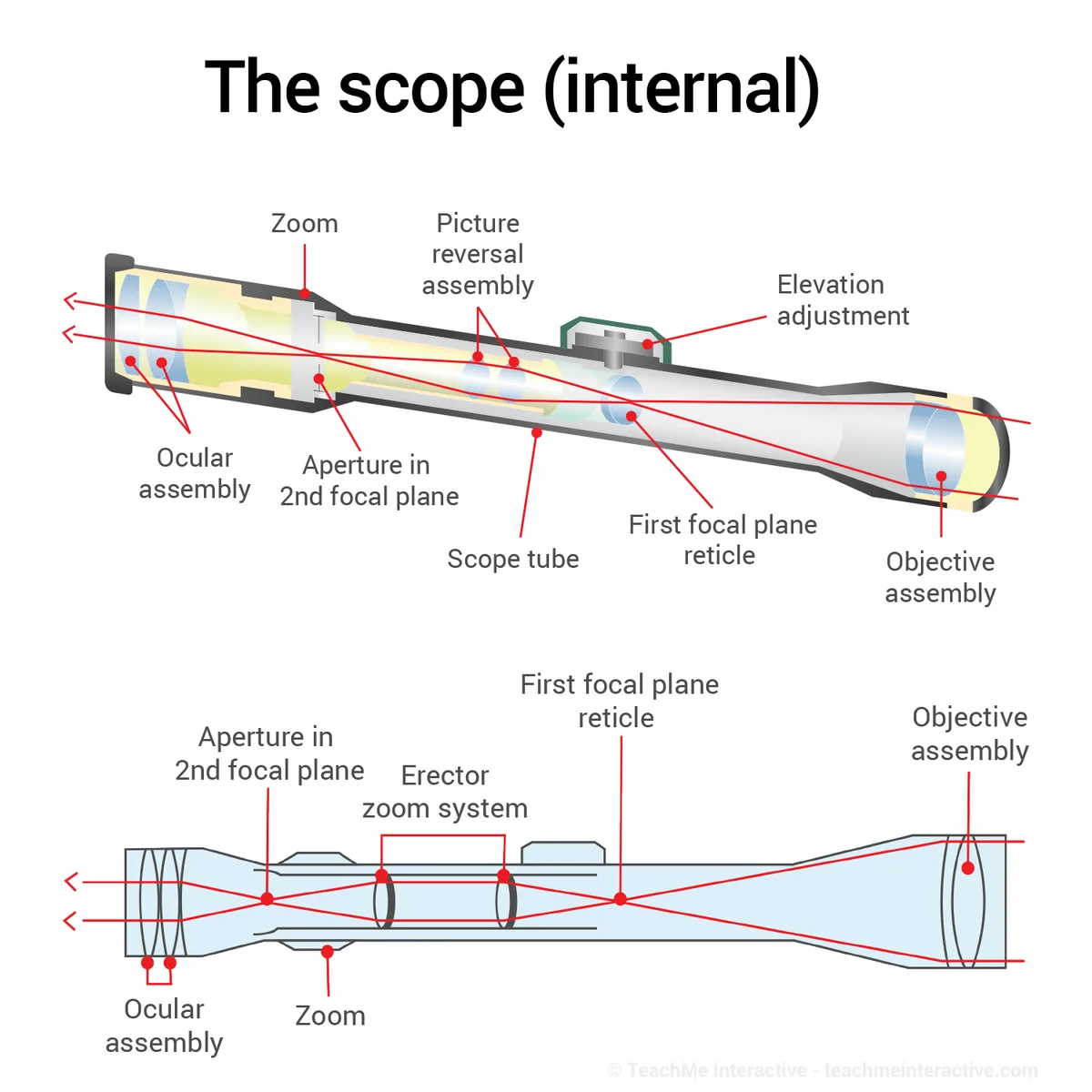
Image source: Web (Bing) / storage.googleapis.com (Web image (fair-use with source credit))
Objective lens size. This is the diameter of the front lens, measured in millimeters. Common sizes are 32mm, 40mm, 44mm, 50mm, and 56mm. A larger objective lens gathers more light.
But it also adds weight and often requires higher rings.
Exit pupil. This is the diameter of the light beam that reaches your eye. The math is simple: divide the objective lens diameter by the magnification level. A 50mm objective at 10x gives you a 5mm exit pupil.
The same scope at 20x gives you only 2.5mm.
Here's how exit pupil changes as magnification increases:
| Objective Lens | At 4x | At 10x | At 16x |
|---|---|---|---|
| 32mm | 8.0mm | 3.2mm | 2.0mm |
| 40mm | 10.0mm | 4.0mm | 2.5mm |
| 50mm | 12.5mm | 5.0mm | 3.1mm |
The human pupil dilates to about 7mm in full darkness and 2 to 3mm in daylight. When the exit pupil drops below 3mm, your image gets noticeably darker. This is why higher magnification scopes look dimmer at dusk even with large objective lenses.
Field of view. As magnification increases, your field of view narrows. Manufacturer specs typically report field of view in feet at 100 yards. A 3-9x scope might show 32 feet at 3x and 12 feet at 9x.
At 12 feet, you're looking through a narrow slice of the world.
Per the American National Standards Institute, optical instrument testing standards tie image brightness and contrast directly to exit pupil diameter and lens coatings. This isn't marketing fluff. It's optics physics.
The practical takeaway: if you hunt in low light, the combination of magnification and objective lens size matters more than either specification alone. A 3-9x with a 50mm objective will outperform a 4-16x with a 40mm objective at the same setting in dim conditions.
Common Magnification Mistakes Hunters Make at the Store
Walking into a scope display case is where most hunters get overwhelmed and make the wrong choice. Here are the mistakes we see most often.
Buying for maximum range, not typical range. This is the number one error. You see a 6-24x scope, imagine a 600-yard shot, and buy it. Months later, you realize your shots almost never exceed 200 yards.
The scope is too heavy and too dim at close range.
Ignoring low-light performance. High magnification scopes with modest objective lenses produce dark images at dawn and dusk. If your hunt happens when light is most challenging, prioritize exit pupil size and lens coatings over raw magnification.
Overlooking reticle behavior at different magnification levels. Some reticles, particularly on second focal plane (SFP) scopes, only show accurate subtensions at one specific magnification. If you're not aware of this, your bullet drop calculations will be off at other power settings. First focal plane (FFP) scopes avoid this issue but cost more.
Choosing magnification without considering recoil. Higher magnification scopes often place your eye closer to the glass. If eye relief is too short, heavy recoiling calibers will push the scope into your eyebrow. Always check eye relief specs before buying, and verify them on the rifle, not just the counter.
Forgetting the caliber's effective range. A .223 Remington or .300 Blackout has an effective hunting range that tops out around 300 to 400 yards for most shooters. Mounting a 4-16x scope on that rifle is overkill. Match your magnification to what the cartridge can actually deliver.
Before you walk into a store, know your terrain, your typical shot distance, and your shooting conditions. That clarity turns an overwhelming wall of scopes into a short list of clear options.
How to Zero and Practice at Your Chosen Magnification
Picking the right magnification is only half the job. You also need to zero your scope properly and practice at the power levels you'll actually use in the field.
Zero at your working magnification. Most hunters zero at full power on a paper target at 100 yards. That's fine for bench work, but your field magnification will be lower. Start your zero at the magnification you plan to shoot most often.
If that's 6x, zero at 6x.
Understand parallax at your chosen distance. Parallax error occurs when the reticle and target are on different focal planes. At lower magnification, parallax matters less. At 12x and above, it becomes significant.
Adjust your side parallax turret to the distance you're shooting, then verify your zero at that range.
Practice at multiple magnification settings. Spend time shooting at 2x, 6x, 10x, and 15x in controlled conditions. This builds familiarity with how the image, reticle, and holdover change at each level. It also helps you understand where your personal comfort zone lies.
Set up your magnification throw lever. Many modern variable scopes come with or accept a throw lever on the magnification ring. This lets you change power quickly without taking your eye off the target. It's a small accessory that pays off in fast-moving field situations.
Confirm your maximum point-blank range (MPBR). MPBR is the farthest distance at which you can aim at the center of a target and still hit it without dialing elevation. For most deer-sized game, MPBR falls between 200 and 300 yards with a 3-9x scope zeroed at 200 yards. Verify this at your chosen magnification before the season.
Time yourself on target acquisition. Have a partner call out targets at varying distances. Practice finding, ranging, and shooting at different magnification levels under time pressure. If you consistently need more than three seconds to acquire a target at your chosen power setting, the magnification may be too high for your conditions.
Proper zeroing and practice at your working magnification builds the muscle memory that makes the difference when a shot opportunity appears.
Frequently Asked Questions
What magnification is best for deer hunting?
For whitetail deer, a 3-9x variable scope covers virtually every real-world situation. Most deer shots in timber or agricultural settings happen inside 150 yards, which 3-9x handles easily. For open-country mule deer, step up to 4-12x or 4-16x to cover longer shots.
Either way, you'll spend most of your hunt at 4-6x regardless of the scope's maximum power.
What magnification is best for coyote hunting?
Predator hunting rewards higher magnification because coyotes are small targets at often considerable distance. A 4-12x or 4-16x scope gives you the reach and target identification you need for shots at 200 to 400 yards. The key is balancing that reach with enough field of view to spot the animal moving through cover before it stops.
Is 3-9x good enough for long-range hunting?
It depends on what you mean by long range. For shots out to 300 yards, 3-9x performs well for most hunting calibers. Beyond 300 yards, you'll want more magnification and likely a first focal plane reticle to maintain accurate holdovers.
If long-range hunting is your primary goal, move to 4-16x or 5-25x.
What magnification do I actually use in the field?
Most hunters report using 3-6x for the majority of their shots, regardless of what scope they carry. Even in open country, where shots extend to 300+ yards, magnification rarely exceeds 10x in practice. The higher end of your scope is reserved for identification and special situations.
That's why matching magnification to your typical engagement distance matters more than maximum capability.
Is a bigger objective lens always better?
No. A larger objective lens gathers more light, but it also adds weight, height, and cost. The real question is whether the additional light-gathering ability matches your magnification range.
A 40mm objective works fine at 3-9x. A 56mm objective makes sense at 4-16x or higher. Match objective lens size to magnification, not to the highest number you can afford.