Is MOA or MIL better for a rifle scope? Neither system is objectively better, but one of them is almost certainly better for you. Both measure angular adjustment, and both work perfectly well if you commit to a single system.
The real choice comes down to how you think about math, what tools you already use, and what shooting community you run in.
Manufacturer specifications confirm that one MOA equals about 1.047 inches at 100 yards, while one MIL equals roughly 3.6 inches at that same distance. That gap shapes everything from your dial math to your wind holds. Here's why this choice matters more than most shooters give it credit for.
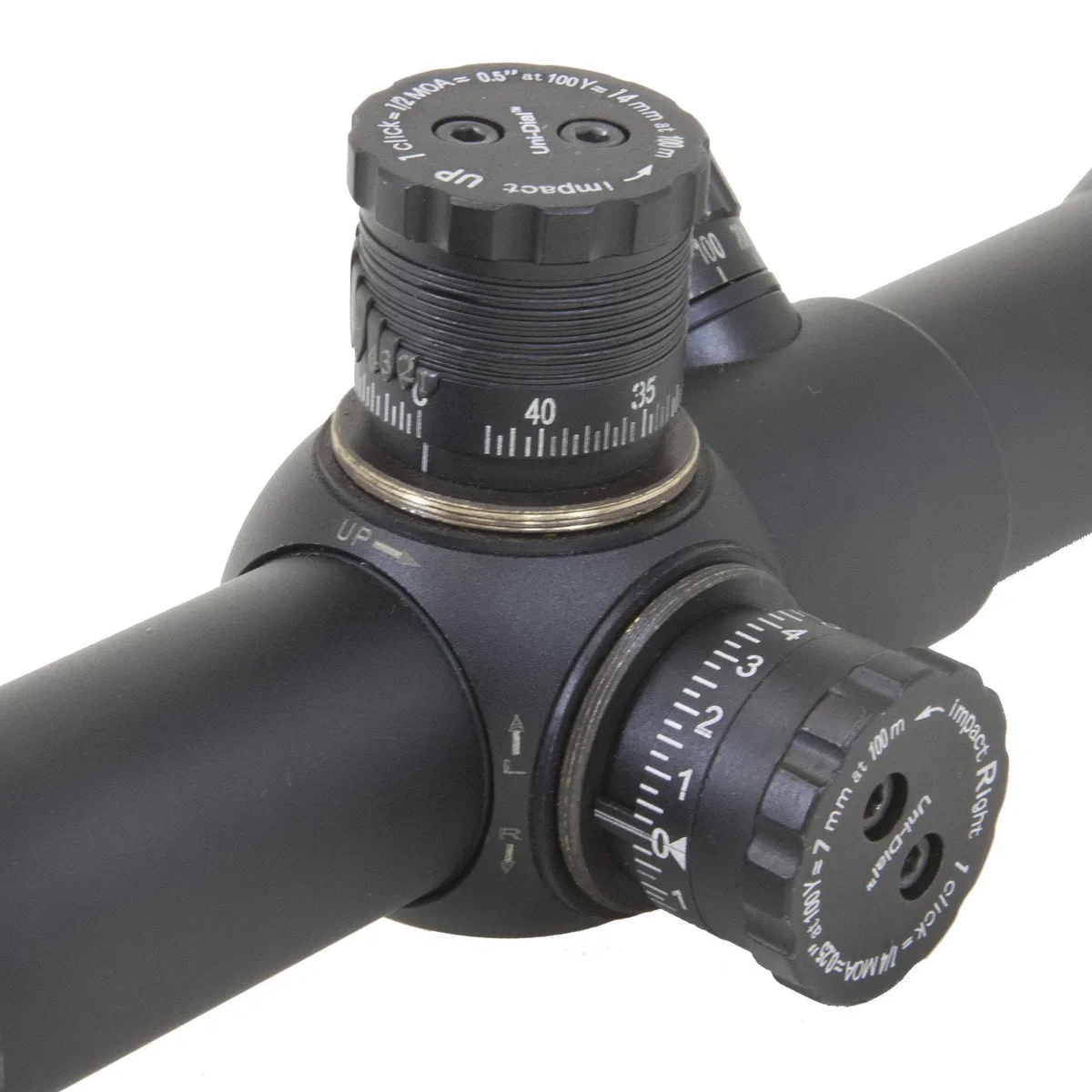
Image source: Web (Bing) / hi-luxoptics.com (Web image (fair-use with source credit))
Quick Answer
Is MOA or MIL better for a rifle scope? Neither system is objectively superior. MIL uses decimal clicks that match most modern ballistic solvers cleanly.
MOA offers intuitive inch-based math at 100-yard distances. Pick one system, then commit to it completely.
Why MOA vs MIL Matters More Than You Think
Most range arguments about MOA vs MIL come down to personal preference. But there's real money and real range time at stake if you get this wrong. Switching systems means relearning your turret math, rebuilding your dope cards, and reworking your ballistic solver inputs.
That's a few hundred dollars and weeks of practice gone.
Competition divisions like PRS and NRL allow both systems, but shooters overwhelmingly pick one and stay with it. Aggregate feedback from match shooters shows MIL trending ahead as of 2026, driven by the decimal system's compatibility with modern ballistic software. MOA still holds strong with hunters and casual range shooters who learned it first.
Military and law enforcement marksmanship programs standardize on MIL for the same reason. The U.S. Army has used MIL-based adjustments in small arms training publications for decades, creating a consistent framework across units and platforms.
You don't need to wear a uniform to benefit from that consistency, but the logic carries over cleanly.
Before we look at how each system actually works, think about who you're learning alongside. If your shooting partner runs MIL and you show up with MOA, you'll spend more time converting numbers than pulling triggers. That shared context shapes the whole experience.
How MOA Works: The Inch-Friendly System
MOA stands for minute of angle. It's an angular unit that translates to about 1.047 inches at 100 yards. Most shooters round that to one inch, and that rough figure does most of the heavy lifting on the range.

Image source: Bing (Web (fair-use with source credit))
Most scopes offer 1/4 MOA clicks, meaning each click moves the point of impact by one quarter of a minute. At 100 yards, one click equals roughly a quarter inch. At 200 yards, that same click moves impact about half an inch.
The numbers scale linearly with distance.
That inch-based reference makes MOA intuitive for anyone raised on yards and inches. If you're dialing 3 MOA of elevation at 300 yards, you're looking at about 3 inches per MOA at that distance. The mental math stays straightforward and fast under pressure.
MOA does have a real weakness though. Its decimal representation gets messy at long range. If your ballistic solver outputs 2.37 MOA of drop, you're dialing 9 clicks and change.
It works fine, but the numbers won't always look clean on your dope card.
This isn't a dealbreaker. Thousands of PRS and NRL shooters run MOA successfully every match season. The system works.
You just have to accept that the math won't always be pretty, and most experienced MOA shooters will tell you the same thing.
How MIL Works: The Decimal Shooter's System
MIL stands for milliradian. A milliradian covers about 3.6 inches at 100 yards. In practice, most scopes use 0.1 MIL clicks, which equals about 0.36 inches per click at that distance.
The decimal-friendly structure is what makes MIL popular with serious shooters. If your ballistic solver spits out 4.2 MILs of drop, you dial exactly 42 clicks. Clean.
No fractions. No mental gymnastics on the firing line.
MIL also plays nicer with metric environments. If you're shooting on ranges marked in meters instead of yards, the conversion math doesn't introduce extra steps. That's one reason European and international competition shooters lean heavily toward MIL.
Wind holds follow the same decimal logic. A 10 mph crosswind might call for 0.4 MILs of hold. You pick the 0.4 MIL line on your reticle and go.
That number line stays consistent, assuming you're running a first focal plane scope where subtensions hold true at every magnification level.
MIL does have a learning curve for anyone who learned MOA first. The numbers feel foreign for a few sessions. But shooters who commit to the system report fast adaptation, usually within a few range trips.
Per manufacturer specifications across major optics brands, MIL-based scopes now account for the majority of new long-range models released as of 2026. Brands like Vortex Optics publish detailed technical breakdowns that help new shooters understand exactly how the system works before committing.
MOA vs MIL Side-by-Side: Click Values, Math, and Turret Travel
Here's where the two systems get compared in concrete terms. The table below breaks down the numbers that actually matter on the range.
| Factor | MOA | MIL |
|---|---|---|
| Common click value | 1/4 MOA | 0.1 MIL |
| Approximate per-click value at 100 yards | ~0.26 inches | ~0.36 inches |
| Typical turret travel range | 30 to 50 MOA | 10 to 18 MIL |
| Ballistic solver output | Decimal MOA (e.g., 2.37) | Decimal MIL (e.g., 4.2) |
| Popular with | US hunters, casual shooters | Long-range competitors, military/LEO |
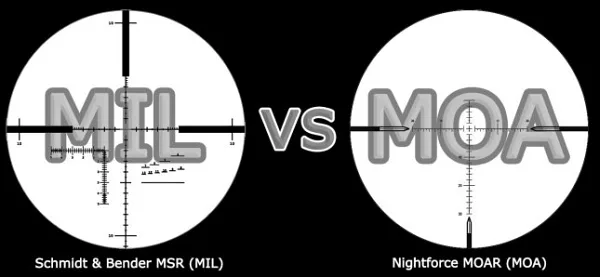
Image source: Web (Bing) / bulletin.accurateshooter.com (Web image (fair-use with source credit))
The turret travel column deserves more attention than it usually gets. If you need to dial 8 MILs of elevation for a 600-yard shot, that's 80 clicks on a 0.1 MIL scope. With 1/4 MOA clicks and roughly 29 MOA of drop at that same distance, you're looking at 116 clicks.
More clicks means more turret turning and more room for a miscount.
Both systems handle extreme long-range shooting just fine. MIL simply gets there with fewer clicks on average, which is why dedicated long-range competitors tend to prefer it. Nightforce Optics, a leading name in long-range competition glass, documents this turret-travel advantage on their technical pages, showing how MIL-based models offer more elevation in a compact turret package.
Which System Fits Your Shooting Style and Use Case
The right choice depends on who you are as a shooter. Here's how the two systems stack up for different needs.
Choose MOA if:
- You learned MOA first and are comfortable with inch-based math
- You hunt primarily on US ranges marked in yards
- You prefer simple fractional adjustments over decimals
- Your ballistic solver already outputs MOA values and you don't want to switch
- You shoot with partners who also use MOA
Choose MIL if:
- You're building a long-range competition rig for PRS or NRL
- You prefer decimal math that matches modern solver software
- You shoot in metric environments or run with military or LEO-trained partners
- You want fewer turret clicks at extended distances
- You plan to shoot internationally or on ranges marked in meters
Neither choice is wrong. The bigger risk is switching back and forth without committing to either system. Once you pick one, stick with it for at least a full season before reconsidering.
Consistency in your dope card matters more than which unit of measurement you chose.
Neither system makes you a better shooter. What makes you better is consistency, repetition, and the discipline to build a reliable dope card on whichever system you pick. The unit of measurement is just the language you use to communicate your adjustments.
Mistakes Shooters Make When Choosing Between MOA and MIL
The biggest mistake isn't picking the wrong system. It's mixing two systems on one rifle or across a shooting partner group. A shooter dialing in MOA while their spotter calls corrections in MILs will miss shots they had no business missing.
The fix is simple. Everyone on the same page, same unit, no exceptions.
Another common error is treating scope click values as universal. Not every MOA scope runs 1/4 MOA clicks. Some older hunting scopes use 1/2 MOA increments, and a few precision models offer 1/8 MOA clicks.
Before you dial anything, confirm your exact click value from the manufacturer's spec sheet.
Ballistic solver setup trips up beginners too. If you enter your scope data in MOA but your solver outputs MILs, you'll dial the wrong number every single time. The software itself isn't the problem.
The input mismatch is, so check your solver settings twice before each range session.
Turret miscounts happen with both systems, but they sting more when the click values don't scale the way your brain expects. Write every adjustment on a dope card instead of trusting memory. Even experienced competitors keep written elevation data on their rifles.
Finally, don't switch systems mid-season because a friend recommends it. If your dope card and habit patterns are built on MOA, switching to MIL means starting from zero. Give whatever you pick at least one full season of consistent practice before you even think about a change.
MOA vs MIL FAQs
Is MOA or MIL better for a rifle scope?
Neither is objectively better. Both systems dial accurately when used consistently. MIL uses decimal clicks that pair well with modern ballistic solvers.
MOA uses inch-based math that feels intuitive on US ranges. Pick the one that matches your existing tools and stick with it.
Can you convert between MOA and MIL?
Yes, the math works, but it adds steps and errors under pressure. One MIL equals roughly 3.44 MOA. If your scope clicks in MOA but your solver outputs MILs, you'll convert every shot.
It's doable, but it's a recipe for dialing mistakes when time matters.
Which system do military and law enforcement use?
MIL is the standard. U.S. Army and Marine Corps marksmanship training publications both rely on milliradian-based adjustments.
That's why MIL carries over so naturally into civilian long-range shooting. If you've ever been around trained marksmen, MIL is likely the language they speak.
Does MIL require a first focal plane scope?
No, but FFP scopes make MIL holdovers work correctly at every magnification level. On a second focal plane scope, MIL subtensions are only accurate at one specific magnification setting. If you plan to hold over with your reticle rather than dial, FFP is the smarter buy.
Will choosing MOA or MIL affect accuracy?
Your choice of angular unit doesn't change mechanical accuracy. What matters is consistency between your ballistic data, your turret clicks, and your written dope card. A shooter with a solid MOA dope card will outperform a MIL shooter with sloppy data every single time.
What is the difference between MOA and MIL at 600 yards?
At 600 yards, one MOA covers about 6.3 inches. One MIL covers roughly 21.5 inches. That scale difference shapes how many clicks you dial for the same elevation correction.
MIL covers more ground per click, which means fewer turret turns at extended range.
The Final Verdict: Which Scope Adjustment System You Should Pick
If you're starting from scratch, MIL is the stronger default. The decimal system matches most modern ballistic software, requires fewer clicks at distance, and aligns with the training programs that serious competitors follow. As of 2026, MIL-based scopes outnumber MOA options in most new long-range product lines, and that trend isn't slowing down.
If you're already fluent in MOA and your tools reflect it, don't switch just because a friend recommends it. MOA works. It has worked for decades across hunting and competition.
A well-built MOA dope card, confirmed at the range and trusted in the moment, beats an unfamiliar MIL setup every time.
The real answer comes down to this. One system beats the other for you based on your tools, your community, and your shooting habits. Choose the one that fits your situation.
Commit to it. Build your dope card on that system and verify it at the range.
That's what separates shooters who hit their targets from shooters who argue about units while their rifle sits in the case.