How long does a rifle scope battery last? The honest answer depends on which optic you're running, the battery type it takes, and how you actually use it. A red dot like the Aimpoint ACRO P-2 can run for over 50,000 hours on a single CR2032.
An illuminated LPVO like the Vortex Razor HD Gen III drains in a few hundred hours. Thermal scopes barely last a full night.
Manufacturer specifications indicate runtime under specific brightness settings in controlled lab conditions. Real-world use looks quite different. We'll break down the actual numbers, compare the four main battery systems, and help you set the right expectations before your next hunt.
Quick Answer
How long does a rifle scope battery last? It ranges from roughly 200 to 50,000 hours depending on the optic. Red dots typically last 30,000 to 50,000 hours.
Illuminated LPVOs usually run 200 to 400 hours. Thermal and night vision scopes drain fastest, often lasting under 10 hours per charge.
The Battery Life Numbers Nobody Tells You
A rifle scope battery can last anywhere from a few hours to over 50,000 hours. That range is enormous. It's not because manufacturers are vague.
It's because battery demand varies completely between scope categories.
Red dot sights like the Aimpoint CompM5 and Holosun HE508T are engineered for long battery life. Manufacturer specs indicate up to 50,000 hours at lower brightness settings. That's roughly five to six years of continuous use on a single battery.
Illuminated LPVOs sit in the middle of the range. Models like the Vortex Razor HD Gen III and Primary Arms SLx typically run 200 to 400 hours on a single battery. Night vision and thermal scopes drain the fastest.
Many night vision models make it through 40 to 80 hours on CR123A batteries. Most thermal scopes barely reach 4 to 8 hours on a full charge.
Brightness settings have the biggest impact on runtime. Most scopes offer 10 to 14 illumination levels. Running at maximum brightness during daylight can cut your runtime by 60 to 80 percent compared to moderate night settings.
| Scope Type | Typical Battery Life | Common Battery |
|---|---|---|
| Red dot (low setting) | 30,000 to 50,000 hours | CR2032, AA, CR123A |
| Holographic sight | 600 to 1,100 hours | AA, CR123A |
| Illuminated LPVO | 200 to 400 hours | CR2032 |
| Night vision scope | 40 to 80 hours | CR123A, AA |
| Thermal scope | 4 to 8 hours | AA, CR123A, proprietary |
The takeaway is simple. If you're buying a red dot for a home defense AR-15, battery life probably isn't your biggest concern. If you're running a thermal scope on a multi-day hog hunt, it absolutely is.
CR2032 vs. AA vs. CR123A vs. USB-C: Which Battery System Matters Most
The battery system your scope uses matters just as much as the optic itself. Here's how the four main options compare.
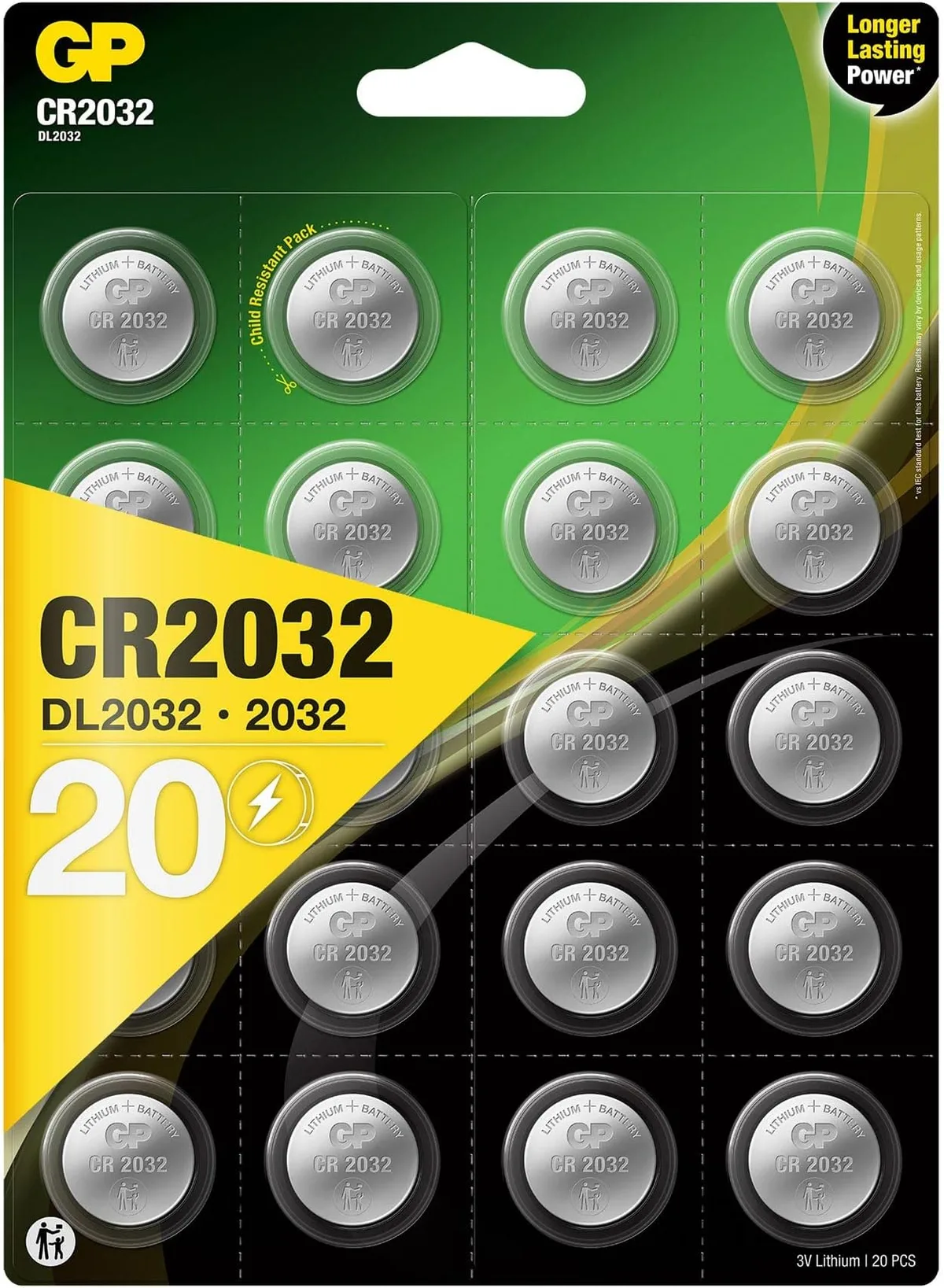
CR2032 coin cell is the most common battery in illuminated LPVOs and many compact red dots. It's cheap, lightweight, and widely available. Average cost per battery is $0.50 to $1.00.
Runtime depends entirely on illumination brightness, but expect 200 to 400 hours in typical use. The downside is that lithium coin cells lose capacity in cold weather. They can also leak if left in a scope for years.
AA batteries power many night vision scopes and some older optics. You can buy them anywhere, which makes field replacements easy. Lithium AA cells outperform alkaline by a wide margin in cold conditions.
They run roughly 4 to 8 hours in thermal scopes and 600 to 1,200 hours in simpler illumination systems.
CR123A lithium batteries deliver higher voltage and better cold-weather performance than AA. EOTech holographic sights and many night vision devices use them. Runtime ranges from 600 to 1,200 hours depending on the device.
They cost more than AA batteries but hold up better in extreme temperatures.
USB-C rechargeable scopes are the newest category. Holosun, Primary Arms, and several other manufacturers now offer models with built-in lithium-ion batteries and USB-C charging ports. You eliminate disposable battery costs entirely.
Charge times run 2 to 4 hours. The tradeoff is that you need power access to recharge, which doesn't help on a week-long backcountry hunt.
| Battery Type | Avg. Cost | Cold Weather Performance | Rechargeable? | Best For |
|---|---|---|---|---|
| CR2032 | $0.50 to $1.00 | Moderate | No | LPVOs, compact red dots |
| AA Lithium | $1.00 to $2.00 | Excellent | Some (NiMH) | Night vision, field replacement |
| CR123A | $2.00 to $4.00 | Excellent | No | Holographic sights, NV scopes |
| USB-C Li-ion | Built-in (N/A) | Good | Yes | Urban and range use |
If you hunt in cold climates, lithium AA and CR123A give you the best reliability. If you shoot mostly at the range or in mild conditions, CR2032 and USB-C rechargeable systems keep things simple and affordable.
Illuminated LPVO, Red Dot, Night Vision, and Thermal: Real Battery Life by Scope Type
Each scope category draws power differently. Knowing what you're actually getting matters before you make a purchase.
Red dot sights are the champions of battery life. Aimpoint models routinely exceed 50,000 hours on CR2032 or AA batteries. Trijicon RMRs run about four years at mid-brightness settings.
This is because red dots use a simple LED and don't need high power to illuminate a reticle. Keep the brightness at a reasonable level, and you're looking at years of service.
Holographic sights from EOTech sit between red dots and LPVOs on battery life. The EXPS series runs about 600 hours on an AA battery. The XPS series gets roughly 1,100 hours on a CR123A.
Holographic technology uses more power than reflex dots, but still gives you hundreds of shooting hours.
Illuminated LPVOs are where battery life becomes a real concern. The Vortex PST Gen II and similar models draw more current because the illuminated reticle has to stay visible through a variable-power lens. Brightness settings matter enormously here.
Most LPVOs run 200 to 400 hours at moderate brightness. Crank the dial to maximum in daylight, and that number drops fast.
Night vision scopes use image intensifier tubes that require constant power. The tubes themselves don't draw much, but the reticle illumination and auxiliary functions do. Expect 40 to 80 hours on CR123A batteries.
Some units use AA batteries for shorter runtime.
Thermal scopes are the hungriest devices in this category. They have processors, detectors, and displays running simultaneously. Average runtime is 4 to 8 hours on AA or CR123A batteries.
Some thermal units use proprietary rechargeable packs with similar durations. As of 2026, no consumer thermal scope breaks the 12-hour mark on a single charge.
| Scope Category | Power Source | Battery Life Range | What Drains It Fastest |
|---|---|---|---|
| Red dot | CR2032, AA | 30,000 to 50,000 hrs | High brightness in daylight |
| Holographic | AA, CR123A | 600 to 1,100 hrs | Continuous illumination |
| Illuminated LPVO | CR2032 | 200 to 400 hrs | Maximum brightness setting |
| Night vision | CR123A, AA | 40 to 80 hrs | Extended session length |
| Thermal | AA, CR123A, proprietary | 4 to 8 hrs | Processor and display power |
The pattern is clear. The more complex the technology inside the optic, the shorter the battery life. Red dots win because they're simple.
Thermal scopes lose because they're doing heavy computational work in real time.
Side-by-Side Battery Life Comparison Across Popular Scopes
Here's how some of the most popular optics compare on battery life, based on manufacturer specs and aggregate field reports.
| Scope Model | Type | Battery | Manufacturer Spec | Real-World Estimate |
|---|---|---|---|---|
| Aimpoint ACRO P-2 | Red dot | CR2032 | 50,000 hours | 35,000 to 45,000 hours |
| Aimpoint CompM5 | Red dot | AA | 50,000 hours | 30,000 to 40,000 hours |
| Trijicon RMR Type 2 | Red dot | CR2032 | ~4 years at setting 4 | 2 to 3 years typical |
| Holosun HE508T | Red dot | CR123A | 50,000 hours | 30,000 to 40,000 hours |
| EOTech EXPS3 | Holographic | AA | 600 hours | 400 to 550 hours |
| EOTech XPS3 | Holographic | CR123A | 1,100 hours | 800 to 1,000 hours |
| Vortex Razor HD Gen III | LPVO | CR2032 | ~300 hours | 200 to 300 hours |
| Vortex PST Gen II | LPVO | CR2032 | ~250 to 300 hours | 180 to 250 hours |
| Primary Arms SLx | LPVO | CR2032 | ~200 to 300 hours | 150 to 250 hours |
| Trijicon Credo 1-8x | LPVO | CR2032 | ~250 hours | 200 to 250 hours |
The pattern is consistent. Manufacturer specs sit at the high end of real-world performance. Aggregate user reviews suggest you should expect roughly 20 to 40 percent less runtime than what's printed on the box.
This isn't dishonest marketing. It's just how specs work. They're tested under ideal conditions at moderate brightness.
A practical note for LPVO buyers. The Vortex Razor HD Gen III's CR2032 battery access sits inside the top turret cap. Swapping it takes seconds in the field if you carry a spare.
Some Primary Arms models have similar setups. Others require removing a scope cap or using a small tool. Check the battery compartment design before you buy.
For thermal scope buyers, the gap between spec and real-world use is smaller because runtime is already so short. You're buying a thermal scope with the understanding that you'll carry multiple battery sets. Most serious thermal hunters carry 4 to 8 spare CR123A cells per outing.
Why Manufacturer Specs Are Lying to You (And What Happens in the Cold)
Manufacturers aren't trying to deceive you. They're testing under conditions that don't match how you shoot. Here's what changes the numbers in the real world.
Brightness settings are the biggest variable. Aimpoint's 50,000-hour rating assumes low illumination. If you run the optic at maximum brightness during a bright range day, expect that number to drop to 5,000 to 8,000 hours. It's not a defect.
It's physics.
Temperature kills lithium battery capacity. Per U.S. Department of Energy guidelines on lithium primary cells, cold temperatures slow the chemical reactions inside the battery. At freezing temperatures, lithium coin cells can lose 20 to 30 percent of their rated capacity.
At zero degrees Fahrenheit, losses can hit 40 to 50 percent.
This is why a CR2032 that runs an LPVO fine in October might barely make it through a late-season hunt in January. It's also why many hunters prefer lithium AA batteries in cold climates. Energizer Ultimate Lithium AA cells perform much better at sub-zero temperatures than alkaline equivalents.
Age matters too. Batteries self-discharge over time. A CR2032 that's been sitting in a scope since last hunting season might have lost 10 to 15 percent of its charge before you even use it. This is why many experienced hunters replace their scope batteries at the start of every season, regardless of whether the optic still "works."
| Condition | Capacity Loss | What Happens |
|---|---|---|
| Room temperature (68°F) | None | Rated performance as specified |
| Cold weather (32°F / 0°C) | 20 to 30 percent | Shorter runtime than spec |
| Extreme cold (0°F / -18°C) | 40 to 50 percent | Dramatic runtime reduction |
| Aged battery (1+ year) | 10 to 15 percent | Reduced starting charge |
| Maximum brightness setting | 60 to 80 percent cut | Far shorter than rated hours |
The fix isn't complicated. Set your brightness to the lowest level that's still visible. Carry spare batteries.
Replace them before the season starts. And treat the manufacturer's spec as an upper bound, not a guarantee.
For proper disposal of spent lithium coin cells, the U.S. Environmental Protection Agency provides clear recycling guidelines at EPA.gov. Don't toss dead CR2032 cells in the trash.
They're small, but they can leak and corrode your scope's contacts if left sitting too long.