What is a parallax adjustment on a rifle scope? It corrects for a small optical error that shifts your reticle against the target when your eye isn't perfectly centered behind the scope. This error grows with higher magnification and longer distances.
If you shoot past 200 yards, understanding parallax matters.
Manufacturer specifications on most long-range scopes show a parallax adjustment range from 25 yards to infinity. The common parallax-free reference distance is 100 yards, though some models use 50 or 150. This is exactly the kind of detail that separates a hit from a miss at long range.
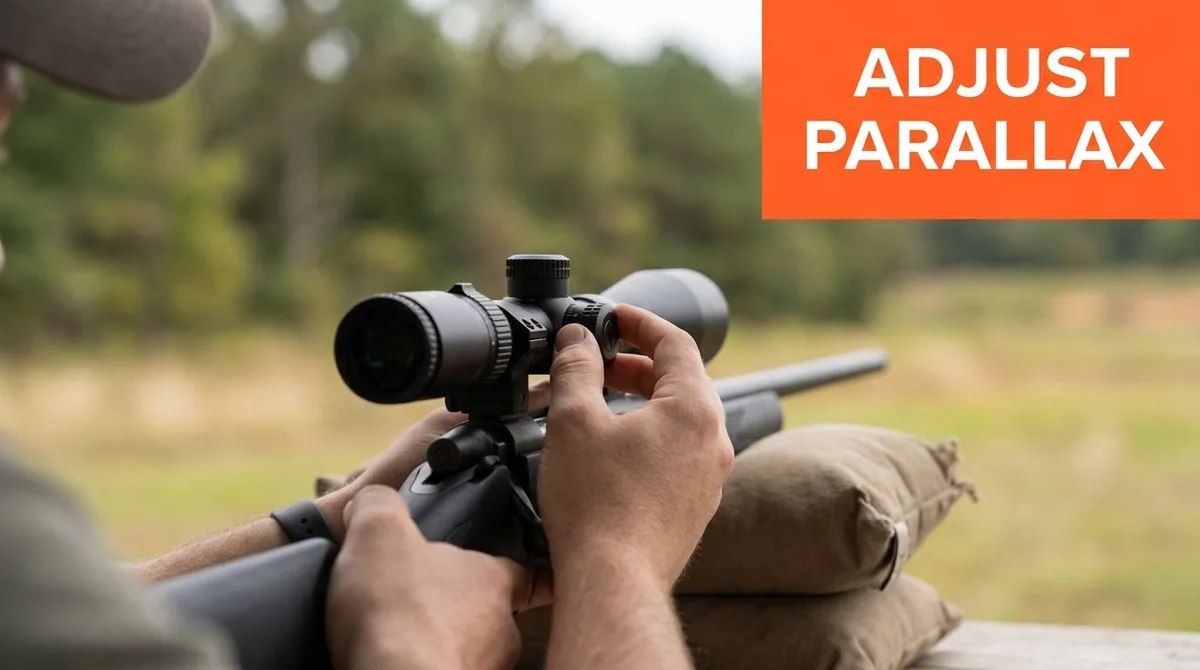
Image source: Web (Bing) / karoooutdoor.com (Web image (fair-use with source credit))
Quick Answer: What Parallax Adjustment Actually Does on a Rifle Scope
A parallax adjustment on a rifle scope corrects an optical error. The reticle shifts against the target when your eye is off-center. Side-focus turrets and adjustable objectives are the two main types.
Shooters use it to eliminate point-of-impact shift at varying distances.
How Parallax Works on a Scope (And Why You Can Feel It Without Knowing Why)
Parallax is an optical phenomenon where the apparent position of one object shifts when viewed from different angles. Inside a rifle scope, you have two images: the target and the reticle. They sit on different focal planes, which is the root of the problem.
When your eye is perfectly centered behind the scope, the reticle lines up perfectly with the target. Move your eye slightly off-center and the reticle appears to shift against the target. The rifle hasn't moved at all.
Your point of impact has changed anyway.
Think about holding a pen at arm's length. Blink between eyes and the pen seems to jump against the background. Scope parallax works the same way, just at a different scale.
At short distances, this error is negligible. Push past 300 yards and it compounds quickly. Long-range competition shooters consistently report that uncorrected parallax shifts point of impact by several inches at that range.
Most scopes are parallax-free at one fixed distance, usually 100 yards. At every other range, the error exists. That's exactly why adjustable parallax matters.
Nightforce Optics and other manufacturers publish detailed optical diagrams on their official sites showing how the reticle and target images interact.
If you moved your head behind the scope and the crosshair drifted off your target, you were seeing parallax in action.
Side Focus vs. Adjustable Objective: The Two Types of Parallax Turrets
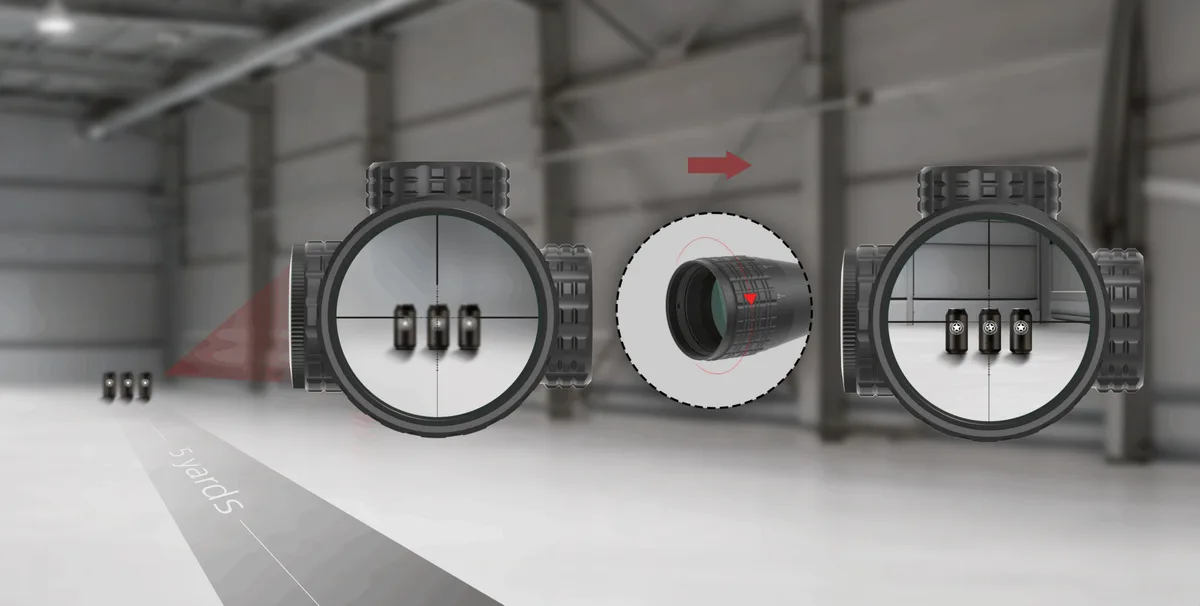
There are two standard ways rifle scopes let you adjust parallax. The type you have changes how you operate the dial and where it sits on the scope body.
| Feature | Side Focus | Adjustable Objective (AO) |
|---|---|---|
| Location | Left side of scope body | Front ring on the objective bell |
| Glove-friendly | Yes | Difficult with large gloves |
| Turret tracking | Generally more precise | Can be less consistent |
| Common on | Long-range and tactical scopes | Hunting scopes and older designs |
Side focus turrets are the standard on most premium long-range scopes. Vortex Optics, Nightforce, and Leupold all use this design on their flagship models. Manufacturer specs typically show a parallax adjustment range from 25 yards to infinity.
Adjustable objective designs work on the same principle. You rotate the objective bell to shift the target image until the reticle stays fixed when your eye moves. They're more common on hunting-focused scopes.
As of 2026, side focus dominates new long-range scope releases. It's easier to use in the field, especially with gloved hands or when you need to make quick adjustments between shots.
If you shoot at varying distances frequently, a side-focus turret is the better pick. AO scopes work well for fixed-distance hunting where you rarely change ranges. For competition or precision work, go with side focus every time.
Fixed Parallax Scopes: When You Don't Have It, What Changes
Some scopes come with fixed parallax. There's no external dial to adjust. Instead, the scope is parallax-free at one manufacturer-specified distance, usually 100 yards.
If your target is at that exact distance and your eye is perfectly centered, you're fine. Step away from it and parallax error appears. How much depends on your magnification level.
| Magnification Range | Distance from Reference | Impact on Accuracy |
|---|---|---|
| 1x to 4x | Up to 300 yards | Minimal to unnoticeable |
| 5x to 10x | 200 to 400 yards | Noticeable for precision work |
| 10x to 24x+ | Any distance away from reference | Significant, POI shifts by inches |
The term "parallax-free at 100 yards" means exactly what it sounds like. The reticle and target image align perfectly at 100 yards only. At 50 yards, the reticle sits slightly off.
At 300 yards, it shifts further. Higher magnification magnifies the error.
A fixed parallax scope is perfectly fine for close to medium-range hunting. Most deer-sized game inside 200 yards won't reveal the difference. The problem starts once you're pushing longer shots or need pinpoint accuracy.
If you've had unexplained misses at long range and your rifle and ammo are confirmed good, check your scope design. A fixed parallax optic could be the reason.
How to Check and Set Parallax on Your Rifle Scope
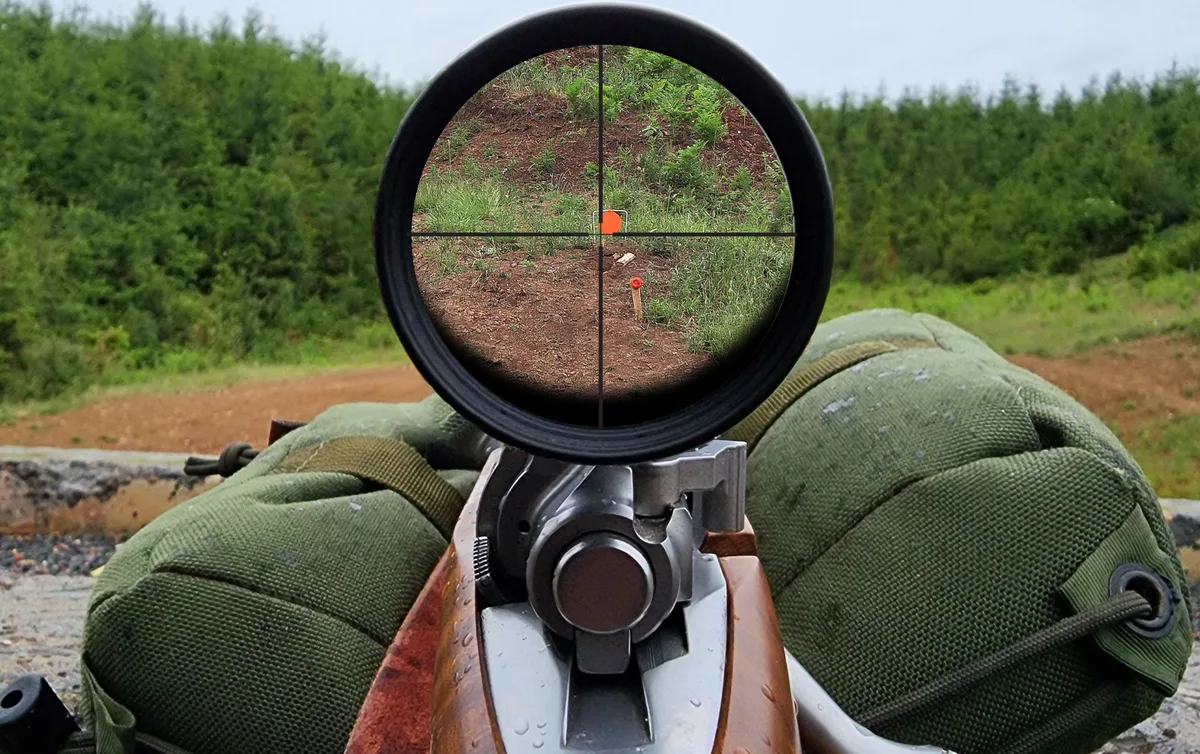
Checking whether your scope has parallax error takes about five minutes. You need a stable rest and a target at a known distance.
The test procedure:
- Set up your rifle on a solid rest and point it at your target.
- Set the parallax dial to match your target distance. If you have no dial, skip to step 4.
- Get behind the scope in your natural shooting position. Keep the rifle completely still.
- Without touching the rifle, slowly move your head left to right behind the scope.
- Watch the reticle against your target. Does the crosshair shift off point?
If the crosshair moves, that's parallax error in action. Turn your parallax dial until the reticle stays locked on the target even when you move your head slightly.
If your scope has no adjustment dial, move your eye closer to or farther from the exit pupil until the reticle appears to stay put. That's the parallax-free eye position for that distance.
Practice centering your eye behind the scope consistently. It becomes automatic with repetition. Your group sizes will tighten noticeably at longer distances.
Common Parallax Mistakes That Cause Mysterious Misses
Parallax error is one of the sneakiest accuracy problems in long-range shooting. These are the mistakes shooters run into most often:
- Ignoring it entirely. Many shooters never adjust parallax because they don't know their scope has it. Check your owner's manual to confirm.
- Setting the dial at the wrong distance. If your target is at 350 yards, don't leave the dial at 100. Match it every time you change ranges.
- Forgetting steep angles. When shooting uphill or downhill, the line of sight through the scope is longer than the straight-line distance to target. This makes parallax error worse.
- Using a fixed-parallax scope for precision work. Budget scopes without adjustable parallax are fine for close range. They're a liability past 300 yards.
- Inconsistent eye position. Even with parallax set correctly, wildly inconsistent eye placement adds error. Practice centering your eye behind the scope.
- Assuming all parallax-free scopes behave the same. Manufacturer-specified distances vary. Some are 50 yards, others 150. Know what yours says.
The most common real-world scenario is this: a shooter zeroes at 100 yards, hunts at 400 yards, and wonders why the rifle shoots wrong with no other explanation. Parallax error is usually the reason.
Pro Tips for Dialing Parallax Faster and More Accurately
A few habits that make parallax adjustment quicker and more reliable in the field.
Mark your turret distances. Many shooters scratch small lines on the parallax dial at the ranges they shoot most often. If you hunt at 150, 300, and 450 yards, mark those three settings on the turret. You'll dial to the right number without squinting under pressure.
Work the turret in cold weather. Side-focus knobs can stiffen when temperatures drop below freezing. Turn the dial through its full range before your first shot to loosen the internal grease. This prevents that gritty, slow feel that throws off timing between shots.
Zero at your parallax-free distance. Set the dial to the manufacturer-specified parallax-free range before shooting your zero groups. If that distance is 100 yards, leave it there. This isolates parallax as a variable while you're confirming your zero.
Build a repeatable sequence. Precision shooters who dial parallax consistently tend to follow this order:
- Measure or estimate range to the target.
- Match the parallax dial to that distance.
- Move your head slightly and confirm the reticle stays put.
- Take the shot.
Repeat this every time until it becomes muscle memory. Aggregate feedback from long-range competition shooters suggests this routine alone shrinks group sizes at 400+ yards.
Keep your eye position consistent. Parallax adjustment only works when your eye sits in the correct spot behind the exit pupil. Practice finding that eye box quickly each time you mount the rifle. Consistent eye placement paired with correct dial settings is what makes parallax correction actually work.
Frequently Asked Questions
Does every rifle scope have a parallax adjustment?
No. Many budget scopes and low-magnification optics use fixed parallax set at one manufacturer-specified distance, usually 100 yards. Scopes with side-focus turrets or adjustable-objective rings let you adjust parallax to match your actual shooting distance.
How do I know if my scope has parallax?
Look for a turret on the left side of the scope body, which is a side-focus design. Or check for a rotating ring on the objective bell, which is an adjustable objective. If neither exists, your scope likely has fixed parallax.
Can parallax cause point-of-impact shift at short range?
Yes, but the effect is tiny at close distances. With magnification below 5x and a target inside 100 yards, parallax error is usually less than a quarter MOA. It becomes meaningful above 200 yards and 10x magnification.
Should I adjust parallax every time I shoot at a different distance?
Yes. Match the parallax dial to your target range before every shot when distances change. Leaving it at 100 yards while engaging a 400-yard target introduces avoidable point-of-impact error that compounds with higher magnification.
What happens if I never adjust parallax?
If you're shooting at moderate magnification inside 200 yards, you probably won't notice a problem. Beyond that range, uncorrected parallax causes inconsistent misses that are hard to diagnose without checking whether the dial was set correctly.