What is an illuminated rifle scope? In simple terms, it's a rifle optic with a reticle that can light up, usually red or green, so you can pick up your aiming point when light gets dim. If you've ever squinted at a plain black crosshair at dawn, you already understand why this feature exists.
Most illuminated scopes use either LED illumination powered by a small battery or fiber optic tubes that gather ambient light. Manufacturer specifications show that many modern models offer between 3 and 12 brightness settings, with battery life ranging from about 1,000 to over 50,000 hours depending on the design. Let's break down how these optics actually work from the inside out.
Quick Answer
An illuminated rifle scope is a magnified optic with a lighted reticle. The reticle glows in red or green for low-light aiming. An external dial adjusts brightness from dim to bright.
Most models run on a CR2032 battery for power. Some use fiber optics that catch ambient light instead.
What Is an Illuminated Rifle Scope, Really?
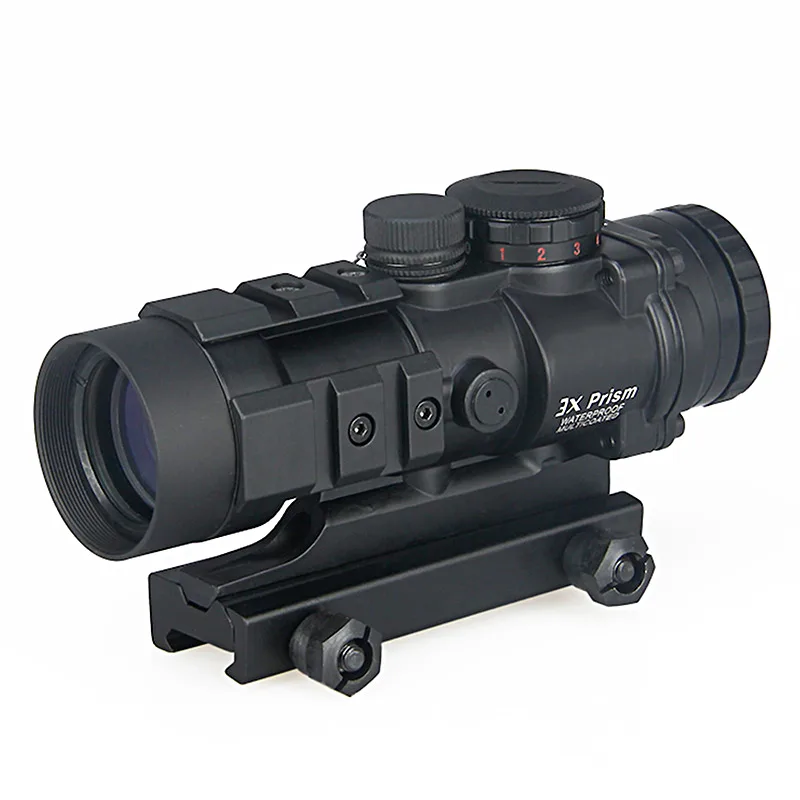
A rifle scope, sometimes called an optical sight, is the magnified device you mount on a rifle for precise aiming. It uses a series of lenses to bring your target closer visually and an etched crosshair, called a reticle, to mark the exact point where your bullet should land.
The illuminated feature means that reticle can light up on demand. Instead of a plain black crosshair that disappears into dark backgrounds, an illuminated reticle glows in red, green, or blue. You control the brightness with a dial on the scope body.
There are three main ways rifle scopes create this illumination:
- LED-powered: A small light-emitting diode inside the scope shines light onto the reticle. You adjust brightness using an external dial. This is the most common method across all price tiers.
- Fiber optic: A tube gathers ambient light and channels it to the reticle. No battery needed, but brightness depends entirely on surrounding light levels.
- Tritium: A tiny radioactive isotope inside the reticle glows continuously without batteries. It's found in some specialized optics like the Trijicon ACOG line.
As of 2026, LED-powered illumination dominates the market. According to manufacturer documentation from Leupold, Vortex, and Nightforce, battery-powered reticle illumination appears in everything from budget hunting scopes to premium long-range optics.
How Reticle Illumination Actually Works
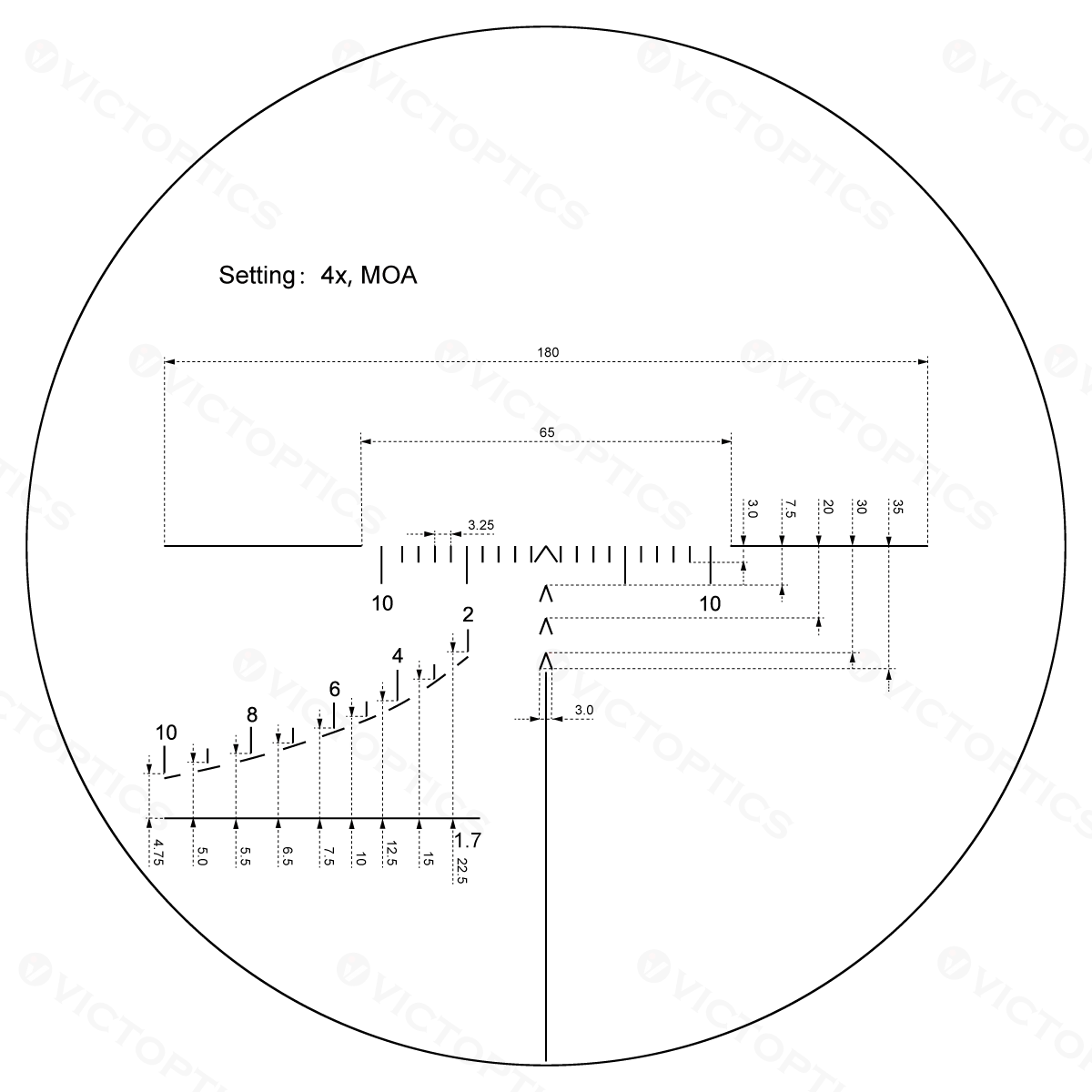
The illumination system inside a scope is surprisingly simple. It comes down to three parts: a light source, a way to project that light onto the reticle, and a dial that lets you adjust brightness.
In an LED-illuminated scope, a tiny diode sits behind the reticle glass. When you turn the dial, the battery sends power to that diode. It casts a red or green glow directly onto the etched crosshair pattern.
The number on the dial corresponds to how much voltage reaches the diode, which controls the brightness you see.
Fiber optic illumination works differently. The fiber optic tube collects light from your environment and routes it to the reticle. There's no battery, no electronics, and no dial.
The reticle brightness rises or falls based on how much ambient light surrounds you. Bright daylight gives you a clearly visible reticle. Full darkness dims it to nearly nothing.
Some optics combine both approaches. The National Shooting Sports Foundation highlights tritium-and-fiber combinations in certain scopes that serve both bright-day and low-light shooting without external batteries.
The practical takeaway is simple. If you hunt during the first or last hour of daylight, LED illumination with adjustable brightness gives you real control. If you only shoot in full daylight, a plain etched reticle does the job just fine.
Inside an Illuminated Scope: What You're Looking At
Understanding the parts helps you evaluate any illuminated scope on the market. Here's what makes up the key components:
| Component | What It Does |
|---|---|
| Reticle (etched or wire) | The crosshair pattern marking your point of aim |
| Illumination dial | Controls brightness levels of the reticle |
| Objective lens | The front lens; larger diameter gathers more light |
| Elevation and windage turrets | Adjust the reticle position for zeroing |
| Battery compartment | Houses the power source, usually a CR2032 or AA |
| Parallax adjustment | Fine-tunes reticle alignment at different distances |
| Magnification ring | Changes how much the target is zoomed in |
Two specs matter more than most others when evaluating an illuminated scope:
- Battery type and life: CR2032 coin cells are the standard across the industry. Aggregate reviews report 1,000 to over 50,000 hours of runtime depending on brightness settings used.
- Brightness levels: Most scopes offer between 3 and 12 settings. More levels give finer control when moving between daylight and twilight.
The objective lens diameter also plays a real role. A 50mm objective gathers more light than a 32mm one, which helps in low-light conditions. But it also adds weight and requires taller scope rings for proper mounting.
If you're comparing First Focal Plane (FFP) versus Second Focal Plane (SFP) illuminated reticles, know this: FFP reticles maintain their scale across all magnification, making them more useful for long-range shooting. SFP reticles stay constant in size, which most hunters prefer for simplicity.
Illuminated vs. Non-Illuminated Reticle: The Real Trade-Off
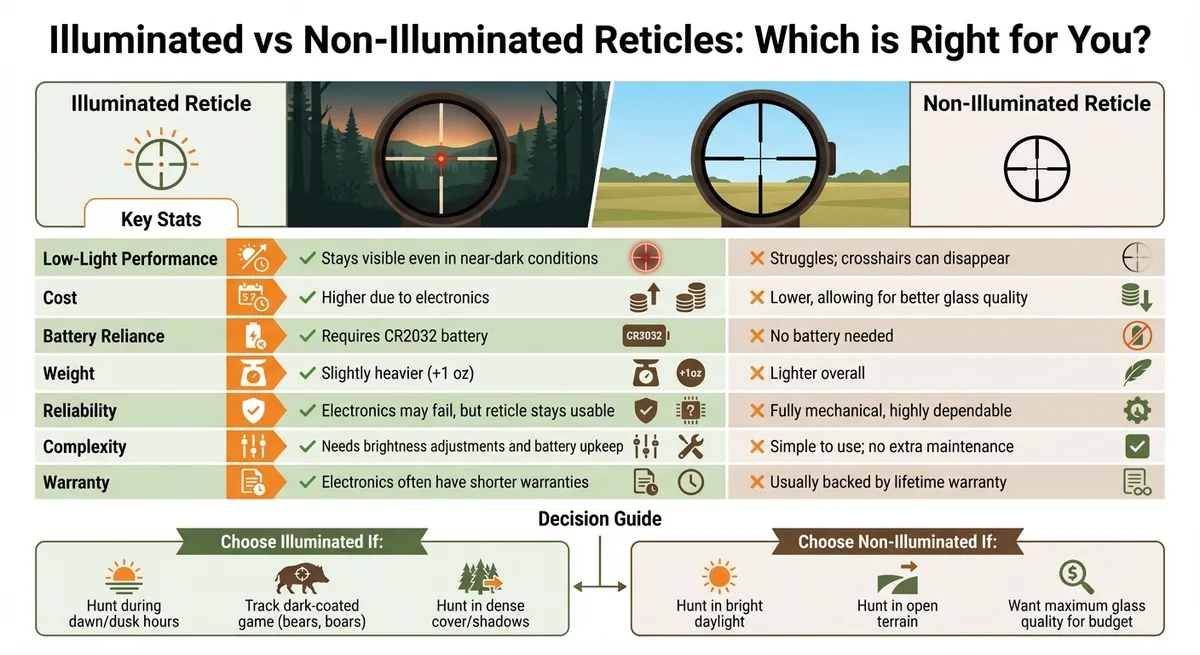
This is the question most buyers wrestle with. An illuminated reticle costs more, adds a battery dependency, and introduces a dial you need to manage. Is it worth it?
Here's a straightforward comparison:
| Factor | Illuminated Reticle | Non-Illuminated Reticle |
|---|---|---|
| Low-light visibility | Significantly better | Limited to ambient light |
| Daylight performance | Good with brightness turned down | Excellent, no adjustment needed |
| Battery dependency | Yes, typically CR2032 | None |
| Cost | Higher by $50 to $300+ | Lower |
| Weight | Slightly heavier | Lighter |
| Maintenance | Battery replacement, dial upkeep | Minimal |
The honest answer depends on your use case. If you regularly hunt at dawn or dusk, where light levels drop fast, the illuminated reticle gives you a real edge. Aggregate reviews from hunter-focused forums consistently report faster target acquisition in low light with illuminated optics.
If you only shoot during full daylight hours or at a well-lit range, a non-illuminated reticle does everything you need without the extra cost or battery worry.
The sweet spot is the low-power variable optic (LPVO) category, typically 1-6x or 1-8x magnification. Many LPVOs come standard with illuminated reticles because they're designed for variable lighting conditions. As of 2026, nearly every LPVO priced above $300 includes illumination.
Who Actually Needs an Illuminated Rifle Scope?
Not every shooter benefits from illumination. Here's who gains the most from it:
Hunters who shoot in low light. The first hour after sunrise and the last hour before sunset are prime hunting times for deer, hogs, and predators. Light levels during these windows are the hardest for any reticle to read. An illuminated reticle cuts through the ambiguity fast.
Predator and varmint hunters. Coyote and bobcat hunting often happens at twilight. Some predator hunters use red illumination specifically because many varmints have reduced sensitivity to red wavelengths.
Tactical and defensive shooters. If your rifle serves a home defense role, you'll be using it in low-light conditions more often than not. The National Shooting Sports Foundation hunter education program emphasizes that shooters should identify their target and sight picture reliably regardless of lighting.
Long-range precision shooters. FFP illuminated reticles allow fast holdover adjustments in variable light. PRS and similar competitions run in all weather, including overcast days where dim reticles slow you down.
Shooters with older or declining eyesight. A glowing reticle is easier to pick up than a thin black crosshair against a dark tree line or shadowed ground.
Who probably doesn't need one? Range-day plinkers shooting at bright, well-lit targets. If that's your main use, save the money and skip the extra features.
Mistakes People Make With Illuminated Reticles
Even experienced shooters make these errors. Here are the most common ones and how to avoid them.
Leaving the battery in during long-term storage. This drains the cell over time and can corrode the contacts. Manufacturers of scopes from Leupold, Vortex, and similar brands generally recommend removing batteries when storing optics for more than a month.
Forgetting to turn brightness down in daylight. An over-bright reticle blooms and washes out your view of the target. On a bright morning hunt, dial the brightness to its lowest usable setting. You want the reticle visible, not the only thing you can see.
Choosing a magnification range that doesn't match your use. A 4-12x scope with illumination looks great on paper. But if you hunt timber at close range, you'll never use anything past 6x. Match magnification to your actual shooting distances.
Assuming illumination replaces good glass. A bright reticle can't fix poor optical quality, chromatic aberration, or a weak objective lens. The scope's glass quality matters more than whether the crosshair glows.
Using the wrong battery. CR2032 and CR123A batteries look similar but aren't interchangeable. Check your scope's manual before heading into the field. A dead or wrong battery means you're shooting with no illumination at all.
Neglecting parallax adjustment. Many illuminated scopes include side-focus or parallax dials. If you don't adjust them for different distances, your reticle won't stay true on target. Spend a few minutes during zeroing to learn where the dial sits for your most common ranges.
Mounting the scope without proper torque. Scope ring screws should be tightened to manufacturer-specified inch-pounds, usually 15 to 25 in-lbs depending on the ring size. Over-torquing can crush the tube and damage internal illumination components.
Frequently Asked Questions
How does an illuminated rifle scope work?
An illuminated rifle scope uses an LED light source powered by a small battery to project a glow onto the etched reticle. You control the brightness with an external dial on the scope body. Some models instead use fiber optic tubes that gather ambient light, removing the need for batteries altogether.
What is the difference between an illuminated and non-illuminated reticle?
The illuminated reticle glows in red, green, or blue, making it easier to see in low-light conditions. A non-illuminated reticle is a plain etched crosshair that relies entirely on ambient light. Illuminated reticles cost more and need a battery but give you a real advantage at dawn and dusk.
Do I need an illuminated rifle scope?
If you hunt at dawn or dusk, shoot in variable lighting, or have trouble seeing a plain black crosshair, an illuminated reticle helps significantly. If you only shoot during bright daylight at a range, a non-illuminated scope works fine. Match the feature to how and when you actually shoot.
How long does the battery last in an illuminated scope?
Most illuminated scopes use a CR2032 coin cell. Manufacturer specifications show runtime from about 1,000 hours on high brightness to over 50,000 hours on low settings. Many hunters replace batteries annually as a routine precaution.
What magnification should I choose for an illuminated rifle scope?
For general hunting, 3-9x covers most North American game distances. For close-range or brush hunting, a 1-6x LPVO works well. Long-range shooters benefit from 4-14x or higher ranges with FFP illuminated reticles.
Are illuminated rifle scopes legal for hunting?
In most US states and Canadian provinces, illuminated rifle scopes are legal for hunting. Some regulations restrict certain hunting hours regardless of optics used. Always check your state or provincial hunting regulations before using an illuminated scope during legal shooting windows.




