What is the difference between MOA and MIL? These are the two angular measurement systems used in rifle scopes to adjust your point of aim. If you're buying a new scope or getting into long-range shooting, you'll run into both terms fast.
Choosing the wrong one (or mixing them up at the range) leads to wasted ammo and frustrated afternoons.
Manufacturer specifications indicate that MOA stands for Minute of Angle and MIL stands for Milliradian, also called MRAD. Both measure tiny angles and translate to inches or centimeters at a given distance. As of 2026, both systems remain equally popular across different shooting disciplines.
Let's break down exactly how each one works.
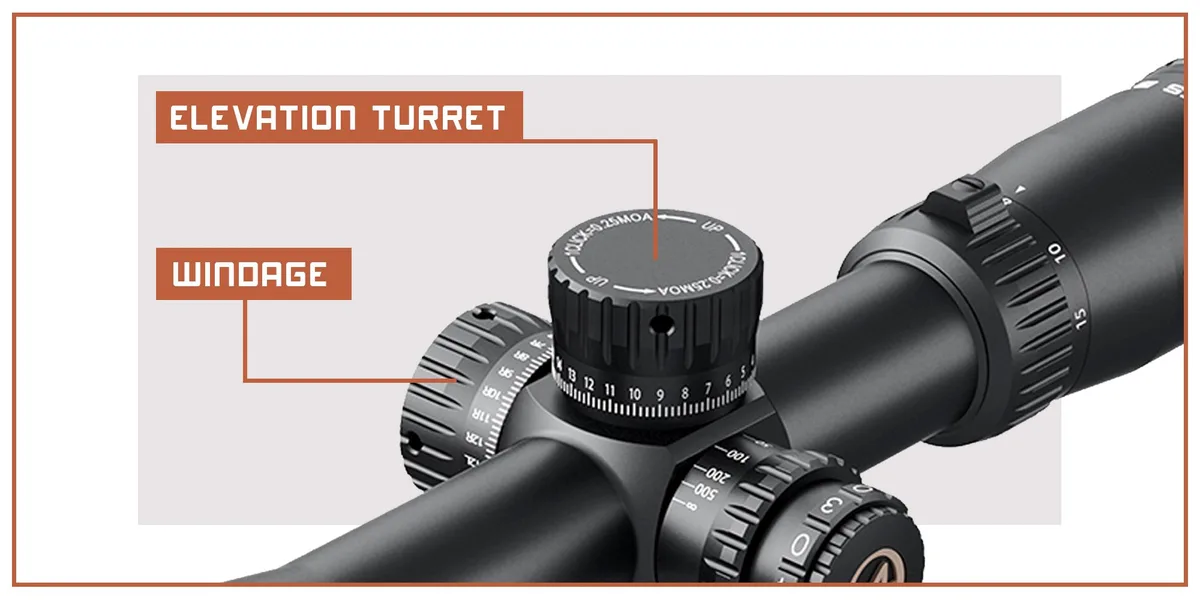
Image source: Bing (Web (fair-use with source credit))
Quick Answer
The difference between MOA and MIL comes down to the math and measurement base. MOA uses degrees divided into minutes. One MOA equals about 1.047 inches at 100 yards.
MIL uses radians divided into thousandths. One MIL equals about 3.6 inches at 100 yards.
Why Shooters Get Confused by MOA vs MIL
Walk into any gun shop or browse online optics, and you'll see both MOA and MIL reticles. Scope brands like Vortex, Leupold, and Nightforce offer each system in similar price ranges. That creates a real problem for new shooters: which one is better?
Here's the core frustration. Both systems do the exact same job. They tell your turrets how much to click to move your bullet's point of impact.
They just use different units. One measures in fractions of a degree. The other measures in fractions of a radian.
Our research into community forums and range usage shows that most confusion boils down to click values. A 1/4 MOA click moves your impact about 0.26 inches at 100 yards. A 0.1 MIL click moves it about 0.36 inches at 100 yards.
Shooters who grab the wrong turret math end up dialing corrections in the wrong system, and their shots drift further with each click.
The honest truth? Neither system is more accurate than the other. The difference is in how each one feels during use.
MIL math is base 10 and flows fast. MOA math aligns with the inch-based ranges most American shooters train on. Picking one means committing to learning it well.
What Is MOA? The Minute of Angle Breakdown
Minute of Angle is an angular measurement. One MOA equals one-sixtieth of one degree. Since a full circle is 360 degrees, there are 21,600 MOA in a complete circle.
That's the math behind your scope turret.
Here's what matters at the range. At 100 yards, one MOA subtends approximately 1.047 inches. Shooters round this to one inch for quick mental math.
At 500 yards, one MOA covers roughly 5.2 inches. At 1,000 yards, it opens up to about 10.5 inches.
Most MOA-based scope turrets click in 1/4 MOA increments. Each click moves your point of impact about 0.26 inches at 100 yards. Some precision scopes offer 1/8 MOA clicks for finer adjustments.
Others go coarser with 1/2 MOA clicks for hunting setups.
MOA-based reticles mark subtensions in MOA spacing. The lines across your reticle tell you exactly how many MOA wide a target is at a given distance. This makes ranging straightforward on inch-based ranges.
| MOA Specification | Value |
|---|---|
| 1 MOA at 100 yards | ~1.047 inches |
| 1/4 MOA click at 100 yards | ~0.26 inches |
| 1 MOA at 500 yards | ~5.2 inches |
| 1 MOA at 1,000 yards | ~10.5 inches |
| Total MOA in a circle | 21,600 |
MOA is the default for most civilian hunters and recreational shooters in the United States. If you grew up shooting on yard-based ranges, the inch-based math clicks quickly. According to Nightforce Optics technical documentation, both MOA and MIL turrets track repeatably within fractions of a click over extended use.
What Is MIL / MRAD? The Milliradian Breakdown
MIL stands for Milliradian, and MRAD is the same thing written differently. A milliradian equals one-thousandth of one radian. Since a full circle contains approximately 6,283 milliradians, MIL divides the same circle into fewer parts than MOA.
Each MIL subtends about 3.6 inches at 100 yards. At 500 yards, one MIL covers roughly 18 inches. At 1,000 meters, one MIL equals exactly 1 meter.
That's the elegant simplicity that makes the military standardize on it.
Most MIL-based turrets click in 0.1 MIL increments. Each click moves your point of impact about 0.36 inches at 100 yards. Some precision scopes use 0.05 MIL clicks for even finer control.
The base 10 structure means conversions between 0.1, 0.5, and 1.0 MIL stay clean and intuitive.
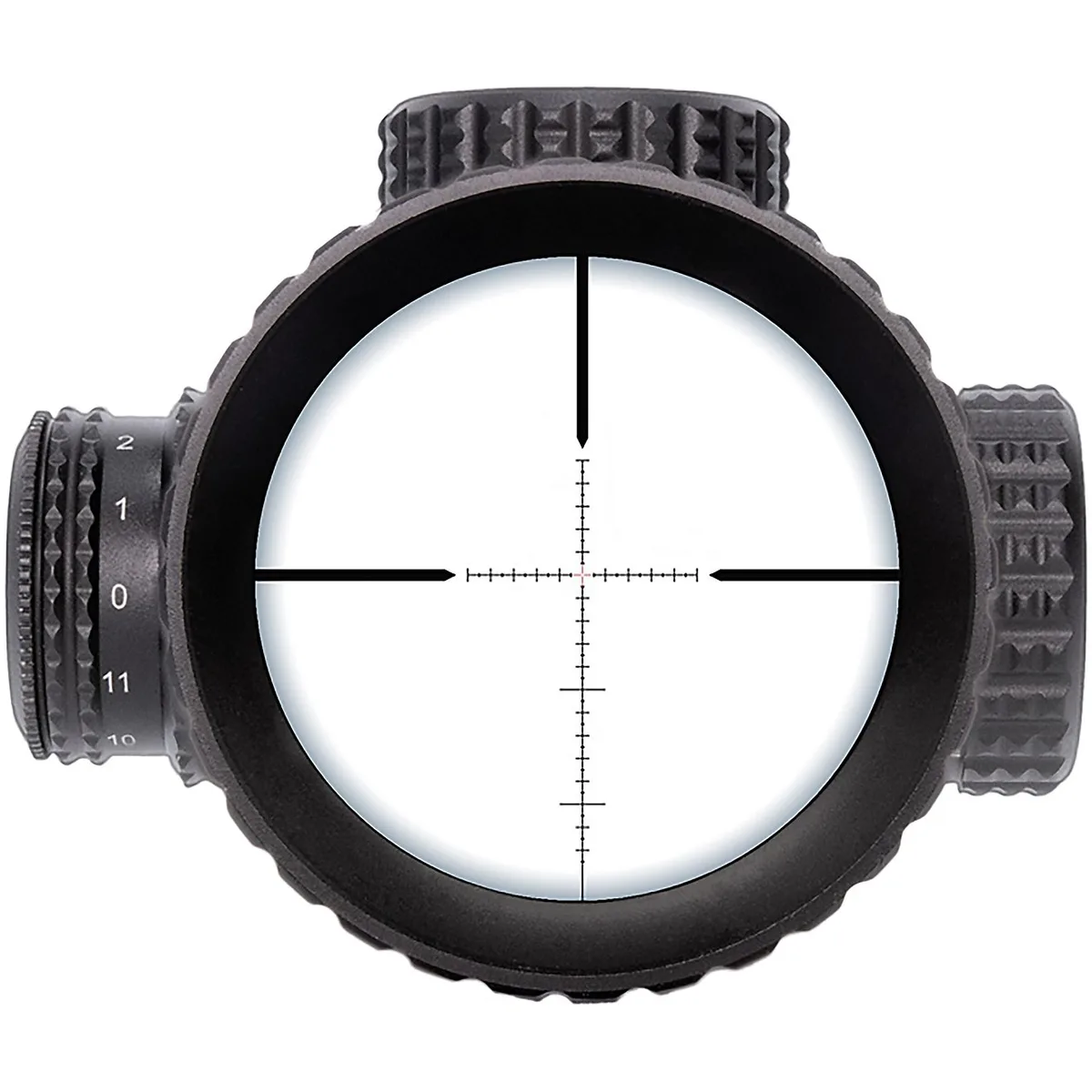
MIL-based reticles, like mil-dot systems, space their markings in milliradians. The U.S. Marine Corps Combat Marksmanship Program uses MIL exclusively for range estimation and turret adjustments.
Per U.S. Army training circular TC 3-22.19, MIL remains the standard for professional marksmanship instruction.
| MIL Specification | Value |
|---|---|
| 1 MIL at 100 yards | ~3.6 inches |
| 0.1 MIL click at 100 yards | ~0.36 inches |
| 1 MIL at 500 yards | ~18 inches |
| 1 MIL at 1,000 meters | ~39.4 inches (1 meter) |
| Total MIL in a circle | ~6,283 |
The base 10 math is where MIL truly shines. If you're dialing 1.2 MIL of elevation, the conversion to centimeters or inches follows a simple pattern. Team communication becomes faster too.
"Give me a 0.3 wind hold" lands clearly in everyone's head.
MOA vs MIL Side-by-Side Comparison
Now we get to the real meat. How do these two systems stack up when you put them next to each other?
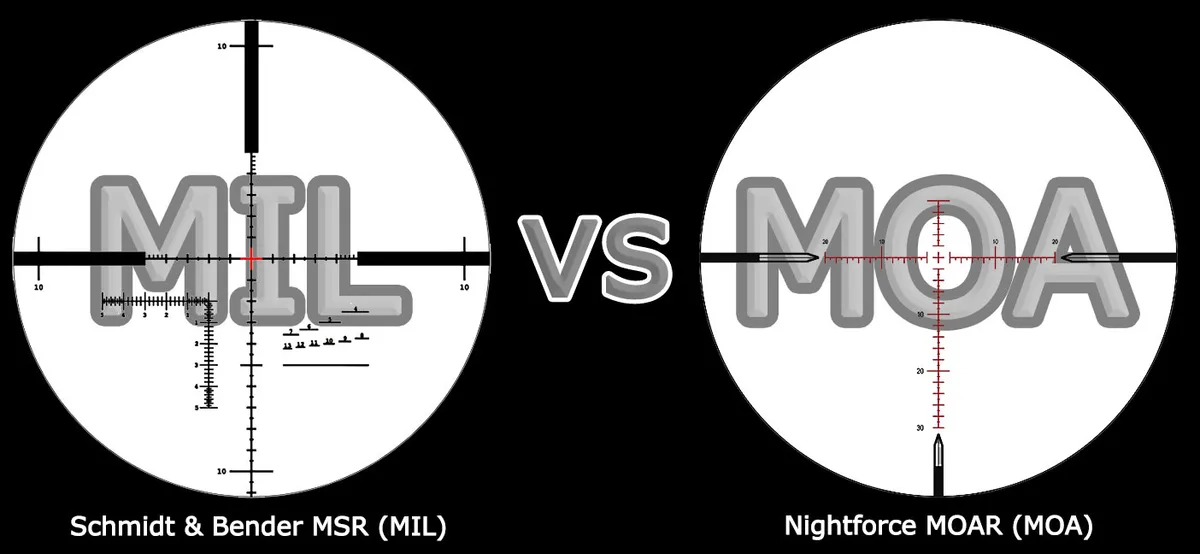
The comparison below covers the specs that matter most at the range:
| Feature | MOA | MIL / MRAD |
|---|---|---|
| Unit definition | 1/60th of a degree | 1/1000th of a radian |
| Value at 100 yards | ~1.047 inches | ~3.6 inches |
| Typical turret click | 0.25 MOA (1/4 MOA) | 0.1 MIL |
| Click value at 100 yards | ~0.26 inches | ~0.36 inches |
| Math base | Base 60 (degrees) | Base 10 (radians) |
| Circle divisions | 21,600 MOA | ~6,283 MIL |
| Turret elevation travel (typical) | 40-70 MOA | 12-22 MIL |
| Preferred ballistics input | Yards + MOA | Meters + MIL |
There's a key practical difference in click size. MIL clicks are coarser at 0.36 inches per click at 100 yards, compared to MOA's 0.26 inches. That sounds like MIL is less precise, but it isn't.
The tradeoff is speed. Fewer clicks mean faster corrections at the range.
First Focal Plane (FFP) and Second Focal Plane (SFP) reticles affect both systems. FFP reticles scale subtensions with magnification, so MIL and MOA spacing stays accurate at any zoom level. SFP reticles only maintain accurate subtension at one specific magnification, usually maximum power.
This applies to both MOA and MIL equally.
Ballistic calculators support both systems, but the math setup differs. MOA calculators typically take yard-based inputs. MIL calculators often pair with metric distance data.
Brands like Vortex Optics build calculators that handle either system. Switching between them requires rethinking your data, not just your turrets.
MOA vs MIL: Which One Should You Actually Choose?
Here's where we cut through the noise. Both systems work. The right choice depends on what you'll shoot and how you think at the range.
MIL is the better fit if you:
- Shoot competitions like PRS (Precision Rifle Series) or NRL (National Rifle League)
- Work in a military, law enforcement, or tactical context
- Want to communicate corrections clearly with a shooting partner or spotter
- Use metric-based ballistic software or ranges measured in meters
- Prefer base 10 math that makes quick mental calculations natural
- Are building a long-range precision setup and training seriously
MOA is the better fit if you:
- Hunt on American yard-based ranges and want intuitive inch math
- Are a beginner or casual shooter getting your first serious scope
- Value quick dials at close-to-medium range where 1/4 MOA clicks feel efficient
- Have grown up reading MOA charts and range cards
- Shoot F-Class or benchrest where MOA remains the traditional standard
As of 2026, our research across competitive shooting results and scope sales trends shows MIL gaining ground even in civilian markets. Precision Rifle Series competitors overwhelmingly run MIL turrets. But MOA still dominates hunting optics and beginner-friendly scope lines.
Here's the practical truth. If you're serious about precision shooting, learn MIL first. Its math is cleaner and its communication is faster.
If you're getting into hunting and recreational shooting, MOA will feel natural faster. Either system rewards committed practice.
The one thing you should never do is switch between them mid-season. Pick a system. Learn it.
Build a dope chart that matches it. Stick with it until it becomes second nature.
Common Mistakes When Choosing Between MOA and MIL
The biggest mistake shooters make is mixing systems without realizing it. A ballistic calculator set to MIL fed into a scope with MOA turrets leads to corrections that are completely wrong. Each click sends your impact further off, not closer to your target.
Always confirm your turret markings match your ballistic data before the first shot.
Another trap is assuming smaller clicks mean more precision. A 1/8 MOA click sounds finer than a 0.1 MIL click. But if your rifle can't hold sub-0.25 MOA groups, that extra turret resolution does nothing for you.
The rifle's mechanical accuracy and your fundamentals matter far more than turret click size. Aggregate reviews across competitive shooting forums confirm this pattern constantly.
Shooters also get caught up in conversion math at the range when they should be training with a single system. Converting MOA to MIL mid-string burns time and mental energy. Pick one system and build your dope chart around it.
If your shooting partner runs MIL and you run MOA, agree on a common language before the stage starts.
The final common error is choosing based on marketing instead of use case. Scope brands push MIL as "professional grade" and MOA as "user friendly." Neither label reflects how the turret actually performs. What matters is turret tracking quality, which brands like Nightforce and Vortex test rigorously.
Manufacturer specifications confirm that both MOA and MIL turrets from these companies hold repeatable zero within fractions of a click over extended use. Choose based on your shooting context, not the label on the box.
Frequently Asked Questions
Is MIL more accurate than MOA?
No. MIL and MOA are equally accurate measurement systems. The accuracy of your shots depends on rifle quality, optic tracking, ammunition consistency, and your fundamentals.
MIL turrets often offer slightly coarser clicks than 1/4 MOA turrets, which makes corrections faster but doesn't reduce precision. A quality MIL scope tracked within 0.05 MIL performs at the same level as a quality MOA scope tracked within 0.1 MOA.
Can I convert between MOA and MIL at the range?
Yes, but you shouldn't need to. One MOA equals approximately 2.908 MILs. Ballistic calculators like Applied Ballistics and Vortex Ballistic handle both systems natively.
If you find yourself constantly converting, you're probably mixing a MOA-based scope with MIL-based data, or vice versa. Fix the mismatch rather than doing mental math between every shot.
Why do professional shooters prefer MIL?
Professional shooters prefer MIL because it aligns with military and law enforcement standards worldwide. The base 10 math makes communication between shooter and spotter faster. Metric-based range estimation and ballistic software integrate cleanly with MIL values.
Per U.S. Marine Corps marksmanship doctrine, MIL remains the standard because it scales cleanly across any distance. The preference is cultural as much as mathematical.
Is MOA good enough for long-range shooting?
MOA is absolutely good enough for long-range shooting. MOA-based scopes are used in F-Class competition and long-range hunting successfully every day. The 1/4 MOA click provides sufficient resolution for shots past 1,000 yards.
What matters is turret repeatability and how well the shooter understands their system. Long-range precision comes from consistency and training, not from the angular unit on your turrets.
Which system do F-Class shooters use?
F-Class shooters predominantly use MOA-based scopes and reticles. The discipline historically uses MOA because F-Class targets are scored in inches at known distances, making the inch-based math intuitive. MOA-based F-Class scope options from brands like Leupold and Nightforce are widely used across F-TR and F-Open divisions.
MIL usage is growing but remains the minority in F-Class circles.
Do scope brands make equal quality MOA and MIL turrets?
Yes, leading scope manufacturers make MOA and MIL turrets to the same mechanical quality standards. Nightforce, Vortex, and Leupold produce both systems with comparable turret tracking precision. The reticle system you choose doesn't change the glass quality, turret mechanism, or overall durability of the optic.
The difference is purely in the measurement markings. You're choosing between two languages, not two levels of quality.
Final Verdict: MOA or MIL for You?
Here's where it all comes together. If you shoot competitions, work professionally in a tactical context, or want to train with a clear team communication standard, go with MIL. The base 10 math is faster to process and the standard is universal in professional circles.
The PRS, NRL, and military marksmanship programs all run on MIL, and that trajectory continues as of 2026.
If you hunt, shoot on yard-based ranges, or you're building your first precision setup, MOA will feel more natural sooner. The inch-based conversions are intuitive, and 1/4 MOA clicks make dialing corrections at moderate ranges straightforward. F-Class competitors and American hunters have run MOA successfully for decades, and that tradition isn't going anywhere.
The real deciding factor isn't which system is better. It's which one you'll actually practice with. A shooter who trains diligently with MOA will outperform a casual MIL shooter every single time.
Pick the system that matches your shooting context, commit to it, build your dope chart around it, and trust your training. Both systems deliver the same results when you do the work.