How do I clean a rifle scope? Bluntly, it takes less than five minutes if you know what you're doing. Most owners either over-clean with harsh chemicals or under-clean and let grit score their lenses for years.
There's a middle ground, and it's simpler than you think.
A quality rifle scope can cost anywhere from $300 to over $3,000. Manufacturer specifications confirm that multi-coated lenses carry three to five protective layers per surface. Let's walk through the exact process, step by step.
Quick Answer
How do I clean a rifle scope? Blow off loose dust with compressed air. Brush remaining grit with a dry lens pen.
Wipe the lenses gently with optical-grade cleaning fluid and a microfiber cloth. Always confirm the firearm is unloaded before handling.
Why a Dirty Rifle Scope Costs You Accuracy (And How to Fix It Fast)
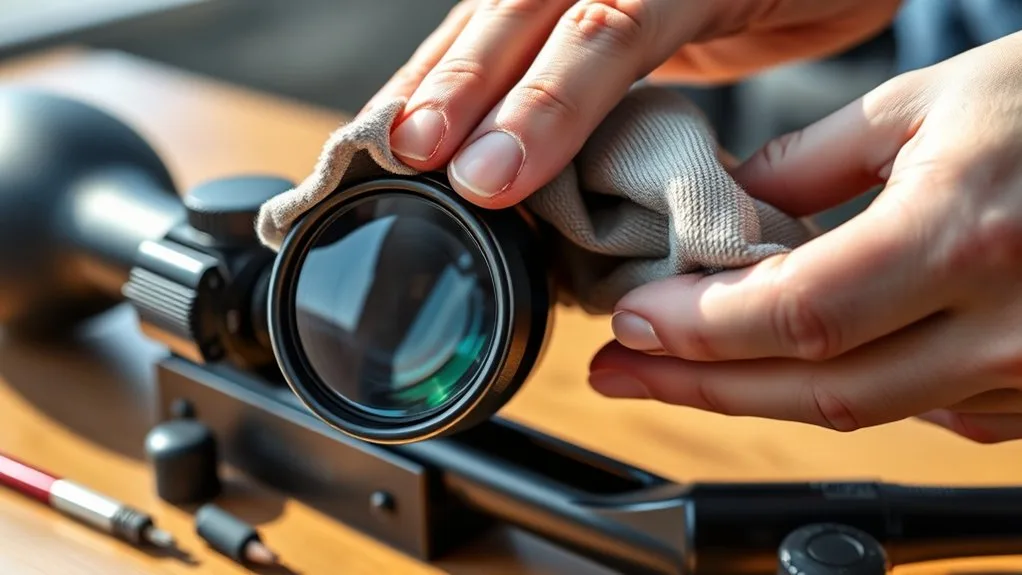
A dirty scope doesn't just look bad. It measurably degrades your shooting performance.
Dust, fingerprints, and water residue scatter incoming light. The result is a duller sight picture and reduced contrast between your crosshairs and the target. This hits hardest at dawn, dusk, or under heavy overcast when every bit of contrast matters.
The damage runs deeper than what you can see. Multi-coated lenses carry thin chemical layers that protect against glare and boost light transmission. If grit or harsh chemicals contact those layers, the coating degrades permanently.
There's no fixing a worn-out coating.
Here's what most shooters miss. A single grain of sand under a microfiber cloth can scratch your front objective lens. That scratch diffuses light every time you look through it.
Over months of neglect, those micro-scratches compound into a noticeably worse sight picture.
It's not just the glass either. Dirt and grime accumulate around turret caps, magnification rings, and mount interfaces. This debris works its way into moving parts, affecting turret clicks and magnification smoothness over time.
As of 2026, most major optic brands rate their scopes at IPX7 or higher for waterproofing. But that rating assumes external surfaces are maintained. A cracked seal around a turret cap, often caused by forced removal or improper cleaning, breaks that protection entirely.
For competitive shooters, a hazy lens at 400 yards makes target identification harder. For hunters in a tree stand, it's the difference between a confident ethical shot and a risk you can't take. Proper cleaning isn't just about optics.
It's about shot discipline.
Even light surface contamination reduces how much light passes through your objective lens. That loss is most punishing at first and last light. That's when most hunters and predators are active.
Aggregate user reports across optic brands show that shooters who clean regularly get clearer sight pictures and fewer warranty issues. The key is doing it right the first time.
Let's start with the tools you actually need.
The Only Tools You Need to Clean a Rifle Scope Properly

You don't need an expensive kit to clean your scope properly. You need four things, and one of them is nearly free.
Here's what goes in your cleaning kit:
A quality microfiber cloth. This is your primary wiping tool. It must be clean, dry, and free of debris. Replace it every 6 to 12 months with regular use.
A lens cleaning pen. These have a brush on one end and a carbon tip on the other. The brush removes loose particles. The carbon tip lifts fingerprints and oily smudges. Brands like Nikin and Zeiss make reliable models.
Optical-grade cleaning fluid. Zeiss Lens Cleaning Spray is a common choice. The key is it's formulated specifically for multi-coated optics. It won't strip your lens coatings the way harsh household cleaners can.
A rocket blower or compressed air can. This is your first line of defense. Blowing off loose dust before you touch the lens prevents scratching. Avoid canned air meant for electronics. Some types contain moisture propellant that leaves residue.
| Tool | Purpose | Typical Cost |
|---|---|---|
| Microfiber cloth | Wiping lenses | $5 to $10 |
| Lens cleaning pen | Brushing grit, lifting fingerprints | $8 to $20 |
| Optical cleaning fluid | Cleaning without coating damage | $8 to $15 |
| Rocket blower | Blowing off loose dust | $10 to $20 |
What NOT to use:
- Shirt tails, paper towels, or regular cloths. They leave micro-scratches on coated glass.
- Ammonia-based cleaners like Windex. They permanently damage lens coatings.
- Tap water on coated lenses. It leaves mineral deposits that are hard to remove.
- Harsh household cleaners of any kind.
As of 2026, the National Shooting Sports Foundation (NSSF) recommends that gun owners keep a dedicated optics cleaning kit separate from general cleaning supplies. Cross-contamination from household products is a leading cause of lens coating damage.
Vortex Optics also publishes official care guidelines that walk through their recommended cleaning products and techniques. It's worth bookmarking if you own one of their scopes.
The total cost for a quality cleaning kit runs about $20 to $40. That's a small investment compared to the price of a replacement scope.
Decision Branch 1: What's on Your Scope Right Now?
Cleaning technique depends on what's actually on the lens. Treating all contamination the same way is where most people go wrong. Here's how to read the situation and pick the right approach.
Dust and Grit (Dry, Loose)
This is the easiest case. Use your rocket blower first to blow off loose particles. Then run the brush end of your lens pen across both lenses in gentle strokes.
Wipe with a dry microfiber cloth if needed. No cleaning fluid required.
Fingerprints and Oil
Fingerprints leave oils that smear and attract more dust. Apply one drop of optical-grade cleaning fluid to your microfiber cloth, not directly on the lens. Wipe in small circular motions from the center outward.
Repeat if the print doesn't lift on the first pass.
Water Spots and Mineral Deposits
These form after rain, river crossings, or morning dew sits on the lens. The mineral residue is stubborn. Dampen a corner of your microfiber cloth with optical cleaning fluid.
Use slightly more pressure than usual, but still gentle. For persistent spots, a cotton swab with a drop of fluid works well in a circular motion.
Mud and Caked-On Debris
If mud has dried on the lens, resist the urge to wipe it immediately. Hardened grit acts like sandpaper. Let it dry fully, then use compressed air to break loose the largest particles.
Follow with a soft brush, then a wet clean with your fluid and cloth.
Internal Fogging
Fogging inside the scope means moisture has gotten past your O-ring seals. Cleaning the outside won't help. This is a sign the scope needs professional service.
Many manufacturers offer repair programs. Do not attempt to disassemble the scope yourself.
Step-by-Step: The Correct Cleaning Workflow for Your Rifle Scope

Here's the full workflow, start to finish. It works for most conditions and most scopes.
Step 1: Safety check. Unload the rifle. Open the action. Engage the safety.
If you're cleaning the scope while it's mounted, this matters even more. The NSSF emphasizes that firearm safety is non-negotiable, even during maintenance.
Step 2: Assess what's on the scope. Is it dust? Fingerprints? Mud?
Water spots? This determines which technique from the decision tree above you'll use.
Step 3: Blow off loose debris. Use a rocket blower or compressed air. This is the most important step. If you skip it, you're rubbing grit into the lens with your cloth.
Step 4: Dry brush. Use the brush end of a lens pen or a dedicated lens brush. Work across both the objective and ocular lenses. This catches particles that blowing alone missed.
Step 5: Apply cleaning fluid to your cloth. One to two drops of optical-grade solution. Never spray fluid directly onto the lens. Overspray can seep into turret gaps and mount interfaces.
Step 6: Wipe the lenses. Start at the center and work outward in gentle circular motions. Keep pressure light. Let the cloth do the work, not your hand.
Step 7: Stubborn spots. If something won't come off, add another drop of fluid to a fresh section of cloth. A cotton swab works for edges and hard-to-reach areas.
Step 8: Clean the turret caps and body. Remove the turret caps and wipe around the O-ring seals. Use a foam swab or damp cloth. Check for debris under the cap before reseating it.
Step 9: Clean the magnification ring and mount interfaces. These collect grime from handling. A damp swab handles the crevices. Avoid getting fluid inside the tube.
Step 10: Reassemble and verify. Remount the scope if you removed it. Torque the ring screws to manufacturer specification, typically 15 to 20 inch-pounds. Check that the zero hasn't shifted.
Inspect the lenses under a bright light for streaks or missed spots.
Step 11: Store properly. Lens caps on. Dry environment. Avoid storing in a vehicle during temperature extremes.
Rapid heating and cooling can cause internal fogging.
As of 2026, the full workflow above takes most people 3 to 5 minutes with a standard rifle scope.
Mistakes That Damage Your Scope (And Cost You Money)
Some cleaning errors don't just leave the scope dirty. They cause permanent damage you can't undo.
Using Ammonia-Based Cleaners
Windex, household glass cleaners, and ammonia-based solutions strip multi-coated lenses. The coating is chemically bonded to the glass. Ammonia breaks that bond.
Once the coating is gone, you're looking at glare, reduced light transmission, and permanent degradation. Use only optical-grade cleaning fluid.
Pressing Too Hard on the Front Objective
The front objective lens is the largest piece of glass on your scope. It's also the most exposed to scratches. Scratches here are permanent.
Keep your pressure light and consistent. Let the cloth glide, not dig.
Cleaning in Freezing Conditions with Water-Based Fluid
Water-based cleaning fluid applied in freezing temperatures can leave residue that freezes on the lens. Or worse, moisture seeping into turret gaps can freeze internally and damage seals. Clean indoors or above freezing whenever possible.
Cleaning the Scope Interior Yourself
This is the big one. Scope internals are nitrogen or argon purged and sealed at the factory. Opening a scope destroys that purge.
It also almost certainly voids your warranty. Internal fogging means the scope needs professional service.
Using Canned Air Meant for Electronics
Electronics-grade canned air often contains moisture propellant. This leaves a faint residue on your lens. Use a rocket blower or an air compressor with a moisture trap instead.
Forcing Turret Caps or Lens Covers
If a cap is stuck, don't pry it. Forcing it can crack the housing, deform the O-ring, or scratch the surrounding finish. Gentle heat or a soft grip usually frees a stubborn cap.
Skipping Cleaning Before Storage
Storing a dirty scope means grit sits against the lens coatings for months. During that time, temperature changes cause micro-expansion and contraction. Grit particles can dig into the coating surfaces.
Always clean before storage.