Why does my rifle scope fog up? If you've ever pulled your rifle from a warm truck only to find the lens covered in mist, you're not alone. Scope fogging is one of the most common frustrations hunters and shooters deal with every season.
Most rifle scopes are purged with nitrogen to prevent internal moisture buildup, and manufacturer specs for mid-tier models list operating ranges from -40°F to 160°F. But seals degrade over time, and external fog can form in seconds when cold glass meets humid air. Here's how to tell the difference and fix each type.

Image source: Web (Bing) / pintydevices.com (Web image (fair-use with source credit))
Quick Answer: Why Your Scope Is Fogging Up
Your rifle scope fogs up for two main reasons. Internal fog means moisture has breached the seal and entered the scope. External fog is condensation on the outside lens.
Temperature swings and dew point differences cause most cases. Internal fog needs professional repair, while external fog clears with proper cleaning.
Is the Fog Inside or Outside? How to Diagnose It in 2 Minutes
Before you buy anti-fog sprays or ship your scope off for repair, you need to know which type of fog you're dealing with. Most shooters guess wrong and waste time on the wrong fix.
Here's the test. Bring your scope indoors and let it sit in a warm room for 15 to 20 minutes at 70°F (21°C) or higher. This warms the entire scope body to match the indoor air.
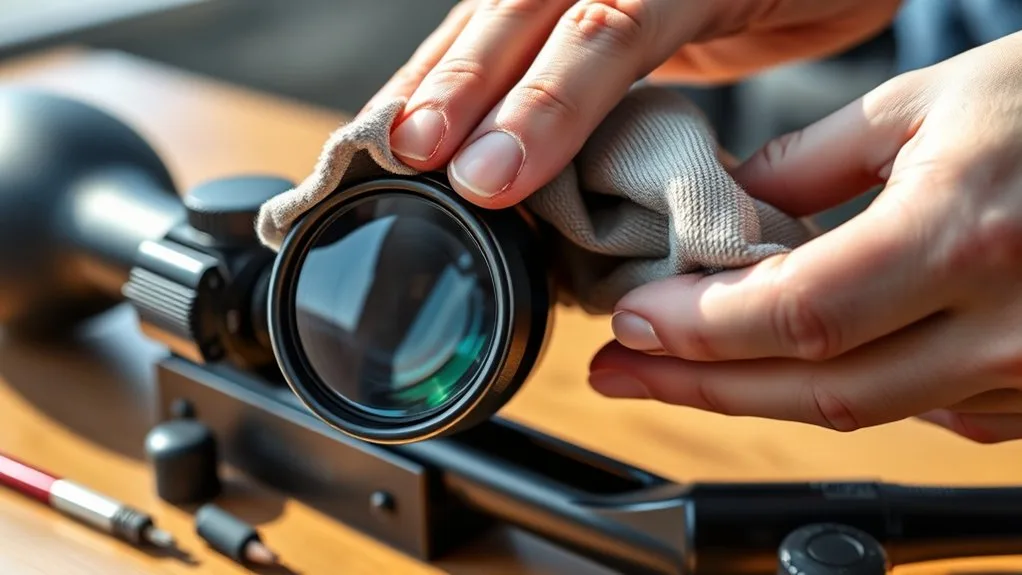
Image source: Bing (Web (fair-use with source credit))
After warming, check both lenses under a bright light. Tilt the scope and watch for haze, film, or water marks on the glass. Check the objective lens at the front and the ocular lens at the rear.
If the fog clears completely
The fog is external. External fog sits on the outside of the lens and responds to temperature equalization. This is the easy case.
If the fog persists after warming
You're looking at internal fog. It forms inside the sealed tube when moisture gets past the O-rings. It won't clear with wiping because it's not on the outside surface.
Dried internal moisture sometimes leaves visible mineral deposits on the internal lens surfaces.
If you see film or residue that won't wipe off
This could be degraded lens coating rather than fog. Coating breakdown looks like a hazy film that doesn't respond to temperature changes. If your scope is old and heavily used, this is worth ruling out.
Common diagnostic mistakes:
- Assuming all fog is external because it seems like it should be
- Not warming the scope long enough before checking
- Wiping the lens and assuming the problem is fixed when it returns after a temperature change
- Confusing dust or fingerprint smudges with actual fog
What Causes Internal Scope Fog (Seal Failure, Purging Loss, and Moisture Intrusion)
Internal fog means your scope's sealed chamber has been compromised. Most rifle scopes are filled with nitrogen gas during manufacturing. The nitrogen is held inside by O-ring seals at the lens assemblies and tube junctions.
Here's the problem. O-rings degrade over time. They dry out, crack, and lose their sealing ability.
This is especially true in scopes exposed to extreme temperature swings. As of 2026, most manufacturers recommend O-ring inspection every 3 to 5 years for scopes used in harsh conditions.

Image source: Web (Bing) / billingsoptics.com (Web image (fair-use with source credit))
Temperature cycling is the biggest culprit. Every time you move a scope from a warm vehicle to a cold field, the materials inside expand and contract. Over hundreds of cycles, this stresses the seals.
Moisture can then get drawn in during warm periods. It condenses on cold internal lens surfaces when the scope cools again.
Single-piece tube designs have fewer seal points than multi-piece tubes. That's why higher-end scopes resist internal fogging longer. Multi-piece tubes have joints where the body connects to the objective and ocular bells.
Each joint is a potential failure point.
Other factors that accelerate seal failure:
- Physical damage to the tube from drops or impacts
- Corrosion around lens housing threads
- Improper storage in damp environments
- Repeated use of harsh chemical cleaners near the lens housing
Budget scopes are more susceptible for two reasons. They often use lower-grade O-ring materials. The purging process may also be less rigorous, with lower nitrogen pressure or incomplete evacuation of air before filling.
A common scenario plays out like this. A hunter buys a mid-range scope, uses it across temperature extremes for several seasons, and starts noticing recurring fogging years later. The scope didn't fail overnight.
The seals wore down gradually over hundreds of thermal cycles.
What Causes External Scope Fog (Dew Point, Temperature Shifts, and Lens Coatings)
External fog is the simpler problem. It happens when cold glass meets warm, moist air. The moisture condenses on the lens surface, much like a cold drink sweats on a hot day.
Dew point is the key concept here. Dew point is the temperature at which air becomes fully saturated with moisture and condensation begins to form. When the lens surface drops below the dew point of the surrounding air, you get fog.
NOAA's weather resources explain dew point and relative humidity clearly if you want the full science behind it.
The most common hunting scenario is a dawn hunt. You leave a warm truck, walk out to your stand, and by the time you're ready to glass a ridge, the objective lens is covered in mist. Cold dawn air sits near or at dew point, and your scope glass is colder still.
Humid environments make external fog worse. Coastal hunters in the southeastern United States, swamp hunters in the Gulf Coast region, and tropical shooters all deal with higher ambient moisture. The higher the relative humidity, the easier it is for fog to form.
Temperature differentials that commonly trigger external fog:
- Moving from a heated vehicle (65 to 75°F) to cold outside air (below 40°F)
- Dawn and dusk hunts where air temperature drops rapidly
- High-altitude environments with daily temperature swings exceeding 30°F
- Sudden cold fronts moving through a warm, humid region
Lens coatings play a significant role. Hydrophobic coatings repel water, so moisture beads up and runs off instead of forming a flat fog film. Fully multi-coated lenses shed condensation faster than uncoated or single-coated glass.
Untreated or older lenses with degraded coatings fog more easily and hold moisture longer. If your scope is 10 or more years old and you've never had the coatings inspected, this is worth considering.
Fixes for External Fogging (Quick and Effective)
External fog is fixable in the field, and you can prevent most cases before they happen. Here's what works.
Acclimation is the single most effective fix. Keep your scope in a temperature-stable spot until you're ready to head outside. Leave it in the truck overnight only if the overnight temperature won't drop below your planned field temperature.
For fog that's already on the lens, use a dedicated microfiber lens cloth. Wipe gently in a circular motion without pressing hard. Never use a shirt sleeve, paper towel, or bandana.
Those can scratch coatings and leave lint behind.
Anti-fog sprays and wipes create a temporary hydrophobic layer on the glass surface. They're effective for external fog, but they do nothing for internal moisture. Reapplication is needed after several uses.
Prevention strategies that actually help:
- Store scopes in a climate-stable environment when not in use
- Avoid leaving scopes in hot vehicles for extended periods
- Use lens caps consistently to limit air contact with the glass
- Apply a quality lens coating treatment every few months
| Solution | Best For | Duration | Notes |
|---|---|---|---|
| Microfiber cloth | Quick field fix | Immediate | Does not prevent re-fogging |
| Lens pen | Stubborn fog or debris | Immediate | Safe for coated lenses |
| Anti-fog spray | Preventing re-fogging | 4 to 8 hours | Reapply after cleaning |
| Lens caps | Ongoing prevention | Ongoing | Most underrated fix |
| Temperature acclimation | Preventing fog before it starts | Varies | Best long-term solution |
Vortex Optics and other manufacturers publish detailed care guidance for their scopes. You can find handling and maintenance recommendations directly on Vortex Optics for your specific model.
If your fog clears with wiping and doesn't return until the next temperature swing, it's external. Manage it with the techniques above. If it keeps recurring even after acclimation and proper cleaning, it's time to focus on internal fog.
Frequently Asked Questions
Does fogging mean my scope is broken?
No, not necessarily. External fog is normal and happens with any cold glass surface in humid air. Internal fog signals a seal problem, but that's fixable through warranty repair or professional service in most cases.
Is fogproof the same as waterproof?
Not exactly. Fogproof means the scope is purged with nitrogen or argon to prevent internal condensation. Waterproof means the scope can withstand water exposure to a certain depth, typically rated on the IPX scale from IPX4 to IPX8.
Can I prevent scope fogging in extreme cold?
You can significantly reduce it. Proper temperature acclimation, quality lens caps, and avoiding extreme temperature swings all help. Hydrophobic lens coatings also improve performance in cold, humid conditions.
Does magnification level affect fogging?
Indirectly, yes. Higher magnification changes the effective aperture and light path through the scope. Some shooters notice more visible fog at higher magnification because the smaller exit pupil makes condensation on the lens more apparent.
How long should a nitrogen-purged scope last before fogging becomes an issue?
Most well-built scopes stay fog-proof for 8 to 15 years under normal use. Budget scopes may show internal fogging after 4 to 6 years if they've been exposed to repeated extreme temperature swings.
Should I send my scope in for repair or just replace it?
If the scope is under warranty and the fog is internal, send it in. Manufacturer repair typically costs little to nothing under warranty. If the scope is old, out of warranty, and inexpensive, replacement is often the better value.




