How many clicks equal 1 MOA on a rifle scope? It depends on your turret's click value. Most scopes use ¼ MOA per click, meaning 4 clicks equal 1 MOA.
But that number changes entirely if your scope uses ½ MOA or 1 MOA per click.
In our research across major manufacturer specs, turret click value is the biggest source of confusion for new shooters. Getting it wrong at 500 yards can throw your shot off by a foot or more. Let's walk through how turret clicks work and how to get the right count every time.
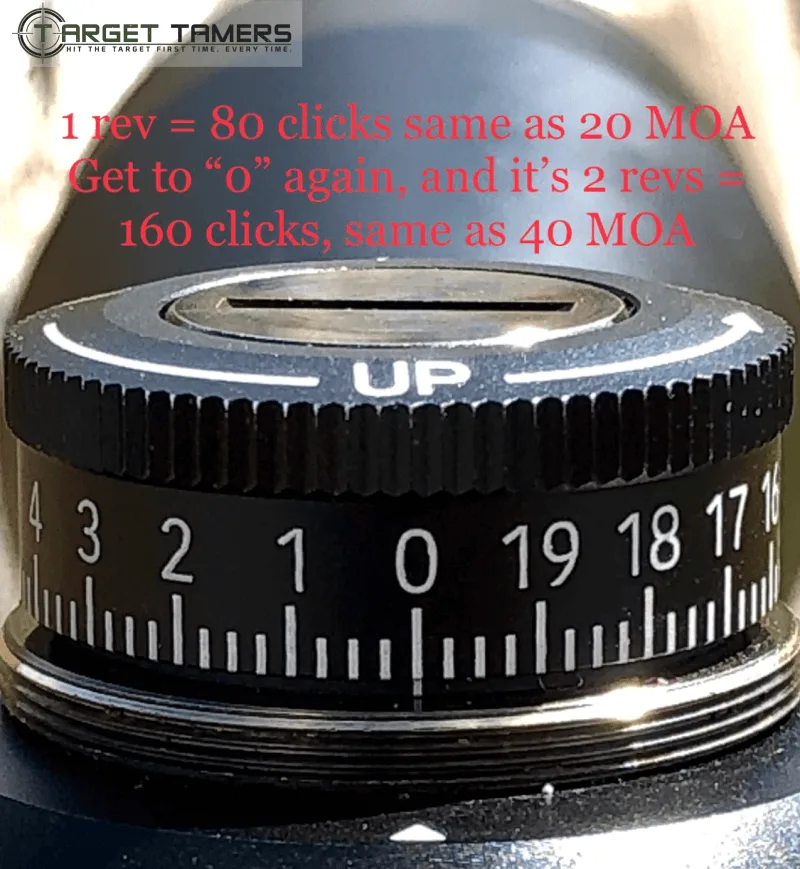
Image source: Web (Bing) / storage.googleapis.com (Web image (fair-use with source credit))
Quick Answer
How many clicks equal 1 MOA on a rifle scope? It depends on your turret's click value. Most scopes use ¼ MOA per click.
That means 4 clicks equal 1 MOA. Some scopes use ½ MOA per click, where 2 clicks equal 1 MOA.
Why This One Question Trips Up So Many Shooters
The short answer is 4 clicks, but that number only holds for ¼ MOA turrets. Plenty of scopes ship with ½ MOA or 1 MOA per click. Mil-based scopes don't convert to MOA clicks at all.
If you assume the wrong value, your turret math falls apart fast.
Here's the real problem. Most beginner guides just say "¼ MOA per click" and move on. That works for many scopes.
But as of 2026, more long-range setups are using mil turrets or mixed systems. The old shorthand breaks down quickly when you step outside the default.
We see this play out at the range all the time. A shooter dials 20 clicks for 600 yards and expects 5 MOA of adjustment. If their scope actually moves ½ MOA per click, they've dialed 10 MOA instead.
That's roughly 52 inches of vertical shift at 600 yards, way more than needed.
The fix is simple. Check your turret marking before you dial anything. It takes ten seconds and saves you a whole box of ammo.
The Short Answer: It Depends on Your Turret
If your scope turret says ¼ MOA per click, then 4 clicks equal 1 MOA. That's the most common turret value on the market today. It's the default on many scopes from Vortex, Leupold, and a long list of other brands.
The conversion formula is straightforward:
Clicks per MOA = 1 ÷ click value in MOA
| Turret click value | Clicks to equal 1 MOA |
|---|---|
| ¼ MOA per click | 4 clicks |
| ½ MOA per click | 2 clicks |
| 1 MOA per click | 1 click |
But that formula only works if your turret is MOA-based. Mil scopes work in a completely different measurement system. You can't directly compare mil clicks to MOA without conversion math first.
Here's why the one-size-fits-all answer fails. Budget scopes tend to stick with ¼ MOA turrets. But many mid-range and premium scopes now ship with mil turrets instead.
Match and competitive shooting setups increasingly favor 0.1 MRAD per click turrets because the decimal math is cleaner at long range.
So the real answer is simple. Look at your turret. Find the click value.
Divide 1 by that number. That gives you exactly how many clicks equal 1 MOA on your specific scope.
How MOA and Click Values Actually Work
Minute of Angle, or MOA, is an angular measurement used in shooting. One MOA equals 1.047 inches at 100 yards. That's called the 1.047 rule, and it scales linearly with distance.
At 200 yards, 1 MOA equals about 2.09 inches.
Turret click values are expressed as fractions of an MOA. When a turret says "¼ MOA," each click moves the point of impact by one quarter of a MOA. So 4 clicks add up to 1 MOA.
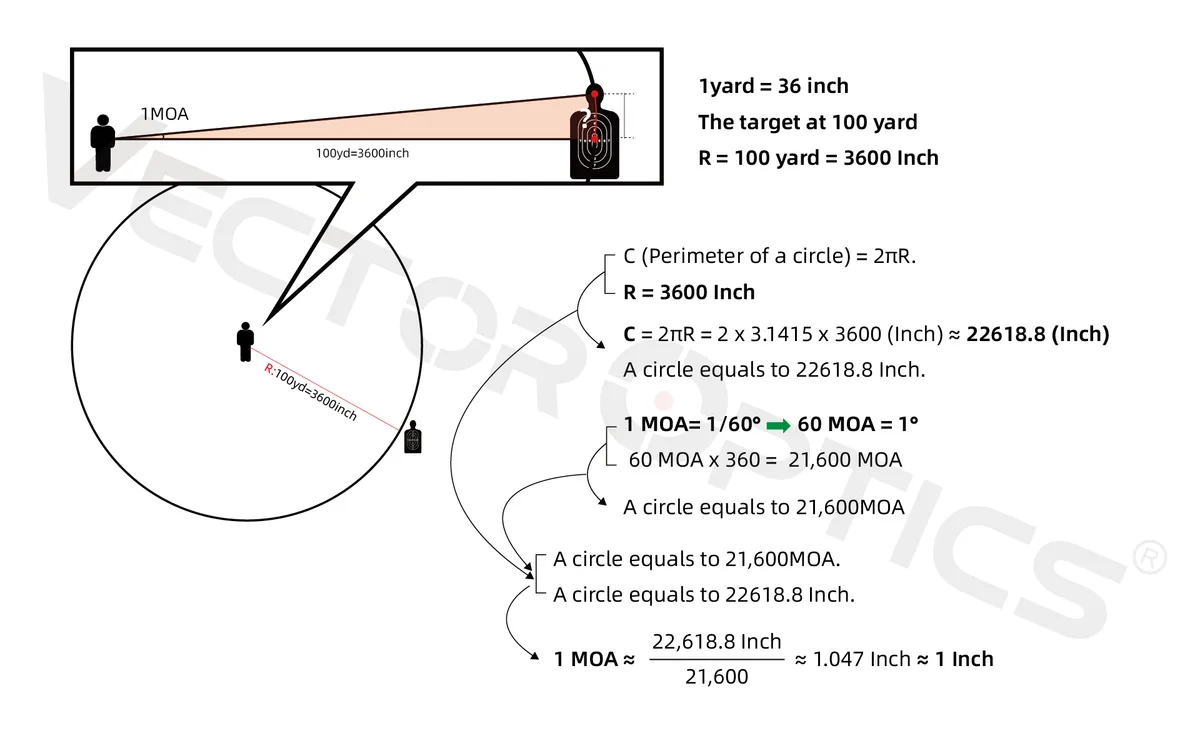
Image source: Bing (Web (fair-use with source credit))
There's a parallel system called the milliradian, or mil. It's used heavily in European shooting and long-range competitions. One mil equals 3.6 inches at 100 yards.
Mil turrets typically move in 0.1 mil increments, which equals about 0.36 inches at 100 yards.
The National Institute of Standards and Technology (NIST) provides the official unit conversion definitions behind these measurements. MOA and mil both measure angles, not inches directly. The inches you see on target just follow from distance.
Here's the key takeaway. Turret clicks control angular adjustment. The distance you're shooting at determines how many inches that angular change actually equals.
Identifying Your Turret Click Value
Before you can calculate anything, you need to know what your turret actually does. Most scopes have the click value stamped directly on the turret itself. Look for markings like "¼ MOA," "½ MOA," "1 MOA," or "0.1 MRAD."
If the turret markings are worn or missing, check the scope manual or the manufacturer's spec sheet. Most major brands list turret click value in the product data sheet. You can also email the manufacturer directly with your scope's model number.
If you're heading into a match, the National Shooting Sports Foundation (NSSF) maintains equipment standards used across competitive shooting organizations.
Here's a quick cross-check if you're unsure:
- Mount the scope on a stable rest at 100 yards.
- Fire one group at the bullseye.
- Dial 4 clicks up on the elevation turret.
- Fire another group.
- Measure the distance between the two groups.
If the second group is roughly 1 inch higher, your turret is ¼ MOA per click. If it's about 2 inches higher, it's likely ½ MOA per click. This test takes 10 rounds and gives you certainty before you trust your turret on a hunt or match.
Converting Clicks to Distance: The Step-by-Step Method
Once you know your turret's click value, you can calculate exactly how many clicks to dial for any distance. The math is the same whether you're on a 100-yard range or a 1,000-yard line.
Here's the process:
- Determine your turret click value. Most common is ¼ MOA per click.
- Find the drop in MOA for your distance. Use a ballistic calculator or your rifle's DOPE card.
- Convert MOA to clicks. Divide the MOA of drop by your turret's click value.
Worked example at 100 yards with a ¼ MOA turret:
Your rifle shoots 2 inches low at 100 yards. Divide 2 by 1.047 to get about 1.9 MOA. Divide 1.9 by 0.25.
You need approximately 7.6 clicks, so round to 8 clicks.
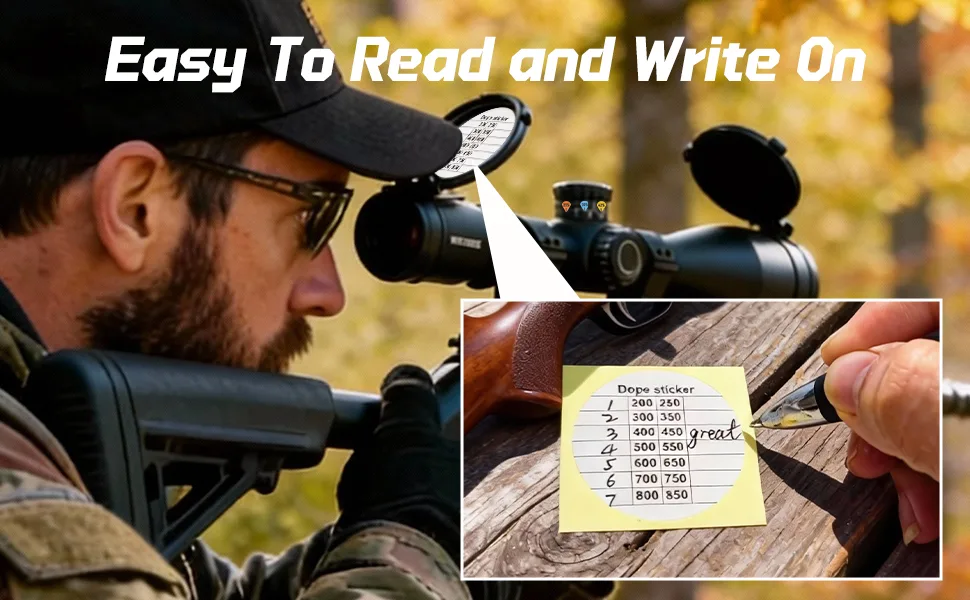
Image source: Bing (Web (fair-use with source credit))
Worked example at 600 yards with a ¼ MOA turret:
Say your drop at 600 yards is 18 MOA according to your DOPE card. Divide 18 by 0.25. That's 72 clicks on a ¼ MOA turret.
On a ½ MOA turret, it would only be 36 clicks. That's the difference between hitting the plate and going over the berm.
Here's the formula in one line:
Total clicks = (MOA of drop) ÷ (turret click value in MOA)
One more thing to watch for. Turret travel limits. Many scopes have only 20 to 50 MOA of total elevation travel.
If your rifle needs more elevation than the turret provides, you'll need a canted scope base to compensate.
Mistakes to Avoid When Dialing Turret Adjustments
The most common mistake is assuming every scope uses ¼ MOA per click. That default works for many scopes, but not all. If your turret actually moves ½ MOA per click, every calculation you make is off by a factor of two.
The second big error is confusing MOA with mil. They're both angular measurements, but they use different numbers. One mil equals roughly 3.6 MOA.
Dialing mil clicks on an MOA scope, or vice versa, produces wildly wrong adjustments.
Here's a quick rundown of the mistakes we see most often:
- Ignoring turret click value before dialing. Always check the marking first.
- Using holdover data as turret dial data. Reticle subtensions and turret clicks aren't interchangeable.
- Forgetting range in the conversion. Turret clicks are angular. Distance determines the inches on target.
- Skipping the tracking test. Budget scopes sometimes don't move exactly what their markings say.
- Not returning to zero after adjusting. Leaving the turret dialed up is a classic way to lose your zero at the next hunt.
- Ignoring environmental factors. Temperature, altitude, and humidity shift bullet drop. Your dial value needs to account for those too.
One more thing. Parallax. If your scope has a side focus turret, dialing it incorrectly can introduce apparent point-of-impact shifts that aren't caused by your elevation adjustment at all.
Real Scenarios: What Happens When You Get the Click Count Wrong
Scenario 1: The new shooter dials for 600 yards on a ¼ MOA turret
A shooter zeros at 100 yards and reads that they need 18 MOA of elevation for 600 yards. On a ¼ MOA turret, that's 72 clicks (18 ÷ 0.25). If they assume "4 clicks per MOA" but mistakenly divide instead of multiply, they dial only 4.5 clicks.
The shot lands roughly 18 inches low at 600 yards. A full box of ammo gets wasted before they realize the math error.
Scenario 2: The competitor switches from mil to MOA
A PRS shooter moves from a 0.1 MRAD turret to a ¼ MOA scope. They're used to dialing 15 clicks for a 500-yard target (which on a mil scope equals about 1.5 mil or 5.4 MOA). On their new MOA scope, 15 clicks only equals 3.75 MOA.
The shot lands several inches low. The fix: always recalculate in the turret system your scope actually uses.
Scenario 3: The budget scope's click value doesn't match the box
Aggregate reviews of budget rifle scopes report instances where turrets advertised as ¼ MOA per click actually move closer to ½ MOA per click under sustained adjustment. The safest approach is the simple dial test described earlier. Spend ten minutes verifying your turret before you trust your DOPE card on a hunt or match day.
Frequently Asked Questions
How do I know if my scope uses MOA or mil clicks?
Check the turret markings or your scope's spec sheet. MOA scopes are labeled in fractions like ¼ MOA or ½ MOA. Mil scopes are labeled in decimals like 0.1 MRAD or 0.2 MRAD.
If the markings are worn, contact the manufacturer with your model number and they'll confirm the turret value for you.
Can I mix MOA and mil systems on the same rifle setup?
Technically yes, but it's not recommended. Keeping everything in one system eliminates conversion math and reduces errors. If you switch scopes between MOA and mil, keep separate range cards for each setup so you're never guessing at the firing line.
Why does my scope say ¼ MOA per click but I'm getting ½ MOA of adjustment?
Turret tracking can drift on budget optics. Aggregate buyer feedback on entry-level scopes shows some units moving closer to ½ MOA per click despite ¼ MOA markings. The dial test at 100 yards is the fastest way to confirm what your specific scope actually does per click.
Do magnification and reticle type change how many clicks equal 1 MOA?
No. Turret click value is fixed by the turret mechanism itself. Magnification and reticle type (FFP vs SFP) affect what you see through the scope, but they don't change how much the turret moves per click.
That said, reticle subtensions can differ between FFP and SFP scopes, so holdover calculations may need adjusting if you switch reticle types.
What's the difference between ¼ MOA per click and 1 MOA per click?
With ¼ MOA per click, each click moves the point of impact by one quarter of a MOA. It takes 4 clicks to equal 1 MOA. With 1 MOA per click, each click moves the full MOA at once.
Turrets with 1 MOA per click are faster for large adjustments but less precise for fine tuning.
Should I dial elevation or use holdover for long-range shooting?
Both methods work. Dialing is common in F-Class and PRS shooting where you have time to dial between stages. Holdover using a tree-style reticle is faster in hunting and tactical scenarios where the target appears unexpectedly.
The best choice depends on your rifle setup, shooting position, and the time you have to adjust.




