Side focus is the turret on your rifle scope that corrects parallax, the optical error that makes your reticle appear to shift off the target when your eye moves slightly off-center. It's one of the most misunderstood adjustments on a precision scope, and most new shooters don't realize it exists until their shots start drifting.
Manufacturer specifications indicate side focus turrets typically adjust across ranges from 25 yards to infinity or 50 yards to infinity. In 2026, most mid-to-high-end scopes from brands like Vortex Optics, Leupold, and Nightforce include a dedicated side focus turret as standard equipment.
Quick Answer
What is side focus on a rifle scope? It's a turret that adjusts parallax by moving an internal lens element. The turret sits on the left side of the scope body.
It shifts the target image to match the reticle's focal plane. The result is a sharp, locked reticle at any shooting distance.
What Side Focus Does on a Rifle Scope (and Where You'll Find It)

Side focus is a physical turret mounted on the left side of a rifle scope body. Its single job is to correct parallax, the optical misalignment between where the reticle appears and where the target actually sits in the scope's image. When set correctly, the reticle "locks" onto the target at a specific distance.
You'll find side focus on most scopes designed for precision shooting, long-range hunting, or competitive use. Scope manufacturers put it there because parallax error gets worse at higher magnifications and longer ranges. Even a small reticle shift translates into a missed shot.
Here's what the turret actually does internally:
- Moves a lens element inside the scope's erector system
- Shifts the target image onto the same focal plane as the reticle
- Keeps the reticle visually pinned to the target at a chosen distance
- Eliminates the "floating" reticle appearance when your head moves slightly
Where You'll See It on the Scope
The side focus turret sits directly behind the magnification ring on most scopes. It's usually a knurled dial, often with yardage markings printed around it. Some turrets have clicks like a windage knob.
Others are smooth without detents.
You won't find side focus on budget scopes. Those either use an objective lens parallax adjustment (a ring on the front) or have no parallax correction at all. If your scope has a plain, smooth objective ring with no markings, that's an objective parallax adjuster.
If it has a turret on the side, that's your side focus.
What Correcting Parallax Means in Practice
Parallax happens because your scope has multiple focal planes. The target image forms at one plane, the reticle sits at another, and your eye sits behind both. When those planes don't line up, any small eye movement causes the reticle to appear to shift relative to the target.
Side focus fixes this by sliding the target image to the reticle's plane. Once they're on the same plane, the reticle can't float. Your point of impact stays put even if your head position shifts slightly.
It's the difference between guessing and knowing where your shot will land.
How Parallax Works and Why Side Focus Corrects It
To understand side focus, you need to understand the problem it solves. Parallax is the reason your reticle appears to move on the target when you shift your head position behind the scope, even though your rifle hasn't moved.
The Two-Plane Problem
Inside a rifle scope, light passes through several lens elements. The target image forms on one focal plane. The reticle sits on a different focal plane.
Your eye sits behind both.
When these two planes don't coincide, your eye sees the reticle and target from slightly different angles. Move your head a quarter inch to the left, and the reticle appears to jump to the right on the target. That shift is parallax error.
How Side Focus Solves It
Side focus physically moves an internal lens element. That movement slides the target image along the scope's optical axis until it lands on the reticle's focal plane. Both planes now coincide.
Here's what changes at the lens level:
- The erector lens group shifts rearward or forward
- The target image plane shifts to match the reticle plane
- Any remaining difference between eye position and target becomes negligible
The result is simple: the reticle stays fixed on the target regardless of small head movements.
Why Magnification Makes Parallax Worse
At low magnification (4x), parallax error is small enough that most shooters never notice it. The reticle looks stable, shots land where they should. But at 16x, 24x, or higher, the same optical misalignment becomes much more visible.
The reason is angular resolution. Higher magnification narrows the light cone entering the scope. That amplifies any difference between the reticle plane and the target plane.
A 2-inch reticle shift at 200 yards might miss completely at 400 yards with high magnification. Side focus becomes essential in these conditions.
Side Focus Turret vs. Objective Parallax Adjustment: Spotting the Difference

Before you can adjust parallax, you need to know which type your scope has. Two systems exist. They look and feel very different.
Getting this wrong leads to frustration at the range.
Side Focus Turret (Left-Side Dial)
A side focus turret is a knob or dial mounted on the left side of the scope tube, typically behind the magnification ring. It's labeled with yardage markings (25, 50, 100, 200, 500, infinity). Many models have click detents so you can feel each adjustment.
Best for: Precision shooting, PRS competition, long-range hunting, and any scenario where you dial to known distances quickly.
Objective Parallax Adjustment (Front Lens Ring)
An objective parallax adjuster is a rotating ring on the front of the scope, around the objective lens. You twist the objective end to change parallax. It works the same way internally but requires a different hand position.
Best for: Scopes where a left-side turret adds cost, and for shooters who prefer the simplicity of one adjustment point at the front.
Side-by-Side Comparison
| Feature | Side Focus Turret | Objective Parallax Adjustment |
|---|---|---|
| Location | Left side of scope body | Front objective lens ring |
| Markings | Yardage (often with clicks) | Yardage markings on ring |
| Ease of use | Turret feels natural while shooting | Requires reaching to the scope front |
| Common on | Mid-to-high-end scopes | Budget and some mid-range scopes |
| Adjustment feel | Clicked detents | Smooth, non-clicked rotation |
| Speed of adjustment | Faster from shooting position | Slower, requires repositioning hand |
The visual difference is obvious once you know what to look for. If you see a turret behind the magnification ring, it's side focus. If you see a plain ring on the front, it's objective parallax adjustment.
How to Adjust Side Focus on Your Scope
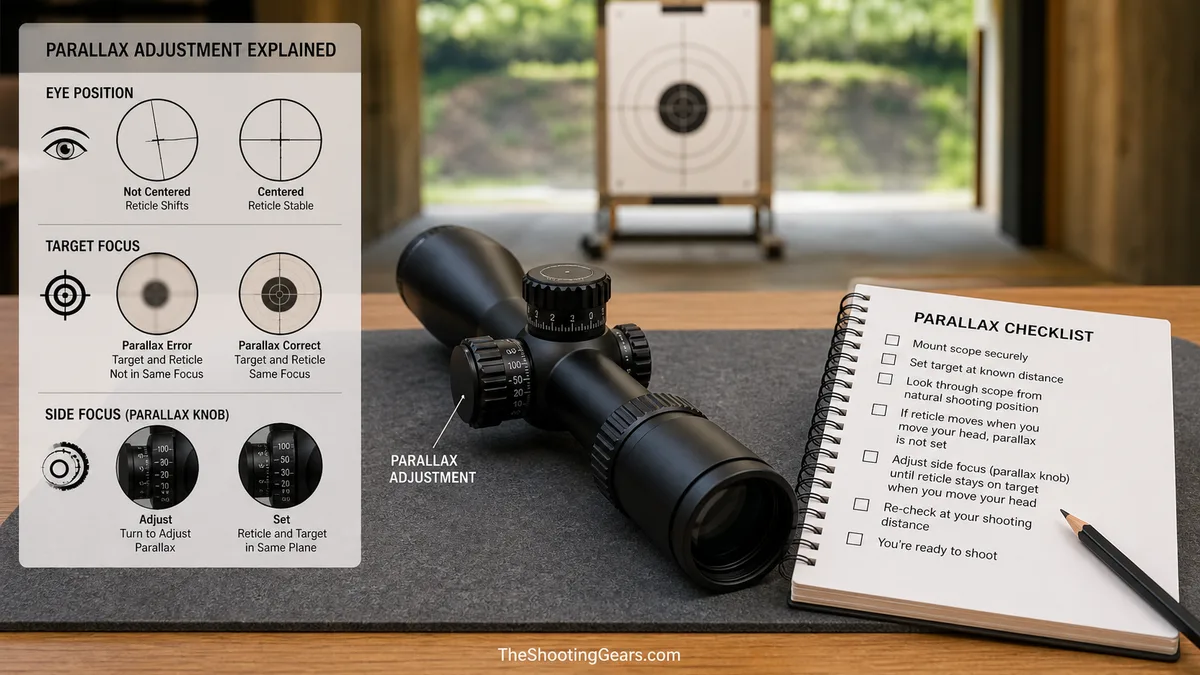
Adjusting side focus is straightforward. The problem is that most shooters do it in the wrong order. Follow these steps in sequence and you'll get a locked reticle at any distance.
Step 1: Set Your Magnification
Dial your magnification to the level you'll shoot at first. Parallax behavior changes with magnification. The side focus setting that works at 8x won't hold at 20x.
Adjust magnification before touching the parallax turret.
Step 2: Set Your Eye Relief
Move your head to your normal shooting position. Adjust the ocular (eyepiece) focus until the reticle is sharp and crisp. This diopter adjustment gets set once, then left alone.
Don't confuse eye relief with parallax.
Step 3: Establish a Cheek Weld
Settle into your shooting position. Get your cheek welded to the stock consistently. If your head position varies, parallax adjustment won't hold.
A stable, repeatable cheek weld is the foundation.
Step 4: Pick a Known Distance
Look at a target at a known distance. Use a range finder if you're unsure. Choose something clear and high-contrast, like a steel target or a distinct object at the range.
Step 5: Adjust the Side Focus Turret
Here's the core action:
- Look through the scope at the target.
- Slowly rotate the side focus turret in one direction.
- Watch the target image for clarity and the reticle for stability.
- If the image gets sharper and the reticle looks more locked, keep going that direction.
- If it gets worse, reverse direction.
Step 6: Test the Lock
Without changing anything else, move your head slightly left and right behind the scope. If the reticle stays fixed on the target, your side focus is set correctly. If it still floats, keep fine-tuning until it locks.
Step 7: Mark Your Common Distance
Many shooters put a small dot or mark on the turret at their most common shooting distance. This lets you return to it quickly without guessing. Some scope models include reference marks from the factory.
Common Side Focus Mistakes and How to Fix Them
Even experienced shooters get side focus wrong sometimes. These are the mistakes that come up most often, and how to fix each one.
Mistake 1: Ignoring Side Focus After Zeroing
The most common mistake. A shooter zeroes at 100 yards, assumes everything's set, and never touches side focus again. Parallax error develops at other distances.
Shots drift, and the shooter blames the rifle or the ammo.
Fix: Adjust side focus every time you change distance or magnification significantly. Treat it like part of your shooting routine, not a one-time setup.
Mistake 2: Confusing Eye Relief with Parallax
If the reticle looks blurry, new shooters immediately reach for the parallax turret. But a blurry reticle usually means eye relief or diopter focus is wrong, not parallax.
Fix: Sharp reticle means eye relief and diopter are correct. Stable reticle on target means parallax is correct. Fix eye relief first, then adjust parallax.
Mistake 3: Adjusting While Looking Away From the Target
Some shooters turn the turret, then look back at the target to check. By then their head position has changed and they're judging the wrong thing.
Fix: Keep your eye on the target through the scope while turning the turret. Your cheek weld stays locked. Only move your hand, not your head.
Mistake 4: Guessing the Distance
Dialing side focus to "about 200 yards" when the target is at 350 causes parallax error you can't see until the shot goes wide.
Fix: Use a laser rangefinder. Set side focus to the actual distance, not a rounded guess.
Mistake 5: Forgetting About Magnification Changes
Side focus set at 10x doesn't hold at 22x. Parallax shifts with magnification. If you dial up without adjusting side focus, the reticle starts floating again.
Fix: If you change magnification, re-adjust side focus. Every time.
Mistake 6: Over-Turning the Turret
Some turrets spin freely and have no click detents. It's easy to spin past the correct setting without realizing it.
Fix: Move the turret slowly. Small, deliberate movements. If you overshoot, back it off and start again from the opposite direction.
When Side Focus Matters Most (and When You Can Skip It)
Side focus isn't critical at every distance or magnification level. Understanding when you need it saves you from over-adjusting at the range.
Where Side Focus Is Essential
Parallax correction matters most when magnification climbs and distance grows. Parallax error becomes visible at around 10x magnification and worsens quickly beyond that. It's also a non-negotiable tool at long distances where small errors compound.
Here's where it's critical:
- Magnification at 10x or above: Parallax shift becomes clearly visible during head-movement testing.
- Distances beyond 300 yards: Small optical errors compound into real point-of-impact shifts.
- Precision competition (PRS, F-Class, ELR): Even minor reticle float means missed points.
- Variable magnification hunting scopes: Changing magnification throughout a hunt shifts parallax behavior.
- Rimfire at 50 yards with high magnification: 24x rimfire shooting requires correction to keep groups honest.
When You Can Skip It
If you're shooting at low magnification (6x or below) and moderate distances (under 200 yards), parallax error is small enough to ignore. Many hunters on brush guns or low-power variable optics never adjust parallax at all and shoot perfectly fine.
Fixed-power scopes under 10x also have limited parallax sensitivity. For casual range shooting at 100 yards, adjusting parallax won't change your groups noticeably.
A Simple Rule of Thumb
If your reticle visibly floats on the target when you move your head behind the scope, you need parallax correction. If it stays locked, you're fine. Test it at the range using the head-movement check.
That single test tells you whether side focus needs attention.
Scopes With Side Focus vs. Without: What You're Actually Paying For
Not every scope needs side focus, but the ones that include it come with trade-offs worth understanding before you buy.
What Side Focus Adds to a Scope
Adding a side focus turret requires more complex internal engineering. The erector system needs an additional moving element. The scope tube needs an additional port.
This adds manufacturing cost and slightly increases weight.
Aggregate reviews indicate most shooters notice three key differences when comparing scopes with and without side focus:
- Sharper image at varied distances because parallax can be dialed in per distance.
- Better reticle stability at higher magnifications, especially beyond 12x.
- Faster shooting in variable-distance scenarios where targets appear at different ranges.
What You Give Up
Scopes without side focus are typically lighter, simpler, and cheaper. For close-range hunting, plinking, or low-magnification use, those advantages often matter more than parallax correction.
Price and Availability Comparison
| Scope Category | Side Focus? | Typical Price Range | Best For |
|---|---|---|---|
| Budget hunting scopes | Rarely | $100 to $250 | Close-range hunting, plinking |
| Mid-range hunting scopes | Often | $300 to $600 | General hunting, occasional long range |
| Precision/tactical scopes | Standard | $600 to $1,500+ | Competition, long-range shooting, ELR |
| Premium European scopes | Standard | $1,500 to $3,000+ | Professional precision shooting |
Manufacturer specs confirm scopes with dedicated side focus turrets consistently price $75 to $200 higher than comparable models without the feature. The gap reflects real engineering cost, not just branding.
Who Should Prioritize It
If you shoot at varying distances, dial magnification frequently, or compete in precision matches, side focus is worth the investment. If your scope lives on a hunting rifle used at fixed magnification under 300 yards, you'll likely never notice the difference. For more context on optical setup standards, Leupold's official site offers manufacturer-level guidance on turret configurations and adjustment ranges across their product lines.
Side Focus FAQs
What is side focus on a rifle scope?
Side focus is a turret that adjusts parallax by moving an internal lens element. The turret sits on the left side of the scope body and is usually labeled with yardage markings. It eliminates reticle float caused by eye position shifts behind the scope.
Does every rifle scope have side focus?
No. Side focus appears on mid-to-high-end scopes designed for precision shooting or long-range use. Budget scopes either use an objective lens parallax adjustment or have no parallax correction at all.
If your scope has a plain, unmarked ring on the front, that's an objective parallax adjuster, not a side focus turret.
How do I know if my scope needs parallax adjustment?
Point the scope at a clear target at a known distance. Get into your shooting position and slowly move your head left and right behind the scope. If the reticle appears to float or shift on the target, your scope needs parallax adjustment.
If it stays locked, parallax is already corrected.
Can you damage your scope by adjusting side focus incorrectly?
No. Rotating the side focus turret won't damage the scope under normal use. These turrets are designed to rotate freely throughout their range.
The only mistake you can make is setting it to the wrong distance, which causes inaccurate shots rather than any mechanical harm.
What magnification level does parallax become a problem?
Parallax becomes visible at around 10x magnification in most scopes. It worsens significantly beyond 15x. At 20x to 30x, parallax error causes noticeable reticle float that shifts your point of impact.
Below 6x, most shooters won't detect parallax issues at typical hunting distances.
Should I adjust side focus before or after setting eye relief?
Adjust eye relief first. Eye relief sets the correct distance between your eye and the ocular lens, ensuring the full image circle is visible without vignetting. Once eye relief is correct and the reticle is sharp, you can adjust side focus to eliminate reticle float.
Getting this order wrong leads to chasing your tail on the turrets.




