What is a first focal plane rifle scope? It's a rifle scope where the reticle, the crosshair or holdover markings you see, physically sits behind the objective lens inside the optic. That placement means the reticle scales in size as you zoom in and out.
Holdover markings always represent the same angular measurement on target, whether you're at 3x or 25x magnification.
Most modern FFP scopes use MIL or MOA-based reticles with subtension values that stay accurate across the entire zoom range. Vortex Optics and Nightforce Optics both build their precision rifle lines around this technology. Let's walk through how it actually works and when it matters most.
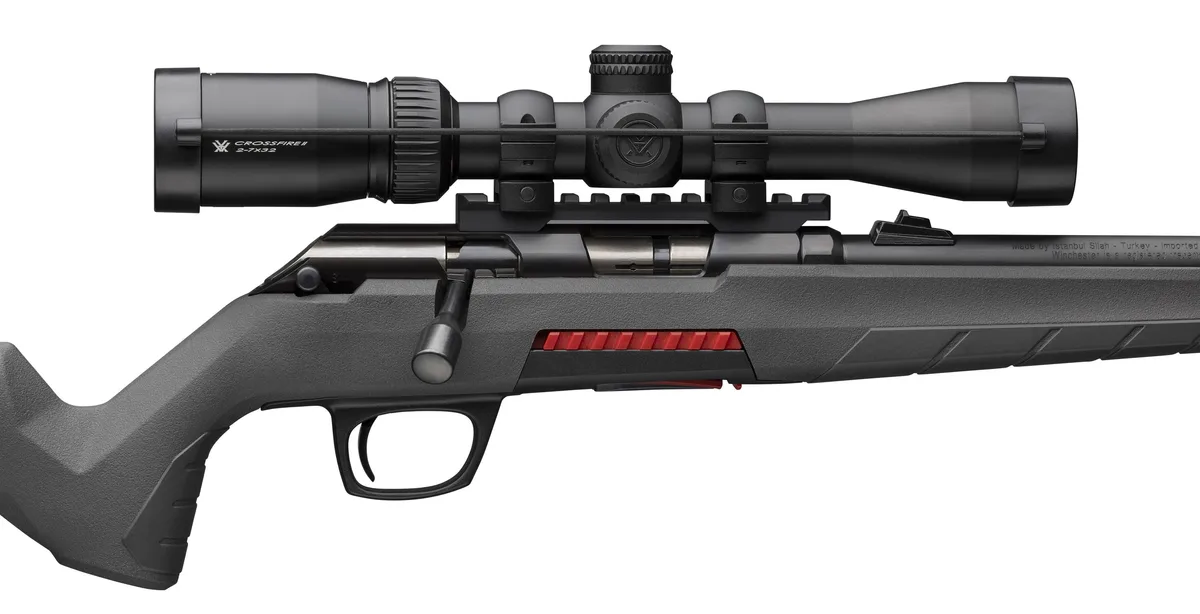
Image source: Web (Bing) / winchesterguns.com (Web image (fair-use with source credit))
Quick Answer: What "First Focal Plane" Actually Means
A first focal plane (FFP) rifle scope places the reticle behind the objective lens inside the optic. Because of that position, the reticle physically scales in size as you zoom in and out. When you dial up to 15x, the reticle grows to match the larger target image.
When you drop to 3x, the reticle shrinks.
This is the defining difference from a second focal plane (SFP) scope, where the reticle stays the same size regardless of magnification setting.
The practical payoff is significant. If your reticle shows 5 MILs of holdover at 10x magnification, it still shows 5 MILs at 3x. You change magnification and your holdovers stay valid.
There's no mental math to account for zoom level.
Manufacturers like Nightforce Optics, Vortex, Leupold, Athlon, and Primary Arms all build precision rifle scopes around FFP technology. As of 2026, FFP is the default choice for PRS competition, tactical applications, and long-range hunting.
The tradeoff? FFP reticles can look small and cluttered at low magnification. That's a real consideration for shooters who spend most of their time at minimum power.
But for anyone varying magnification during a session, FFP solves a problem SFP scopes simply can't handle.
How a First Focal Plane Reticle Works (Why Magnification Changes Everything)
In a first focal plane scope, the reticle is positioned at the internal focal plane where the target image forms. The lens system converges light from the target at that exact location. Because the reticle sits there, anything that affects the target image also affects the reticle.
When you increase magnification, the lens system makes the target image larger. The reticle, sitting at that same focal plane, grows along with it. When you decrease magnification, both the target image and the reticle shrink.
Think of it this way. At low magnification, the target appears small through the scope. The reticle also appears small, so the holdover marks line up proportionally with the smaller target.
At high magnification, the target fills more of the view. The reticle fills more of the view too.
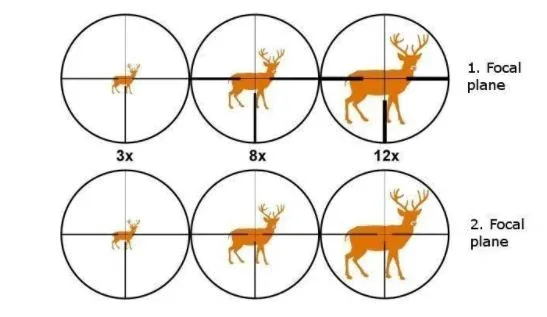
Image source: Web (Bing) / billingsoptics.com (Web image (fair-use with source credit))
The key insight is that the relationship between reticle markings and the target stays constant. If a reticle gap measures 5 MILs at 10x, it still measures 5 MILs at 4x. The gap just looks smaller because everything scaled down together.
This is why FFP scopes excel in variable-range situations. You zoom in on a distant target, and your holdovers stay accurate. You zoom out to scan, and they're still correct when you zoom back in.
First Focal Plane vs Second Focal Plane: The Real Difference
The core difference comes down to where the reticle sits relative to the lens system. In an FFP scope, the reticle is at the internal focal plane where the target image forms. In an SFP scope, the reticle sits behind the objective lens at a fixed-size location that doesn't scale with magnification.
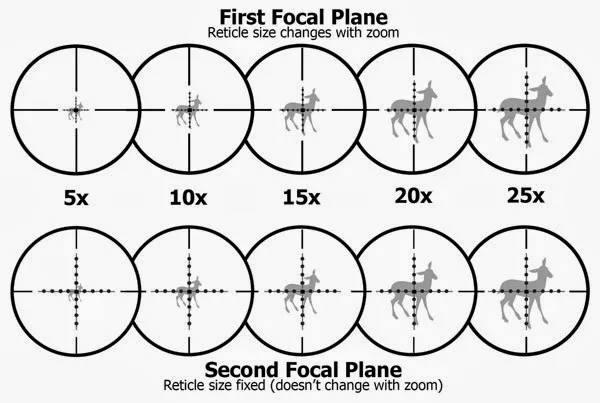
Image source: Web (Bing) / mauserm03blog.blogspot.com (Web image (fair-use with source credit))
Here's what that difference looks like in practice.
| Feature | First Focal Plane (FFP) | Second Focal Plane (SFP) |
|---|---|---|
| Reticle scaling | Scales with magnification | Stays fixed size |
| Holdover accuracy | Consistent at every power | Accurate at one magnification only |
| Common use | Competition, tactical, hunting | Hunting, tactical at fixed range |
| Typical price range | $800 to $4,000+ | $200 to $1,500 |
| Low-power readability | Can look small or cluttered | Clear and easy to read |
An SFP scope with an MOA or MIL reticle is only truly accurate at the magnification it was designed for, often 10x or 25x. Change power, and the holdover values become wrong.
That's the real danger with SFP scopes in variable-range scenarios. You're relying on a fixed magnification setting and hoping you don't forget to adjust.
FFP scopes eliminate that problem entirely. Holdover values are correct at every magnification. That's why competitive shooters running variable distances almost universally choose FFP.
When a First Focal Plane Scope Is the Right Choice
FFP scopes aren't right for everyone. But if your shooting situation involves changing magnification during a session, FFP is almost always the safer choice.
Here's when FFP wins:
- Competition shooting (PRS, NRL, F-Class): Target distances shift between stages. FFP reticles keep holdovers valid at every power setting.
- Long-range hunting: You might dial from 5x to 20x to glass a valley. FFP reticles stay accurate when you settle on a target.
- Tactical and law enforcement: Variable ranges are the norm. FFP eliminates recalculation under pressure.
- Ballistic calculator users: If you run a ballistic app to calculate drop, FFP reticle markings align cleanly with your app's MIL or MOA outputs.
SFP scopes still make sense in specific cases:
- You shoot at a fixed magnification and never change it
- You want the clearest reticle at minimum power, which matters for LPVO use in bright daylight
- Budget matters and you don't need accurate holdovers at multiple power settings
- You primarily use holdoffs rather than reticle-based elevation holds
As of 2026, the trend strongly favors FFP for anything beyond basic hunting use. Most new rifle scope releases in the precision category now default to FFP as standard. Vortex Optics, for example, has shifted nearly its entire precision line to FFP configurations.
The question isn't really "FFP or SFP?" It's "do I change magnification during a shooting session?" If yes, FFP.
Common FFP Scope Mistakes and How to Avoid Them
FFP scopes solve one problem and create a new set of learning curves. Here are the mistakes that trip up most new FFP shooters.
Using the wrong subtension values at low magnification.
At 3x, FFP reticle markings can be tiny and hard to read. Some shooters guess their holdover instead of checking the subtension chart. Fix: always consult your manufacturer's subtension table for your specific magnification level.
If the markings are too small, dial up magnification first.
Assuming all FFP reticles work the same way.
Not true. An MOA reticle (minutes of angle) and a MIL reticle (milliradians) produce different holdover values at the same distance. Mixing them up causes missed shots.
Stick to one system and learn it thoroughly.
Ignoring the low-power tradeoff.
FFP reticles at 1x can look like a fine wire you barely see. If you need fast target acquisition at low power, FFP might frustrate you. LPVO shooters often prefer a bold center dot or SFP option for that reason.
Overcomplicating your reticle choice.
Some FFP reticles carry dozens of holdover dots. Christmas tree reticles, for example, pack in windage and elevation marks that look impressive on paper. More isn't always better.
Choose a reticle that matches your skill level and the distances you actually shoot.
The fix for most of these issues comes down to one thing: know your reticle at your magnification setting. Manufacturer documentation from Vortex, Nightforce, and Leupold all publish detailed subtension charts for every magnification level. Read yours before your first range session.
Choosing the Right FFP Scope: Specs, Subtensions, and Price Tiers
When picking an FFP scope, the reticle system matters more than the magnification range. A MIL reticle and an MOA reticle both work perfectly. But if you already run a ballistics app in MILs, don't buy an MOA scope.
Match your reticle to the system you'll actually use.
Here are the specs worth prioritizing.
| Spec | Entry Tier ($300–$600) | Mid Tier ($600–$1,500) | Premium Tier ($1,500–$4,000+) |
|---|---|---|---|
| Common brands | Primary Arms, Vortex (Viper PST) | Athlon, Vortex (Razor), Nightforce (SHV) | Nightforce (ATACR, NX8), Leupold (Mark 5HD) |
| Magnification range | 3–12x to 4–16x | 4–16x to 5–25x | 5–25x to 7–35x |
| Tube diameter | 30mm | 30mm or 34mm | 34mm (some 30mm) |
| Turret click value | 0.25 MOA | 0.1 MRAD or 0.25 MOA | 0.1 MRAD (precision standard) |
| Glass quality | Good | Very good | Exceptional (ED/fluoride glass) |
For most shooters, the mid tier hits the sweet spot. You get reliable turrets, quality glass, and proven FFP reticles without paying premium prices for glass you'll rarely notice on a range day.
Subtension charts are your best friend here. Every manufacturer publishes them for each magnification level. If you shoot at 10x with a 0.1 MRAD reticle, the chart tells you exactly how many MILs each reticle gap represents.
Bookmark it. Use it. Check it before every session.
One spec many buyers overlook is turret travel. Entry-tier scopes often cap out at 40 to 50 MOA of elevation. Premium models offer 80 MOA or more.
If you're shooting beyond 500 yards with rounds like 6.5 Creedmoor or .308 Winchester, you'll need that extra travel to dial in properly.
Finally, don't underestimate weight. A 34mm premium FFP scope can run 30 to 34 ounces. On a hunting setup where every ounce matters, that weight adds up.
An SFP scope in the same magnification range might weigh 24 to 27 ounces. Decide what your shooting situation actually demands before choosing.
FAQs About First Focal Plane Rifle Scopes
Is FFP better than SFP?
Neither is universally better. FFP wins when you change magnification during a session because holdover values stay accurate at every power. SFP wins for budget buyers, shooters who hold magnification constant, and scenarios where low-power reticle clarity matters more than holdover accuracy.
Do I need a first focal plane scope for long range?
Yes, for most long-range work. At distances beyond 300 yards, holdover accuracy directly affects whether you hit or miss. FFP scopes eliminate the need to remember which magnification setting your reticle holds true.
That consistency is critical when the target is hundreds of yards away.
Why is an FFP scope more expensive?
FP scopes use a more complex internal lens and reticle assembly than SFP models. The reticle must be etched or printed at exact tolerances so it scales correctly. That precision manufacturing drives the price higher.
You're paying for engineering that keeps holdovers accurate at every magnification level.
Can I use an FFP scope for close range?
You can, but it's not ideal. At 1x to 3x, FFP reticles can look small and thin in the optic. If you shoot inside 100 yards at minimum magnification, a bold SFP reticle or red dot will be faster to acquire.
FFP shines when magnification varies, not when you stay at low power.
What magnification range should I choose for an FFP scope?
A 4, 16x or 5, 25x range covers most hunting and range work. Competitive shooters in PRS often prefer 5, 25x for stage variety. For hunting in dense timber, 3, 12x gives you the flexibility to dial down fast.
Choose based on the distances you actually shoot, not the widest range on the spec sheet.
Do all FFP scopes have MOA or MIL reticles?
Most do, yes. The two dominant systems are MOA (minutes of angle) and MIL (milliradians). Some modern FFP scopes also offer BDC reticles with pre-calibrated holdover dots for specific calibers.
The MOA and MIL systems are the most versatile because you can pair them with any ballistic calculator you prefer.