What does 1-6×24 mean on a rifle scope? If you've ever stared at a scope spec sheet and felt completely lost, you're in good company. The numbers 1-6×24 are shorthand for three specific things about the optic.
Once you learn to read the code, comparing scopes becomes a whole lot simpler.
Manufacturer specifications confirm that a 1-6×24 scope zooms from 1x magnification up to 6x, paired with a 24mm objective lens at the front. That combination covers everything from close-range speed shooting to moderate-distance precision work. You'll see this exact spec format on popular LPVO models from brands like Vortex, Leupold, and Trijicon.
Here's what each number actually tells you.
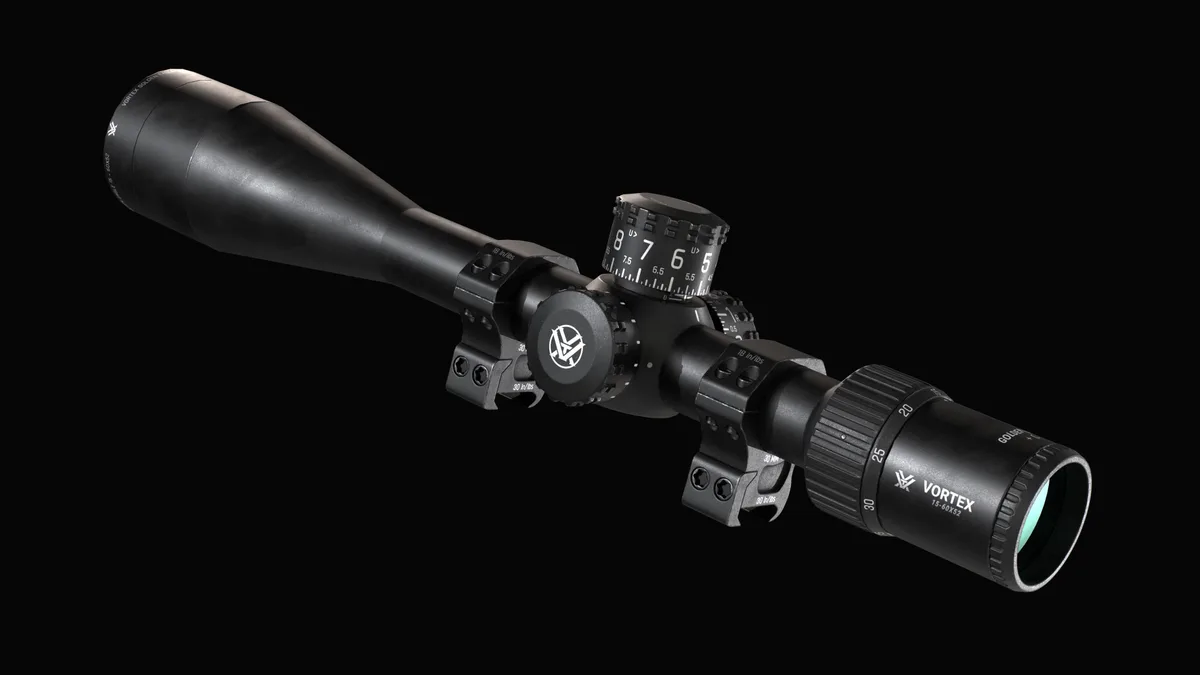
Image source: Web (Bing) / cgtrader.com (Web image (fair-use with source credit))
Quick Answer
What does 1-6×24 mean on a rifle scope? The "1" is the minimum magnification. The "6" is the maximum magnification.
The "24" is the objective lens diameter in millimeters. Together, they describe a scope that zooms from 1x to 6x.
What the Three Numbers Actually Tell You
Scope manufacturers use the same notation across the industry. A spec like 1-6×24 breaks into three parts, and each one tells you something specific about performance. Let's go through them one at a time.
The "1" is the minimum magnification
The first number is the lowest power setting on the scope. At 1x, you get a true 1-to-1 view through the optic. What you see matches what your naked eye sees.
There's no zoom and no distortion to contend with.
That true 1x is critical for fast shooting. At this setting, the scope behaves just like a red dot sight. You keep both eyes open and maintain a wide field of view.
LPVOs shine in exactly this scenario, and it's why they've largely replaced red dot plus magnifier setups on modern carbines.
The "6" is the maximum magnification
The second number is the highest zoom level available. At 6x, objects appear six times closer than they do at 1x. This power level comfortably handles targets out to roughly 200 to 300 yards, depending on caliber and shooter skill.
The tradeoff comes down to field of view. A 1-6x scope typically gives you about 116 feet at 100 yards when set to 1x. Cranked to 6x, that view shrinks to roughly 19 feet.
More magnification always means a narrower picture through the optic.
The "24" is the objective lens diameter
The third number is the diameter of the objective lens, measured in millimeters. This lens sits at the very front of the scope and its job is to gather light. A 24mm objective keeps the optic compact and lightweight.
Many buyers assume a larger objective lens always means a brighter image. That's not entirely accurate. What matters more at each magnification setting is the exit pupil.
Exit pupil equals the objective lens diameter divided by the current magnification.
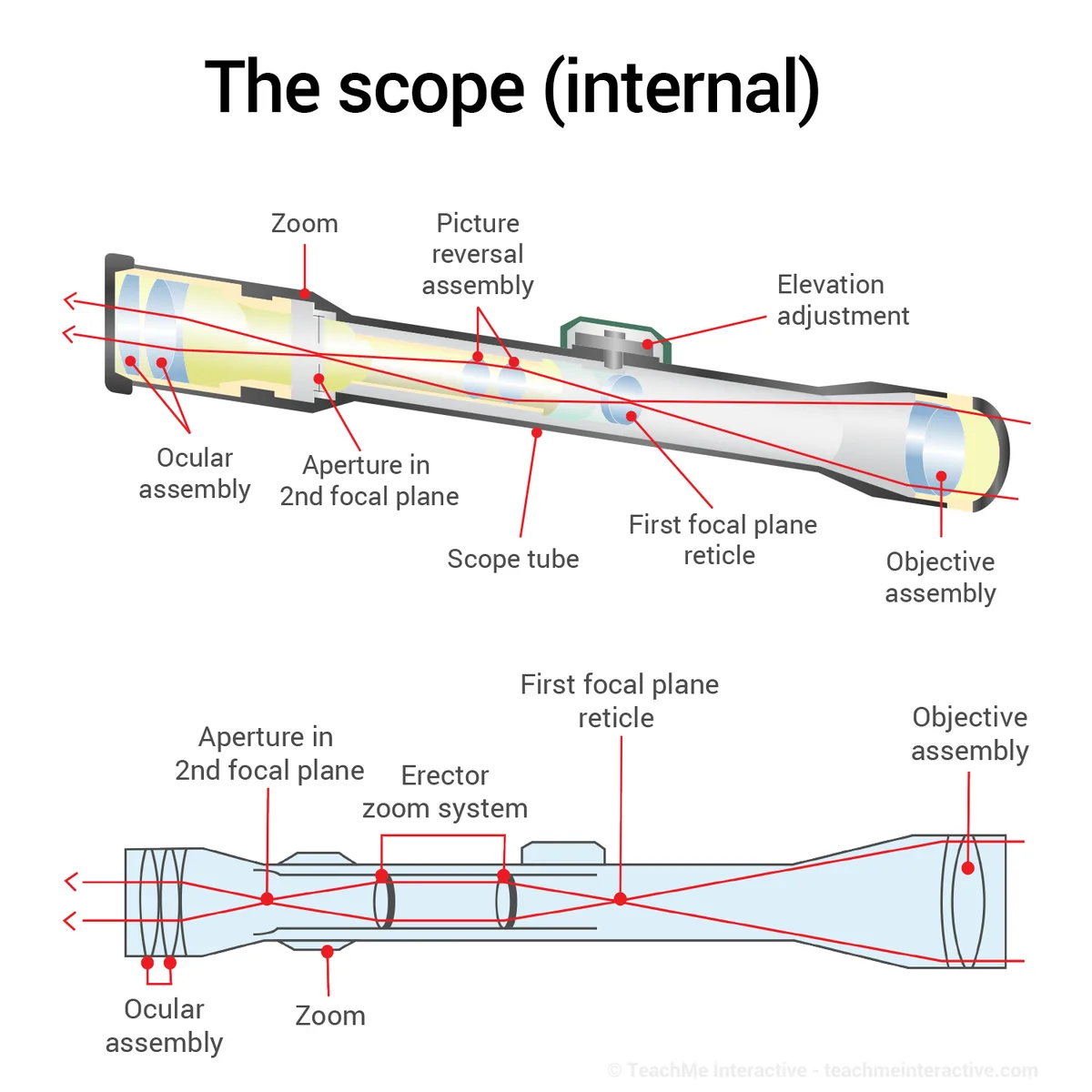
Image source: Web (Bing) / storage.googleapis.com (Web image (fair-use with source credit))
| Magnification | Exit Pupil (24mm Objective) |
|---|---|
| 1x | 24mm |
| 2x | 12mm |
| 3x | 8mm |
| 4x | 6mm |
| 6x | 4mm |
At 1x, the exit pupil is a massive 24mm that floods your eye with light. By 6x, it drops to 4mm. That's still fine in daylight but gets noticeably tight in low-light conditions.
This is exactly why manufacturers offer larger objective lenses (28mm, 30mm) on higher-magnification optics where the exit pupil drops faster.
For context, other common scope notations follow the same format. A 3-9×40 hunting scope zooms from 3x to 9x with a 40mm objective. A 5-25×56 long-range optic zooms from 5x to 25x with a 56mm objective.
Same code, different numbers, different purpose.
Why 1-6x Specifically Is So Popular on Modern Rifles
The 1-6×24 falls under a category called LPVO, which stands for Low Power Variable Optic. This style of scope has become the dominant choice for AR-15 and AR-10 platforms, and the reasons are clear once you look at the numbers.
Manufacturers like Vortex Optics and Leupold built entire product lines around the 1-6x range. The Vortex Razor HD Gen III 1-6×24 is one of the most recognized examples. It set a high bar for what a premium LPVO should deliver in terms of glass clarity and mechanical reliability.
Here's what makes 1-6x specifically catch on with shooters:
- True 1x for speed: Red dot-like performance without carrying a second optic
- 6x for moderate distance: Enough zoom for targets at 150 to 300 yards
- Compact form factor: The 24mm objective keeps the optic low and lightweight
- One optic, multiple jobs: No swapping between a red dot and a magnifier
- Competition favorite: 3-gun competitors and tactical trainers gravitate toward this range as of 2026
Most 1-6x LPVOs use second focal plane (SFP) reticles. In an SFP scope, the reticle appears the same size to your eye at every magnification setting. The tradeoff is that holdover markings are only fully accurate at one magnification, usually the maximum.
First focal plane (FFP) scopes scale the reticle as you zoom, which is better for variable-magnification shooting but adds cost.
As of 2026, SFP remains more common in the 1-6x range because it's simpler to design and keeps the reticle crisp at lower magnifications.
The popularity comes down to practical versatility. Military units like the US Marine Corps fielded LPVOs on the M27 IAR, and competitive shooting communities followed suit. You get close-range capability and moderate-range precision from one optic.
That's a hard combination to beat.
How 1-6×24 Compares to Other Common Scope Ranges
If you're shopping for a scope, the 1-6×24 won't be your only option. Here's how it stacks up against the other ranges you'll encounter. Each choice serves a different shooter, so the "right" one depends on what you're actually doing.
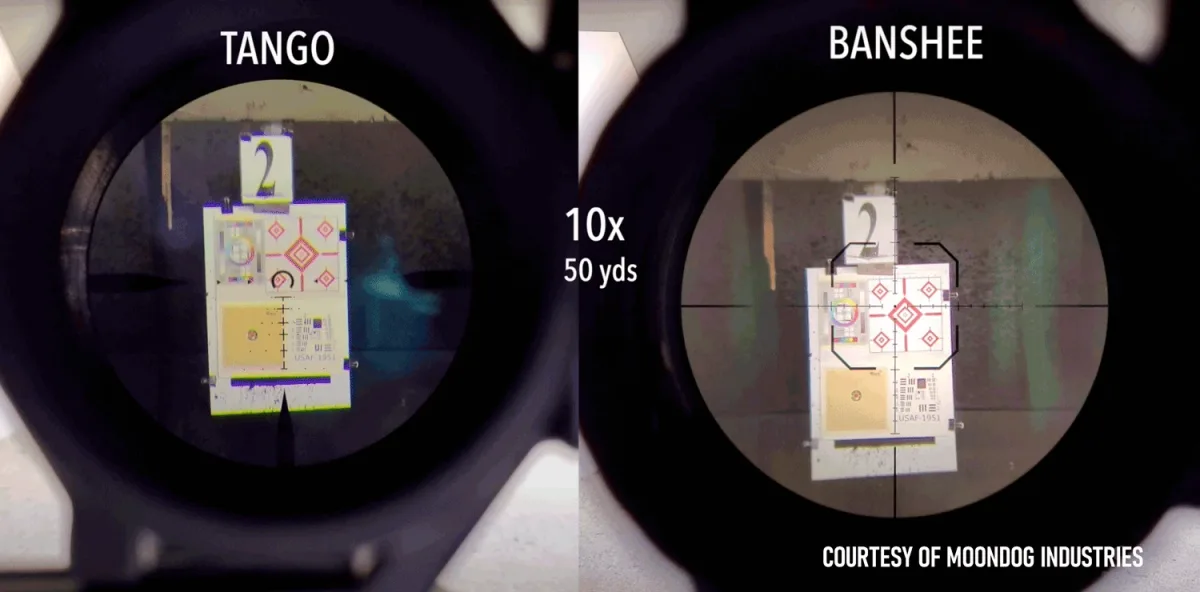
Image source: Bing (Web (fair-use with source credit))
| Scope Spec | Magnification | Objective | Best For |
|---|---|---|---|
| 1-4×24 | 1x to 4x | 24mm | Close-range speed, home defense |
| 1-6×24 | 1x to 6x | 24mm | Versatile tactical, competition, medium-range |
| 1-8×24 | 1x to 8x | 24mm | Extended-range tactical, hunting varmints |
| 3-9×40 | 3x to 9x | 40mm | Traditional deer hunting |
| 5-25×56 | 5x to 25x | 56mm | Precision long-range shooting |
| Red dot + magnifier | 1x plus 3x flip-to-side | N/A | Fast close-range with optional zoom |
1-6×24 vs 1-4×24
The 1-4x is the more budget-friendly entry into LPVO territory. It's lighter, simpler, and great for close-range work. But 4x maximum magnification limits you to roughly 100 to 150 yards with confidence.
If you regularly shoot at 200+ yards, the extra zoom of a 1-6x is worth the price jump.
1-6×24 vs 1-8×24
The 1-8x gives you two additional steps of zoom, which sounds like an obvious upgrade. The catch? The eyebox gets tighter and more unforgiving at 8x.
Some budget 1-8x models struggle with optical clarity at maximum magnification. For most shooters who engage inside 300 yards, 1-6x hits the sweet spot without the compromises.
1-6×24 vs Red Dot with Magnifier
A red dot sight paired with a 3x magnifier is a legitimate alternative. It's lighter and faster at 1x. The tradeoff is that most magnifiers sit at a fixed 3x, and flipping them on and off takes time.
The LPVO stays on the rifle permanently and gives you continuous zoom from 1x all the way to 6x.
Who Should Choose a 1-6×24 Scope, and Who Shouldn't
Not every shooter needs a 1-6×24, and that's okay. Here's a straightforward breakdown of who this optic makes sense for and where you'd be better off with something else.
It's a strong fit if you:
- Shoot an AR-15 or AR-10 and want one optic for multiple scenarios
- Compete in 3-gun, tactical carbine matches, or similar disciplines
- Hunt hogs, coyotes, or varmints at close to moderate ranges
- Want the option to switch from speed shooting to precision shooting without changing optics
- Prefer true 1x performance without carrying a separate red dot
It's probably not the right choice if you:
- Hunt big game exclusively at longer distances (500+ yards) where a 5-25×56 makes more sense
- Need a lightweight dedicated close-range optic (a red dot alone is lighter)
- Shoot suppressed rifles where you want the light-gathering of a larger objective
- Are on a tight budget and only shoot at close range (a quality red dot costs far less)
- Need maximum optical performance in very low light, where 28mm or 30mm objective models perform better
Mistakes to Avoid When Reading Scope Magnification Specs
Scope shopping comes with plenty of traps. Here are the most common mistakes we see people make when they're trying to understand a spec like 1-6×24.
Assuming more magnification always means a better scope
Higher maximum magnification sounds impressive on paper, but it comes with real costs. Eyebox tightens. Field of view shrinks.
Weight goes up. Price climbs. If you never shoot past 200 yards, 6x is already more than you need.
Ignoring the objective lens size implications
A 24mm objective is compact and keeps your optic profile low. But if you hunt at dawn or dusk, the smaller objective means less light collection than a 28mm or 30mm model. Know when you shoot.
Choose your objective size accordingly.
Mixing up focal plane terminology
An SFP 1-6x scope holds a constant reticle size visually. An FFP 1-6x scope zooms the reticle with your magnification. Both have their place, but the differences matter for ranging and holdovers.
Don't assume they're interchangeable.
Forgetting tube diameter compatibility
Most 1-6×24 LPVOs use a 30mm tube, though some premium models use 34mm. Your scope rings must match the tube diameter. A 34mm scope won't fit in 30mm rings, and vice versa.
Get the rings right before you zero.
Skipping the throw lever question
Many LPVOs come with a standard magnification ring that works fine but moves slowly. A throw lever is an aftermarket or included accessory that lets you spin from 1x to 6x in a single motion. If you need to zoom fast in a competition or defensive scenario, it's worth the extra dollars.
Frequently Asked Questions
What does 1-6×24 mean on a rifle scope?
1-6×24 means the scope has variable magnification from 1x (the minimum) to 6x (the maximum), and the objective lens at the front measures 24mm in diameter. The first number is the lowest power setting. The second is the highest.
The third is the objective lens size.
Is 1-6×24 good for deer hunting?
It can work for deer hunting at close to moderate ranges, especially in thick cover. But a 1-6×24 has less magnification than a traditional 3-9×40 or 4-12×40 hunting scope. If you regularly take shots at 250 yards or farther, a dedicated hunting scope may suit you better.
What is an LPVO and is 1-6×24 an LPVO?
LPVO stands for Low Power Variable Optic. It's a scope with variable magnification starting at a true 1x. Yes, 1-6×24 is an LPVO.
It's one of the most popular configurations in this category, used on tactical carbines and competition rifles worldwide.
What does the 24mm objective lens do?
The 24mm objective lens sits at the front of the scope and collects light. A larger objective gathers more light in dim conditions. A 24mm objective is compact and lightweight.
At 6x magnification, it produces a 4mm exit pupil, which works well in daylight but can feel tight in low light.
What's the difference between 1-6x and 1-8x scopes?
A 1-8x scope offers two more steps of zoom, reaching 8x magnification instead of 6x. The tradeoff is a tighter eyebox and potentially lower optical clarity at maximum magnification. For most shooters engaging inside 300 yards, the 1-6x provides all the magnification they need without the drawbacks.
Can you use a 1-6×24 scope at night?
A 1-6×24 works in low-light conditions, but the 24mm objective limits light gathering compared to larger objectives. If you regularly shoot at dusk, dawn, or in heavily wooded areas, consider a 1-6×28 or 1-6×30 model for better light transmission. Dedicated night vision requires equipment designed specifically for that purpose.