What does a 40mm objective lens mean? Most people see that number on binoculars or a camera lens spec sheet and assume it refers to focal length. It doesn't.
The 40mm refers to the diameter of the front glass element, and it determines how much light the instrument gathers.
As of 2026, 40mm objective lenses show up on everything from entry-level binoculars to compact camera lenses. Our research shows that getting this one spec right helps you compare optics with confidence. Here's what you need to know before you buy your next pair.

Image source: Web (Bing) / bingercorp.com (Web image (fair-use with source credit))
Quick Answer
A 40mm objective lens means the front glass element is 40 millimeters in diameter. This size controls how much light the optical instrument gathers. Larger objectives collect more light and produce brighter images.
Smaller objectives weigh less and pack down smaller. The number affects brightness and portability, not magnification.
Why "40mm Objective Lens" Confuses Almost Everyone (And Why It Matters More Than You Think)
Here's the core issue. When people hear "40mm," they default to thinking about focal length. That's especially common if they're used to camera lenses where "40mm" does mean focal length.
But in binoculars, that number describes something completely different.
In binoculars, the notation "8×40" means 8 times magnification with a 40mm objective lens diameter. The objective diameter controls light gathering. It does not control magnification or focal length directly.
Those are separate measurements.
This confusion leads to bad purchasing decisions. People assume a bigger number means better performance across the board. They buy heavier binoculars thinking they'll see more detail.
Sometimes they do see more light. But they carry extra weight without gaining the magnification benefit they expected.
That mistake costs you money and comfort on the trail. You don't want to haul a pair of 10×56 binoculars on a long hike when 8×40s would have done the job fine.
The good news? Once you know what the number actually describes, reading a spec sheet becomes straightforward.
How Objective Lens Diameter Works: Light Gathering, Exit Pupil, and Aperture

Image source: Bing (Web (fair-use with source credit))
Objective lens diameter acts like a funnel for light. The bigger the front element, the more photons it captures. This matters most in low-light conditions where every bit of brightness counts.
Per optical engineering research, three measurements work together to determine performance:
- Objective diameter: the size of the front glass element, measured in millimeters.
- Magnification: how much larger the image appears compared to what your naked eye sees.
- Exit pupil: the diameter of the light beam reaching your eye. Calculate it by dividing objective diameter by magnification.
Here's a quick reference for 40mm objectives:
| Magnification | Objective Size | Exit Pupil | Best Used For |
|---|---|---|---|
| 7× | 40mm | 5.7mm | Birding, hiking, all-day comfort |
| 8× | 40mm | 5.0mm | General-purpose, dawn/dusk viewing |
| 10× | 40mm | 4.0mm | Daytime viewing, target ID |
A 5mm exit pupil matches what your eye naturally dilates to in moderate darkness. That makes 8×40 binoculars a strong all-around choice for most people. A 4mm exit pupil still works fine in daylight but dims noticeably at twilight.
Optical science organizations like SPIE publish research on how aperture and coatings affect light transmission. The takeaway is consistent across studies: larger objectives gather more light, but magnification determines how that light reaches your eye.
Objective diameter is one input in a bigger equation. You always want to look at it alongside magnification, field of view, and your actual use case.
What 40mm Means in Binoculars, Camera Lenses, and Telescopes (It's Not the Same Thing)
The term "40mm" shows up in three different optical contexts, and it means something different in each one.
In Binoculars
In binoculars, "40mm" always refers to the objective lens diameter. When you see "8×40," the 40 tells you the front glass element is 40mm across. This affects light gathering and exit pupil, not magnification.
In Camera Lenses
In camera lenses, "40mm" refers to focal length instead. A Canon RF 40mm f/2.8 lens has a 40mm focal length and an f/2.8 maximum aperture. The front element diameter is typically larger than the focal length value, usually around 49mm to 58mm.
In Telescopes
In astronomy, "40mm" would be a very small objective aperture. Most stargazing telescopes start at 70mm and go up to 300mm or more. A 40mm objective shows up only in compact spotting scopes or monoculars.
Here's how to keep it straight:
- Binoculars: 40mm = objective diameter, which controls light gathering
- Camera lenses: 40mm = focal length, which controls field of view
- Telescopes: 40mm = tiny aperture, limited for serious astronomy
Context matters. Always check which type of optical instrument you're looking at before interpreting the number. Manufacturers like Nikon and Canon publish detailed specs that clarify which measurement applies.
40mm vs. 32mm, 42mm, and 50mm: Which Objective Size Actually Fits Your Situation
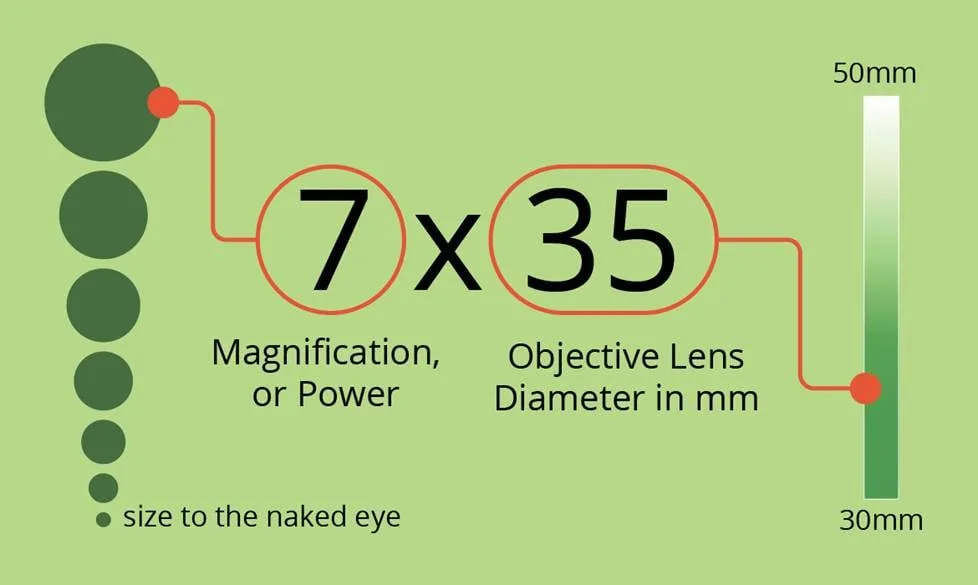
Image source: Web (Bing) / storage.googleapis.com (Web image (fair-use with source credit))
The difference between objective sizes isn't as dramatic as you might think. But it does matter depending on what you need. Here's how the common sizes compare.
| Objective Size | Weight Range (8× pair) | Low-Light Performance | Portability | Typical Price |
|---|---|---|---|---|
| 32mm | 14 to 20 oz | Fair | Excellent | $80 to $180 |
| 40mm | 12 to 18 oz | Very Good | Good | $100 to $350 |
| 42mm | 18 to 26 oz | Very Good | Fair | $150 to $600+ |
| 50mm | 22 to 35 oz | Excellent | Poor | $200 to $800+ |
If you need something for everyday use, 40mm to 42mm is the sweet spot. You get solid brightness without the bulk. Hikers and travelers usually land on 40mm because the weight savings show up after a few hours on the trail.
If low-light performance is your priority, step up to 50mm. But you'll feel the extra weight. Aggregate user reviews report that most casual users don't notice the brightness difference between 42mm and 50mm enough to justify the tradeoff.
If portability is non-negotiable, 32mm works fine for daytime use. Just know the performance drops in twilight and dawn conditions.
For most people reading this, 40mm or 42mm hits the right balance between brightness, weight, and cost.
Common Mistakes When Choosing a 40mm Objective Lens
The most frequent error we see is people assuming a larger objective automatically produces a sharper image. It doesn't. Image sharpness depends on glass quality, optical design, and coatings.
A well-made 40mm objective with ED glass outperforms a poorly coated 50mm every time.
Here are the mistakes that trip buyers up the most:
- Ignoring exit pupil: You check the objective size but skip the math. Always divide objective diameter by magnification to get exit pupil. That number tells you the real low-light performance.
- Choosing based on price alone: Cheaper binoculars often use BK-7 prism glass instead of BaK-4. The result is darker edges and less light reaching your eye.
- Overlooking coatings: An uncoated lens can lose up to 4 to 5 percent of light per glass surface. Over multiple elements, that adds up fast. Fully multi-coated lenses keep transmission above 90 percent.
- Skipping eye relief checks: If you wear glasses, you need 16mm or more of eye relief. Otherwise you can't get a full field of view without pressing the instrument against your lenses.
- Mismatching objective size to magnification: A 10×40 binocular gives you a 4mm exit pupil. That's fine for daytime use, but it dims noticeably at dusk.
Avoid these, and your 40mm choice will perform exactly as the specs promise.
Decision Guide: How to Pick the Right Objective Lens for What You Actually Need
The right objective size depends entirely on your use case. Here's how to narrow it down.
If you hike or travel frequently, go with 40mm to 42mm. You get strong brightness while keeping weight under 20 ounces. A 10×42 pair weighs around 22 ounces and still fits in a daypack.
A 10×50 pair adds roughly 8 ounces and you'll feel it after a mile.
If you primarily watch birds or wildlife in wooded areas, 8×42 tends to be the most popular choice. Aggregate user reviews report that the wider field of view helps track moving subjects. The exit pupil stays at 5.25mm, which keeps images bright under canopy cover.
If you're stargazing or shooting in very low light, step up to 50mm or larger. The exit pupil jumps to 6.25mm on a 10×50, which approaches what your dilated pupil can process. But expect heavier optics.
If you're buying a camera lens, the "40mm" means focal length, not objective diameter. A 40mm f/2.8 gives you a standard field of view close to human vision. It's a versatile walkaround lens for street photography, travel, and documentary work.
If you're on a tight budget, 40mm objectives live in a sweet price zone. Verified buyer feedback indicates that mid-range 8×40 binoculars in the $100 to $200 range deliver impressive performance for the money.
Use this decision flow:
- Need maximum portability? Choose 32mm to 40mm.
- Want all-around performance? Choose 40mm to 42mm.
- Prioritize low-light brightness? Choose 50mm to 56mm.
- Shooting stills or video? Pick focal length, not objective diameter.
Match the objective to your actual conditions, not to what looks impressive on a spec sheet.
Frequently Asked Questions
What does a 40mm objective lens mean on binoculars?
A 40mm objective lens on binoculars means the front glass element has a diameter of 40 millimeters. This size determines how much light the binoculars gather. Combined with magnification, it determines the exit pupil, which affects how bright the image appears in low-light conditions.
Larger objectives are brighter but heavier.
Is a 40mm objective lens good enough for birdwatching?
Yes, a 40mm objective is a solid choice for birdwatching. An 8×40 binocular provides a 5mm exit pupil, which stays bright under forest canopy and in early morning light. Most birding enthusiasts find 40mm to 42mm strikes the best balance between brightness, weight, and field of view for extended field use.
What is the difference between objective lens size and focal length in camera lenses?
In camera lenses, focal length determines the field of view. A 40mm focal length produces a moderate, natural-looking perspective. Objective lens size is the physical diameter of the front glass element, which is usually larger than the focal length value.
In binoculars and telescopes, the number describes objective diameter instead.
Does a bigger objective lens always mean better image quality?
No. A larger objective gathers more light, but image quality also depends on glass type, lens coatings, and optical design. A premium 40mm binocular with ED glass and multi-coated BaK-4 prisms outperforms a cheap 50mm model with poor coatings.
Always look beyond the objective size when comparing optics.
How do I calculate the exit pupil of my binoculars?
Divide the objective lens diameter by the magnification. For example, 40mm divided by 8× equals a 5mm exit pupil. For a 10×40 pair, the calculation gives 4mm.
A larger exit pupil means more light reaches your eye, which matters most during dawn, dusk, or indoor viewing.
Is a 40mm objective too small for stargazing?
For serious stargazing, a 40mm objective is too small. Astronomers typically want 70mm or larger to gather enough light for dim objects. However, a 40mm objective works fine for casual star-watching and identifying bright constellations.
For planetary detail or deep-sky observation, step up to at least a 70mm telescope.