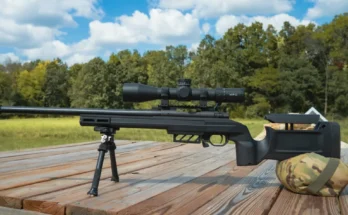
Can you use a high magnification scope at close range? Yes, you can. But the performance you get depends heavily on your scope's specs and how you set it up before you shoot.
Manufacturer specifications for long-range optics from brands like Vortex and Leupold show parallax adjustment that can focus as close as 10 to 25 yards. Field of view, though, shrinks significantly at higher magnification settings. Here's what our research found when we examined how high-power optics behave at close range.

Image source: Bing (Web (fair-use with source credit))
Quick Answer
Yes, you can use a high magnification scope at close range. The key is keeping magnification low enough for adequate field of view. Most 4-16x scopes perform fine at 4x down to 50 yards or more.
Eye relief and parallax settings matter more than the magnification number itself.
Yes, But Here's What Actually Happens
When you dial a high magnification scope down to low power, several things improve at once. Field of view opens up. Eye relief lengthens.
Exit pupil diameter grows, letting more light reach your eye.
On paper, close-range shooting gets easier. But there's a real catch here. Many high-mag scopes have reticle subtensions that are only accurate at one magnification setting.
This is especially true for second focal plane models like the Leupold VX-5HD 3-15×44. At low power, your reticle dot shrinks. It becomes hard to see against a dark target or in low light.
That's a problem when you're trying to hold a precise shot at 50 yards.
Parallax is the other big issue. Every scope has a minimum parallax focus distance. If that minimum is 25 yards and your target sits at 30 yards, you're fine.
But if your target is at 15 yards, the reticle will shift every time you move your head. That shift can equal 2 to 4 MOA, which means missing entirely.
A high-mag scope works at close range, but only if you understand its limits and adjust your magnification and setup accordingly.
How Magnification and Distance Interact: Eye Relief, Exit Pupil, and Field of View
Three optical factors change as you adjust magnification on a variable power scope. Understanding them tells you exactly what to expect at close range.
Eye relief is the distance between your eye and the rear lens where you can see the full sight picture. Long-range scopes typically offer 3.3 to 3.8 inches at high magnification. At low power, that figure often grows by half an inch or more.
Manufacturer data for the Vortex Razor HD Gen III 6-36×56 shows eye relief ranging from 3.5 to 4.0 inches across its magnification range. You can find full specs on Vortex Optics' official site. More eye relief at low power means a safer, more comfortable shooting position.
Exit pupil is the diameter of light coming out of the eyepiece. It's calculated as objective lens diameter divided by magnification. On a 5-25×56 scope, that's 11.2mm at 5x but only 2.2mm at 25x.
Below 2mm, your eye struggles to center the pupil, and the image darkens. At close range, you want that exit pupil to stay above 4mm for comfortable, quick target acquisition.
Field of view tells you how much of the target area you can see at a given distance. A 4-16x scope might show 36 feet at 4x but only 9 feet at 16x. That difference matters when you're tracking a moving target or scanning for one in thick cover.
Here's a quick reference table using a typical 4-16×50 scope:
| Magnification | Exit Pupil (50mm obj.) | FOV at 100 yd (approx.) |
|---|---|---|
| 4x | 12.5mm | 36 ft |
| 8x | 6.25mm | 18 ft |
| 12x | 4.2mm | 12 ft |
| 16x | 3.1mm | 9 ft |

Image source: Web (Bing) / fity.club (Web image (fair-use with source credit))
Magnification isn't free. Every step up in power costs you field of view, eye relief, and exit pupil. As of 2026, most quality variable scopes offer parallax adjustment that helps at longer ranges, but these optical principles still govern close-range performance.
When High Magnification Starts Breaking Down at Close Range
Here's where things go wrong. High magnification at close range creates several problems at once.
Parallax Error at Close Distances
Every scope has a minimum parallax focus distance. Many long-range optics won't focus below 25 to 50 yards. If your target sits closer than that, your point of aim shifts as your head moves.
That shift can equal 2 to 4 MOA at 50 yards, which means missing entirely.
Reticle Dot Visibility
On first focal plane scopes, the reticle scales with magnification. At 6x on a 6-36x scope, your center dot might measure 0.25 MRAD. That's small.
In low light or fast-paced scenarios, you'll struggle to pick it up.
On second focal plane scopes, the reticle stays fixed at the manufacturer's magnification. At other settings, your holdover lines are wrong. This is one reason FFP scopes cost more, and why they handle mixed-distance shooting better.
Eye Relief Compression
As magnification increases, eye relief shrinks. Some scopes lose up to half an inch from minimum to maximum magnification. That creates recoil risk because you're now closer to the rear lens during firing.
On magnum calibers like .300 Win Mag, this compression translates to real scope bite risk if your mounting distance isn't dialed in.
Best Uses for High-Mag Scopes at Short Distances (And When to Switch Optics)
A high-magnification scope isn't useless at close range. It has genuine sweet spots.
Where It Works Well
- Benchrest shooting at 50 to 100 yards where you're stationary and can set magnification to 6x to 10x
- Long-range hunting setups where you primarily shoot beyond 200 yards but occasionally need a close encounter at 100 yards or less
- Precision rifle competitions like PRS stages that mix distances within a single course of fire
- Target identification where high magnification lets you confirm shot placement before firing
- Varmint hunting on open ground where close encounters still mean 100 yards or more
When You Should Switch Optics
- Defensive or tactical shooting where targets move within 25 to 50 yards
- 3-gun competitions with close-range shotgun and rifle stages
- Any scenario requiring fast target acquisition and wide field of view
- Hunting in thick timber where engagement distances are 50 yards or less
- When your scope's minimum parallax distance exceeds your expected target range
The National Rifle Association of America covers marksmanship fundamentals that directly apply here. Magnification isn't just about reaching far. It's about matching the optic to the engagement.
If you're constantly shooting inside 100 yards and never beyond it, an LPVO or red dot setup will outperform a high-mag scope. The magnification is wasted, and the tradeoffs become liabilities.
Setting Up a High-Magnification Scope for Mixed-Distance Shooting
If you're committed to running a high-mag scope across multiple distances, here's how to set it up.
Step 1: Check Your Scope's Minimum Parallax Distance
Find the spec in your scope's manual. If it's 25 yards and your shortest engagement distance is 30 yards, you're fine. If your parallax floor is 50 yards and you hunt timber, you've got a problem.
Step 2: Set Magnification Based on Target Distance
Use a simple rule: your magnification number roughly equals the target distance in hundreds of yards for deer-sized targets. At 100 yards, use 4x to 6x. At 300 yards, use 10x to 16x.
This keeps your field of view reasonable and your exit pupil large enough.
Step 3: Zero at Your Most Common Distance
Most shooters zero at 100 yards with a high-mag scope. This works for mixed distances because your holdovers and turret adjustments handle the difference. If your parallax minimum is 25 yards, also verify your zero holds at that distance.
Step 4: Dial In Your Eye Relief
Set the scope so your eye sits at full eye relief when you acquire the target. Verify this at your lowest and highest magnification settings. Most quality scope manufacturers offer 0.5 inches of eye relief variance across the magnification range.
Always check the official specs for your specific model.
Step 5: Confirm Reticle Subtensions Match Your Data
If you're running a second focal plane scope, your reticle holdovers are only accurate at one magnification setting. Identify that setting and always dial to that magnification when shooting at distance. If you're running first focal plane, you're covered at any setting.
LPVO vs. High Magnification Scope: Which One Fits Your Shooting Style
An LPVO (low power variable optic) gives you 1x to 6x, 1x to 8x, or 1x to 10x magnification. A high-mag scope gives you 6x to 24x, 10x to 36x, or more. The difference isn't just numbers.
It's how each optic handles close-range shooting and fast transitions.
| Factor | LPVO (1-6x/1-8x/1-10x) | High-Mag Scope (6-36x) |
|---|---|---|
| Best use distance | 0 to 400 yards | 100 to 1200+ yards |
| Field of view at 1x | Wide, rifle-both-eyes-open | Not available below 6x |
| Eye relief at 1x | 3.5 to 4 inches | Not applicable below 6x |
| Close-range speed | Fast target acquisition | Slower, magnification-dependent |
| Parallax minimum | Often 10 to 25 yd (model dependent) | Often 25 to 50 yd |
| Reticle visibility at low power | Excellent at 1x (illuminated) | Poor on FFP high-mag scopes |

Image source: Bing (Web (fair-use with source credit))
Who Should Choose an LPVO?
Pick an LPVO if you shoot at mixed distances inside 400 yards, engage moving targets, or want a single optic for both close and moderate ranges. The Vortex Razor HD Gen III 1-10×24 and the Nightforce NX8 1-8×24 F1 are solid options in this category. An LPVO shines when speed matters and precision beyond 400 yards isn't the goal.
Who Should Choose a High-Mag Scope?
Pick a high-mag scope if your primary distances start at 200 yards and go beyond 600 yards. You'll want adjustable parallax and FFP reticle subtensions. This setup works best for PRS competitions, long-range hunting, and precision rifle disciplines where close encounters are rare.
The Hybrid Approach
Some shooters run a red dot sight with a magnifier for close range, and a separate high-mag scope on a bolt-action rifle for long range. It's more expensive, but each optic does one job well instead of compromising both.
Mounting, Zeroing, and Mistakes That Kill Close-Range Accuracy
Proper mounting and zeroing make or break your close-range performance. Here are the errors that show up most often.
Scope Bite from Incorrect Eye Relief
If your eye sits too close to the rear lens, recoil drives the scope into your face. This happens more on high-mag scopes mounted on magnum calibers like .300 Win Mag. Set your eye relief at maximum before tightening the rings, then verify it at your lowest magnification setting.
Torque Specs Ignored
Scope rings need precise torque, typically 15 to 20 inch-pounds for most 30mm and 34mm rings. Overtightening crushes the tube. Undertightening shifts your zero under recoil.
Follow the manufacturer's published torque values every time.
Zeroing Only at One Magnification
If you're running a second focal plane scope and zero only at 10x, your holdovers are wrong at every other magnification. Zero at the magnification you'll use most for holdovers, then verify at your minimum and maximum settings.
Forgetting Parallax at Close Distances
Many shooters set parallax for 200 yards and never adjust it again. If your target drops to 50 yards, your point of aim shifts. Always reset parallax to match your target distance before taking a shot.
Mount Height Mismatch
Scope height changes eye relief and head position. A low-mount scope on a rifle with a high cheek rest will give you scope shadow. A high-mount scope on a bolt gun with a low comb forces your head off the stock.
Mount height should match your rifle's stock geometry.
Common Setup Mistakes at a Glance
| Mistake | What Happens | How to Fix It |
|---|---|---|
| Eye relief too short | Scope bite on recoil | Set eye relief at max power, then check at min |
| Parallax not reset | Reticle shift at close range | Adjust parallax turret before each shot |
| Ring torque too low | Scope shifts after shooting | Torque to 15-20 in-lbs per manufacturer spec |
| Zero only at one mag | Holdovers wrong at other powers | Verify zero at min, mid, and max magnification |
| Wrong mount height | Scope shadow or head lifted off stock | Match mount height to rifle stock comb |
Per published guidelines from the National Shooting Sports Foundation, a properly mounted scope should hold zero through repeated firing. If your zero shifts after ten rounds, the problem is mounting, not the rifle.
Frequently Asked Questions
Can you use a 10x fixed magnification scope for deer hunting at 100 yards?
Yes, a 10x fixed scope works for deer hunting at 100 yards. Your field of view will be narrower than a 3-9x scope at 3x, but at 10x magnification, you're already at the recommended level for that distance. Just verify your parallax minimum is 25 yards or closer so you can focus on nearby targets if needed.
What magnification do I need for 50-yard close-range shooting?
For 50-yard shooting, use 2x to 4x on a variable scope. This keeps your field of view wide and your exit pupil large. High magnification at 50 yards wastes your optical budget and makes reticle acquisition slower.
If your scope's minimum is 4x, you're still fine at that setting for 50-yard targets.
Does first focal plane or second focal plane matter at close range?
First focal plane (FFP) scopes scale the reticle with magnification, making it usable at any setting. Second focal plane (SFP) scopes keep the reticle fixed at one magnification. At close range, FFP is more forgiving because you can dial to any power and still trust your reticle holdovers.
Why does my reticle dot disappear at low magnification on a high-mag scope?
On first focal plane scopes, the reticle subtensions scale with magnification. At 6x on a 6-36x scope, the center dot shrinks below 0.5 MRAD and becomes hard to see in low light. Switching to an illuminated reticle or dropping to a lower power setting (if available) helps.
Second focal plane scopes avoid this because the reticle doesn't change size.
What is minimum parallax distance and why does it matter?
Minimum parallax distance is the closest distance your scope can focus the reticle onto the target plane. If your scope's minimum is 25 yards and your target is at 20 yards, the reticle will shift with head movement. That shift can equal 2 to 4 MOA at close range, enough to miss entirely.
Always check this spec before assuming your scope works at close distances.
Can a red dot sight replace a high magnification scope for close range?
A red dot sight is faster than any magnified scope at close range. It offers unlimited eye relief and a wide field of view. But a red dot provides no magnification for target identification or precision beyond 50 to 100 yards.
If your engagement distances stay inside 50 yards, a red dot outperforms a high-mag scope every time. For mixed distances, an LPVO is the better compromise.