What is a second focal plane rifle scope? In simple terms, it's a rifle optic where the reticle stays the same size no matter how much magnification you dial in. The target behind it changes size.
The crosshairs don't. That single design choice changes how you hold over, estimate range, and calculate shot placement across different distances.
In our research comparing SFP and FFP optics, manufacturer specifications consistently show SFP reticles maintain constant subtension values across the entire magnification range. As of 2026, SFP scopes remain the dominant choice for LPVO platforms and hunting rifles, with entry-level models starting around $150. Here's what you need to know before buying one.
Quick Answer
A second focal plane rifle scope has a reticle that stays one size. The target zooms in. The reticle stays fixed.
Holdover values work only at your zeroed magnification. SFP scopes cost less than first focal plane optics and suit hunting, LPVOs, and consistent-distance shooting.
What Is a Second Focal Plane Rifle Scope?
A second focal plane (SFP) rifle scope places the reticle behind the magnification lens assembly. The result is a reticle that never changes size, regardless of whether you're at 2x or 25x power. The image you see grows larger or smaller.
The crosshairs stay perfectly constant.
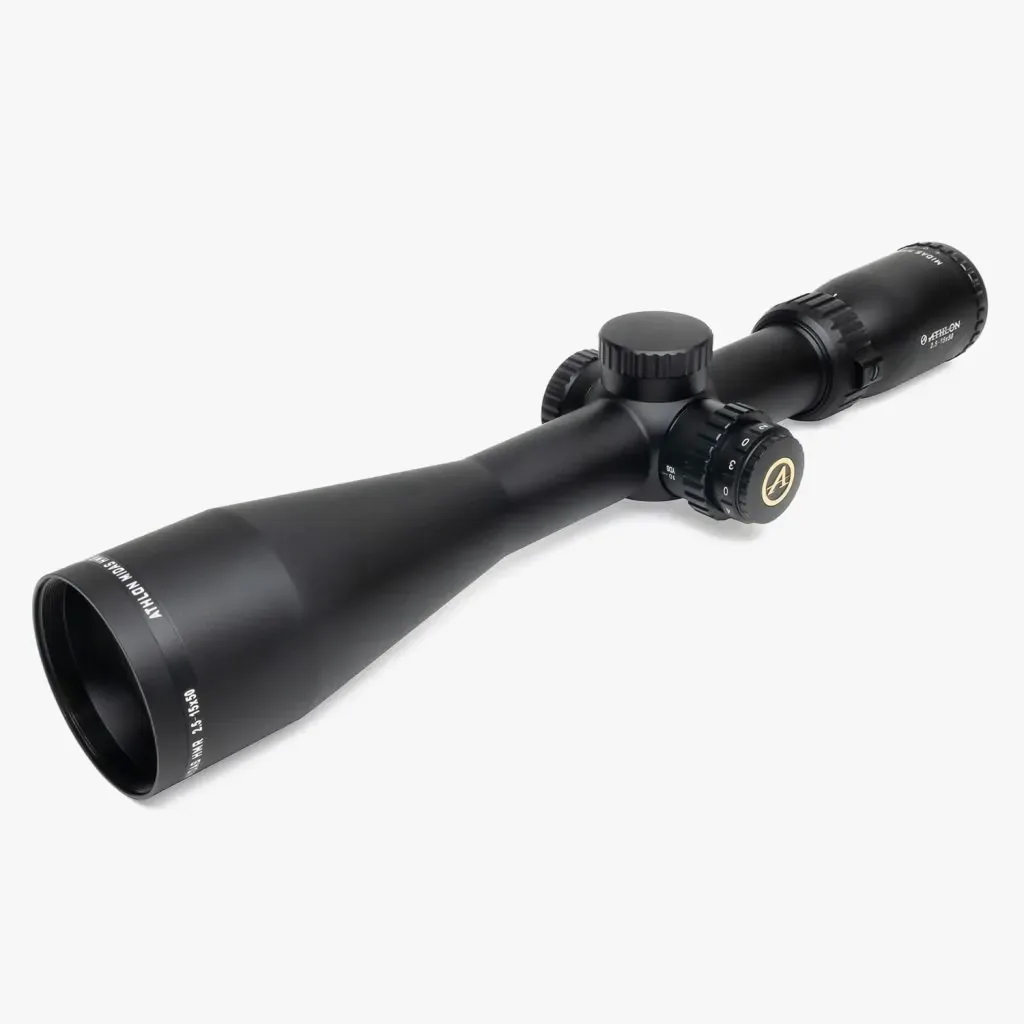
Image source: Web (Bing) / athlonoptics.com (Web image (fair-use with source credit))
This is the defining difference from a first focal plane (FFP) scope, where the reticle scales directly with magnification. Manufacturers like Vortex, Leupold, Nightforce, and Schmidt & Bender all produce SFP models, and the design has been the industry standard for decades.
The practical implication matters. If your reticle subtensions say the crosshair gap is 2 mils, that value only holds true at your zero magnification. At any other power, your actual holdover in mils changes.
That's why SFP scopes are described as magnification-dependent optics.
Here's what the focal plane system looks like at a glance:
| Feature | SFP Reticle | FFP Reticle |
|---|---|---|
| Reticle size at low power | Small, thin | Large, thick |
| Reticle size at high power | Same as low power | Scales up proportionally |
| Holdover accuracy | Only at zeroed magnification | Accurate at every magnification |
| Price tier | Generally lower | Generally higher |
For shooters who dial one magnification and hold there, SFP is simple and reliable. For shooters who need holdovers at variable powers, FFP becomes the better tool. We'll get into that tradeoff shortly.
How SFP Reticles Work Across Magnification
Think of it this way. You zero your rifle at 4x on a 3-9x SFP scope. Your reticle marks now correspond to exact holdover values at that power.
Say the gap between the center crosshair and the first subtension line represents a 3-inch drop at 100 yards. That holds true at 4x and nowhere else.
Now dial down to 3x. The target shrinks, but the reticle doesn't. That gap still covers the same physical width in your sight picture, but the actual drop it represents has changed.
The same thing happens in reverse at 9x. The target fills more of the view while the reticle stays put.
This is the magnification multiplier effect. Shooters need to calculate adjusted holdover values for any magnification other than their zeroed power. Some experienced shooters carry reference cards.
Others train with a single magnification and stick to it.
For LPVO users running 1-6x optics, this matters less than you might think. At low magnification for close targets, precision holdover isn't the goal. Speed is.
SFP reticles in that range stay readable and uncluttered at every power, which is exactly what you want on a defensive or competition rifle.
Manufacturer specifications from brands like Vortex confirm that their Razor HD Gen III 1-10x models and similar LPVOs use SFP reticles precisely because the constant reticle size supports faster target acquisition across the full zoom range.
SFP vs FFP: Side-by-Side Comparison
The question every shooter eventually asks is whether to go SFP or FFP. The honest answer is that neither is universally better. Each one wins in specific situations.
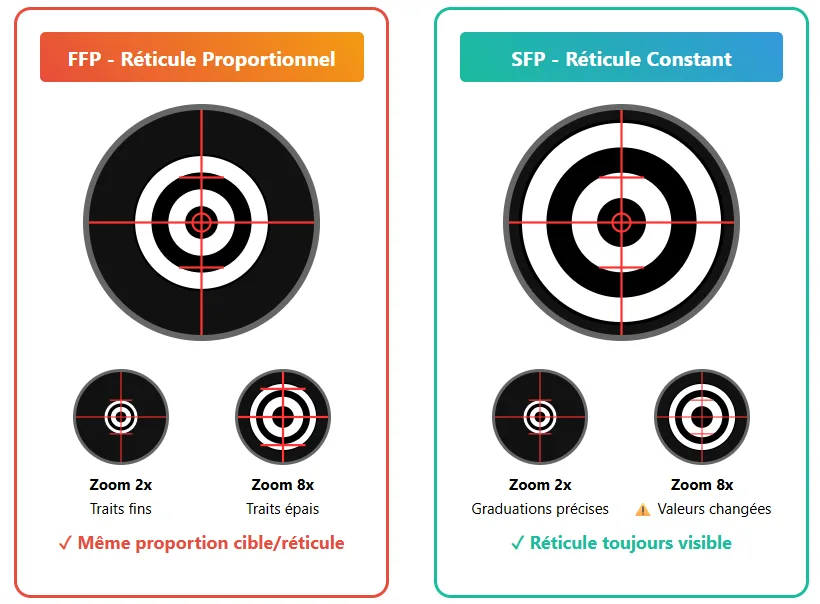
Image source: Web (Bing) / conditionsextremes.com (Web image (fair-use with source credit))
FFP reticles scale with magnification, which means holdover values stay accurate at every power. That's a massive advantage for long-range precision shooting, where you're constantly adjusting magnification for distance. PRS competitors and designated marksman rifle shooters lean heavily into FFP for this reason.
SFP reticles, by contrast, stay locked in size. That makes them easier to read at low magnification and less cluttered at high power. Budget-conscious hunters and LPVO users get more optical performance per dollar, since FFP glass and turret engineering add cost.
Here's how the two systems stack up:
| Criteria | SFP | FFP |
|---|---|---|
| Holdover accuracy | One magnification only | Every magnification |
| Reticle visibility at low power | Clearer | Can be thin or hard to read |
| Reticle clutter at high power | Clean, uncluttered | Can get busy |
| Price | Lower | Higher |
| Best for | Hunting, LPVO, fixed-distance shooting | Long-range, PRS, variable-distance precision |
| Range estimation with reticle | Difficult without magnification adjustment | Straightforward at any power |
If you shoot at known distances or stick to one magnification, SFP delivers everything you need. If your shooting demands holdover accuracy across a wide zoom range, FFP earns its price premium. Manufacturer technical breakdowns from Vortex Optics show how FFP reticles maintain holdover accuracy across every magnification power.
Benefits and Drawbacks of Second Focal Plane Scopes
SFP scopes bring real advantages to the right shooter. They also carry limitations that trip people up when the scope doesn't match the use case.
The biggest benefit is simplicity. Your reticle markings mean the same thing every time you look through the scope at your zeroed magnification. There's no adjusting holdover values as you zoom.
If you set 4x and use it for hunting shots out to 300 yards, the reticle does exactly what it says.
Cost is the second major benefit. A quality SFP scope from a brand like Primary Arms or Burris typically runs $200 to $500, while an equivalent FFP optic often starts at $400 to $700. That gap widens as you move into premium glass.
Here's where SFP falls short:
- Holdovers are only accurate at one magnification setting
- Range estimation using reticle subtensions breaks down at other powers
- The reticle can appear tiny at low magnification, making holdover reading difficult
- Shooters who constantly adjust zoom will fight the reticle's behavior
For a shooter running 3-9x on a bolt-action hunting rifle and zeroing at 9x, SFP is clean and dependable. For a precision rifle competitor dialing from 8x to 25x across stages, the same scope becomes a liability.
The sweet spot for SFP remains fixed-magnification use and LPVO platforms. Everything else pushes you toward FFP.
Best Use Cases for SFP Optics (And When to Skip Them)
Not every shooter needs the same scope, and SFP optics shine in very specific scenarios.
Hunters running 3-9x or 4-12x scopes are the classic SFP user. You zero at one magnification, you hold over for wind and elevation at that power, and you take your shot. The reticle stays consistent, and the glass quality you can afford in an SFP optic often beats what your budget gets in FFP.
LPVO users running 1-6x or 1-8x platforms like AR-15 rifles also benefit from SFP design. The reticle stays thick and visible at 1x for close targets, then remains uncluttered at higher powers. As of 2026, the majority of popular LPVO options use SFP reticles for this exact reason.
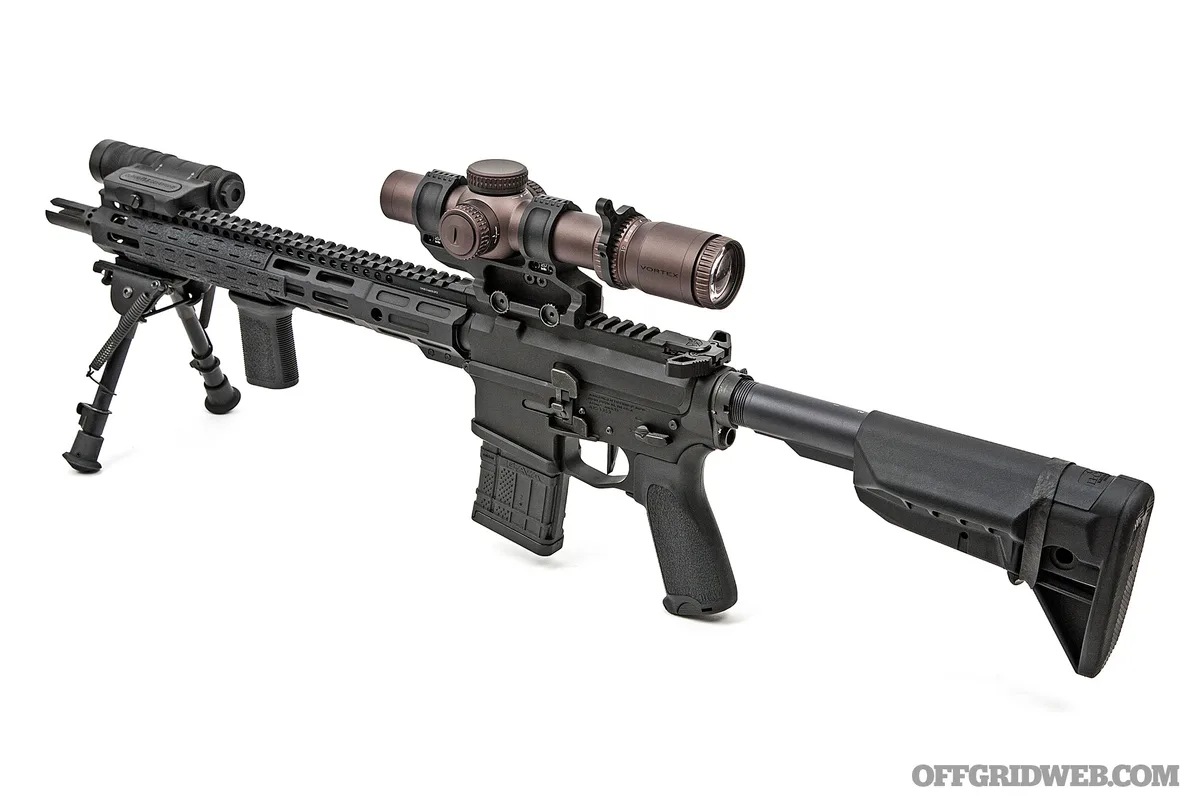
Image source: Bing (Web (fair-use with source credit))
SFP is your best choice if:
- You hunt at known, consistent distances
- You shoot one magnification and stay there
- You want a clear, simple reticle at low power
- You're building on a budget
- You're running an LPVO for defense or competition
Skip SFP if:
- You're competing in PRS or F-Class
- You dial magnification constantly across variable distances
- You need accurate holdover at every power
- You rely on reticle-based range estimation
For long-range hunting at varying distances beyond 400 yards, where you'll zoom from 10x to 20x between shots, FFP becomes the smarter investment. The same logic applies to any precision discipline where magnification changes mid-stage.
Common Mistakes When Choosing an SFP Scope
Buyers who don't fully understand how SFP reticles behave end up with optics that fight their shooting style. These are the most frequent errors we see in aggregate buyer feedback.
Zeroing at the wrong magnification. This is the number one mistake. If you zero your 3-9x SFP scope at 9x but hunt primarily at 6x, your holdover values won't match what the reticle shows. Pick one magnification for zeroing.
Use that same power for shots. Everything else throws off your calculations.
Buying SFP when you need FFP. Long-range shooters gravitating toward variable-distance platforms often default to SFP because it's cheaper. Then they dial magnification constantly and wonder why their holdovers are off. Match the scope to how you actually shoot, not to what fits your budget right now.
Assuming reticle markings work at every power. A subtension that equals 2 mils at your zero magnification can represent a completely different value at another setting. Shooters who skip magnification-aware holdover calculations consistently miss shots at longer ranges.
Ignoring tube diameter compatibility. A 1-inch tube SFP scope has less turret travel than a 30mm or 34mm tube. If your rifle caliber requires significant elevation adjustment, the smaller tube will limit you. Manufacturer specs on turret travel reveal this before you buy.
Skipping parallax adjustment. Many entry-level SFP scopes have fixed parallax set at 150 yards. If you shoot at distances closer or farther, the target image and reticle won't sit on the same focal plane, and accuracy suffers.
Frequently Asked Questions
What is the difference between a first focal plane and a second focal plane rifle scope?
The difference comes down to reticle behavior. In a first focal plane (FFP) scope, the reticle scales with magnification, so holdover values stay accurate at every power. In a second focal plane (SFP) scope, the reticle stays the same size while the target zooms in.
Holdover values are only reliable at your zeroed magnification.
Is a second focal plane scope good for long-range shooting?
SFP scopes work for long-range shooting only if you stick to one magnification and calculate holdovers at that power. Shooters who dial magnification constantly across varying distances need FFP optics instead, because SFP reticle subtensions become unreliable at non-zero powers.
Do SFP scopes cost less than FFP scopes?
Yes, in most cases. SFP scopes run about 30 to 40 percent cheaper than equivalent FFP models across the same magnification range and glass quality tier. Budget entry points start around $150 for SFP, while comparable FFP optics typically begin near $300.
Are LPVO scopes usually first or second focal plane?
Most popular LPVO models, including 1-6x and 1-8x optics, use SFP reticles. The constant reticle size stays visible at low magnification for close targets and remains uncluttered at higher powers. Some premium FFP LPVO options exist, but SFP dominates this category.
Can I use a second focal plane scope for PRS competition?
It's possible, but not ideal. PRS stages require dialing magnification across variable distances, which breaks SFP holdover accuracy. FFP optics like those used in Precision Rifle Series competition keep subtension values consistent at every power, making them the standard choice.
How do I figure out holdover with an SFP scope?
Zero your rifle at one magnification. That's your reference power. Any shot taken at that same magnification can use the reticle's marked holdover values directly.
For shots at different powers, you'll need to calculate adjusted values using the magnification multiplier between your zero power and the power you're shooting at.
SFP or FFP: Which Scope Should You Buy?
The choice isn't about which scope is better overall. It's about which one fits the way you shoot.
If you hunt from a fixed position at known distances, run an LPVO on an AR platform, or build on a budget while staying inside 300 yards, an SFP scope gives you everything you need without paying for features you won't use. Brands like Vortex, Leupold, and Primary Arms all make excellent SFP options across price tiers.
If you compete in PRS, shoot at varying distances beyond 400 yards, or constantly adjust magnification to match your target, FFP earns its price premium. The holdover accuracy at every power removes guesswork and calculation errors. Nightforce, Schmidt & Bender, and Burris lead this category.
Here's a quick decision guide:
| Your Shooting Style | Best Fit |
|---|---|
| Deer or elk hunting at consistent distances | SFP |
| LPVO on an AR-15 for defense or 3-gun | SFP |
| Budget build under $300 | SFP |
| PRS or F-Class competition | FFP |
| Long-range hunting with variable magnification | FFP |
| Precision rifle with distance adjustments every stage | FFP |
Pick your magnification range first, then match the focal plane to how you shoot. Get that order wrong and even the best scope will disappoint you.